
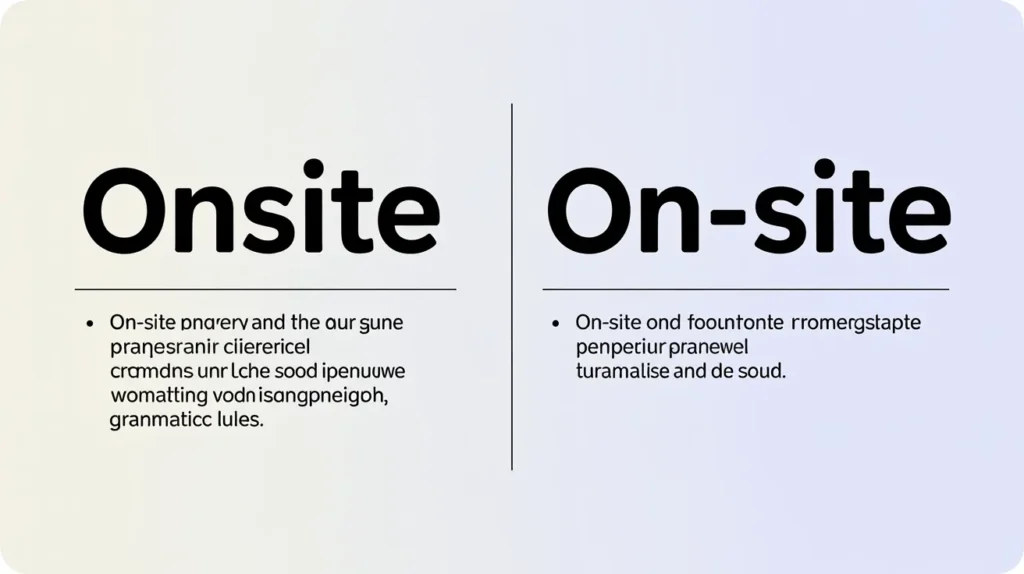
Have you ever typed a word, stopped, and thought — wait, is this actually spelled correctly? That pause, that split-second of doubt, happens to even the most experienced writers. And when it comes to onsite versus on-site, that moment of hesitation is more common than you might think.
These two forms look almost identical. One has a hyphen, one doesn’t. Simple enough, right? But in the world of professional writing, that single dash carries more weight than most people realize. It can be the difference between an email that feels polished and one that feels rushed. It can separate a contract that reads with authority from documentation that seems carelessly put together.
What’s the Real Difference Between Onsite and On-Site?
At first glance, onsite and on-site look almost identical. One tiny hyphen — that’s it. But in professional writing, that small dash carries real weight. It signals formality, shapes tone, and tells your reader how seriously you take precision in language.
If you’ve ever paused mid-sentence wondering which version to use, you’re not alone. Writers, editors, marketers, and business professionals wrestle with this exact question every day. The good news? Once you understand the logic behind each form, the choice becomes second nature.
Understanding the Core Distinction
The fundamental difference between on-site and onsite comes down to three things: hyphenation, formality, and context.
On-site — the hyphenated version — is the traditional, formally accepted form. Major style guides like the AP Stylebook and the Chicago Manual of Style both recommend hyphenating compound adjectives when they appear before a noun. So if you’re writing a business proposal, a legal contract, or an academic paper, on-site is almost always the right call.
Onsite — written as one word — has gained strong traction in modern usage. It feels natural in casual communication, internal company emails, social media content, and marketing copy. The Oxford English Dictionary even recognizes it as an acceptable modern form.
Neither version is wrong. The question is always: What does your context demand?
How Both Words Function Grammatically
Both onsite and on-site typically serve as adjectives — they describe something happening at or associated with a specific physical location.
- “We provide on-site technical support.”
- “The onsite team handled everything.”
In some cases, they can also function as adverbs, describing how or where an action takes place:
- “The engineer worked onsite for three days.”
- “All repairs are completed on-site.”
The part of speech rarely changes between the two versions. What changes is the register — formal versus informal — and the audience expectation that comes with it.
Scenario Examples: Seeing the Difference in Real Life
This is where things get genuinely interesting. Let’s walk through realistic scenarios so you can see exactly how each form performs in practice.
Scenario 1: The Corporate Business Email
Imagine you’re a project manager at a large consulting firm. You’re writing to a senior client to confirm an upcoming visit.
Subject: Confirmation of On-Site Assessment
Dear Mr. Harrison,
I am writing to confirm that our technical team will conduct an on-site assessment of your facility on Wednesday, March 12th, at 9:00 AM. Please ensure that relevant personnel are available during the visit.
We look forward to meeting with your team.
Warm regards, Jessica Monroe Senior Project Consultant
In this scenario, on-site is the clear and correct choice. The email is formal. The client is external. The hyphenated form projects professionalism and attention to detail. Using “onsite” here wouldn’t be grammatically wrong, but it would feel slightly out of place — like showing up to a boardroom meeting in a casual t-shirt.
Scenario 2: The Internal Team Newsletter
Now imagine you’re an HR coordinator sending a Friday update to your team.
Subject: Onsite Fun This Friday — Don’t Miss It!
Hey everyone!
Just a quick reminder about the onsite wellness fair happening this Friday in the main lobby. There’ll be free health screenings, yoga demos, and some seriously good food. Hope to see you all there!
— The HR Team 🎉
Here, onsite fits perfectly. The tone is warm, casual, and friendly. Hyphenating it as “on-site” would feel stiff and overly formal — like the HR team consulted a grammar textbook before writing a party reminder.
Scenario 3: A Technical Service Contract
A software company is drafting a service level agreement (SLA) for an enterprise client.
“The vendor agrees to provide on-site support within 24 hours of a critical system failure. All on-site visits will be documented and submitted to the client’s IT department within 48 hours of service completion.”
In legal and technical documents, on-site is non-negotiable. These documents are referenced, audited, and sometimes presented in court. Clarity and consistency are everything. The hyphen signals precision — and in formal writing, precision builds trust.
Scenario 4: A Social Media Post for an Event Company
An event management company is promoting their upcoming conference services on Instagram.
“Planning a corporate event? Our team offers full onsite coordination, real-time problem solving, and seamless execution — so you can focus on your guests. 📋✨ #EventManagement #OnsiteSupport”
Onsite works beautifully here. Social media writing lives and dies by brevity and energy. The hyphenated version would slow the reader down ever so slightly and feel oddly formal for a platform built on casual connection.
Scenario 5: A University Research Paper
A graduate student is writing a methodology section for their thesis.
“Data was collected through on-site interviews conducted at three urban healthcare facilities between January and April 2024. Each on-site session lasted approximately 45 minutes.”
Academic writing demands on-site. Universities typically follow MLA or Chicago style, both of which favor the hyphenated compound adjective. Submitting a paper with “onsite” scattered throughout would likely earn a note from an editor or professor.
What Do the Style Guides Actually Say?
Here’s a straightforward breakdown of where the major style authorities stand:
| Style Guide | Preferred Form | Context |
|---|---|---|
| AP Stylebook | On-site | Journalism, press, public communication |
| Chicago Manual of Style | On-site | Academic and formal publishing |
| MLA Style | On-site | Academic writing and research |
| Oxford English Dictionary | Onsite | Modern and informal usage accepted |
The pattern is clear: formal style guides lean toward on-site, while modern informal usage increasingly accepts onsite as standard.
Industry-Specific Preferences
Different industries have quietly developed their own conventions. Knowing these can help you write more naturally within your field.
Technology and IT: Technical documentation, contracts, and SLAs almost universally use on-site. However, marketing teams at the same companies often default to onsite in ad copy and social media.
Healthcare: Clinical and administrative documentation sticks firmly to on-site. Patient care reports, hospital protocols, and compliance documents all favor the hyphenated form for maximum clarity.
Event Management: Official event programs and vendor contracts use on-site. Social media promotions and audience-facing content frequently use onsite for a more energetic, approachable feel.
Education: School handbooks, official communications, and academic literature use on-site. Student-facing announcements and casual emails from teachers or coordinators often slide into onsite naturally.
The Consistency Rule — Perhaps the Most Important of All
Here’s the one rule that overrides almost everything else: be consistent.
If you open a document with on-site, every subsequent use should be on-site. Switching between the two within the same piece of writing is the fastest way to make your content look unpolished and poorly proofread.
Before you start writing, make a decision. Stick to it. Your readers may not consciously notice which form you chose — but they will absolutely notice if you switch back and forth.
Practical Tips to Choose the Right Form Every Time
- Ask yourself about the audience. External clients and formal stakeholders? Use on-site. Internal team and casual readers? Onsite works well.
- Check your company or publication’s style guide. Many organizations have internal guidelines that settle this question entirely.
- Follow the document type. Contracts, reports, academic papers = on-site. Newsletters, social posts, informal emails = onsite.
- When in doubt, hyphenate. The hyphenated form is accepted in virtually every context. The same cannot always be said for the one-word version in formal settings.
Conclusion
The choice between onsite and on-site is a small decision with a surprisingly meaningful impact. It shapes how your writing is perceived — as polished and precise, or modern and approachable. Neither form is inherently superior. They simply serve different masters.
On-site commands respect in formal documents, professional correspondence, and academic work. Onsite feels natural and human in casual communication, marketing, and everyday workplace writing.
The best writers don’t just know grammar rules — they understand context, audience, and tone. Master those three elements, and you’ll never second-guess yourself over a hyphen again.