
If you’ve ever typed a word and then stared at it wondering whether it looked right, you know exactly the kind of moment we’re talking about. You write “sueing” and something feels off. Or you write “suing” and second-guess yourself. It’s one of those small spelling traps that catches even careful writers off guard.
This isn’t just a grammar puzzle for students. It shows up in professional emails, legal notices, news articles, and business correspondence every single day. And in those contexts, getting it wrong doesn’t just look careless — it can actually undermine your credibility before anyone reads the substance of what you’ve written.
So let’s clear it up once and for all, with real examples, plain explanations, and the kind of context that actually makes the rule stick.
The Correct Answer: Suing, Not Sueing
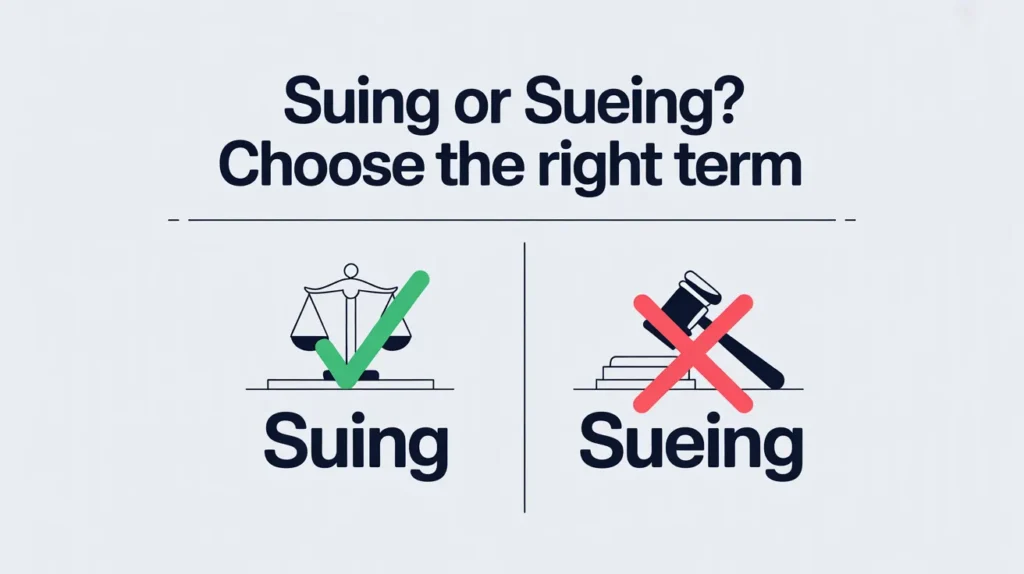
Let’s start with the bottom line. Suing is the correct spelling. Sueing is not a real word. It doesn’t appear in any standard dictionary as an accepted spelling, and no style guide — legal, journalistic, or academic — recognizes it as valid.
That might feel surprising given how naturally “sueing” rolls off the fingertips. But the reason it’s wrong comes down to one of the most consistent rules in English spelling.
Why the Confusion Happens in the First Place
English is full of moments where logic leads you somewhere wrong. Writers look at the base verb “sue” and assume that turning it into a continuous action simply means tacking on “-ing.” The result feels intuitive: sue + ing = sueing. Neat, tidy, logical.
Except English doesn’t always reward that kind of logic.
The verb “sue” ends in a silent “e” — a letter that affects pronunciation of the vowel before it but makes no sound itself. When you add “-ing” to a verb that ends in a silent “e,” the rule is clear: you drop the “e” before adding the suffix.
This is why we write:
- make → making (not makeing)
- write → writing (not writeing)
- drive → driving (not driveing)
- hope → hoping (not hopeing)
- sue → suing (not sueing)
Once you see the full pattern, the spelling of suing stops feeling like a trick question. It becomes obvious.
Does Sueing Ever Work? Anywhere?
No. Not in formal writing, not in informal writing, not in text messages, not in legal documents. Sueing is always incorrect, regardless of the context or the audience.
Some writers assume that informal settings give them a pass on spelling rules. They don’t — at least not with this one. Sueing isn’t a casual variant or a regional alternative. It’s simply a misspelling of suing, and treating it otherwise won’t change that.
Why This Matters More in Legal Writing
Most spelling errors carry low stakes. A typo in a casual email might get a polite mental correction from the reader and nothing more. But legal writing is a different environment entirely.
In legal documents, every word carries weight. Court filings, contracts, notices of litigation, and formal complaints are read by judges, clerks, opposing counsel, and clients who expect precision. A spelling error in that environment doesn’t just look sloppy — it signals a lack of attention to detail, which is precisely the quality legal professionals cannot afford to lack.
Consider what happens when a journalist covers a high-profile lawsuit and quotes a filing directly. If that filing contains the word “sueing,” the story shifts. Readers focus on the mistake rather than the claim. The legal argument becomes secondary to the embarrassment of the error.
Language precision protects your argument. Spelling errors distract from it.
Scenario Examples: Suing in Real Contexts
This is where the spelling question becomes practical. Let’s look at how suing appears correctly across different real-world situations.
Scenario 1: A Formal Legal Notice
Imagine a business owner receives the following email from an attorney:
“Dear Mr. Okafor, this letter serves as formal notice that our client is suing your company for breach of contract related to the delivery failures in Q3 of last year. All further communication should be directed to our office.”
That email reads cleanly and professionally. The spelling reinforces the authority of the message. Now consider what happens if the attorney had written “sueing” instead. The recipient’s attention shifts. Confidence in the sender drops slightly, perhaps unfairly, but inevitably.
Scenario 2: A News Report
A journalist covers a consumer protection lawsuit and writes:
“A group of tenants is suing the property management company for what they describe as systematic neglect of basic maintenance obligations.”
The sentence flows naturally. The word fits the register — formal enough for a news article, clear enough for any reader. Using “sueing” in the same sentence would have triggered editorial corrections before the piece ever went live, because any competent editor would catch it.
Scenario 3: A Business Dispute Between Partners
Two former business partners fall out over intellectual property rights. One sends the other a direct message:
“I’m not trying to escalate this, but if we can’t reach an agreement by Friday, I’ll have no choice but to start suing for the revenue I’m owed.”
Even in a relatively informal message, suing is the correct choice. The stakes of the situation call for precise language, and the spelling reflects that seriousness.
Scenario 4: A Student Writing an Essay
A law student drafts an analysis paper and writes:
“The case explores the ethical boundaries of suing pharmaceutical companies for damages when side effects were disclosed but not adequately explained to patients.”
Academic writing demands accuracy. Using “sueing” here would result in a comment from the professor and a mark against the student’s command of written English — a small but real consequence.
Scenario 5: A Human Resources Complaint
An HR professional documents a workplace grievance:
“The employee has indicated that she is considering suing the organization for wrongful termination and emotional distress.”
HR documentation can become part of formal legal proceedings. Errors in those documents can create complications. The word suing appears here in exactly the right form.
The Silent E Rule: A Permanent Fix
If you want to stop second-guessing yourself on words like this, the silent “e” rule is worth memorizing properly — not just for suing, but for dozens of other verbs that follow the same pattern.
Here’s the full logic: when a verb ends in “e” and that “e” is silent, its only job is to modify the sound of the vowel before it. The moment you add “-ing,” the suffix takes over that job. The silent “e” becomes redundant and gets dropped.
Think of it this way — the silent “e” is like a placeholder that only exists because nothing else is there. Once “-ing” arrives, the placeholder leaves.
Sue → drop the silent e → su → add -ing → suing
That mental model works for every verb in this category. Run through a few in your head right now — make, write, drive, hope, take, shake — and you’ll see that the rule holds without exception.
Common Mistakes That Stick Around and Why
One reason sueing keeps appearing in writing is that spellcheck doesn’t always catch it. Depending on the software, the word may pass undetected, which gives writers false confidence. If your tool didn’t flag it, you might assume it was fine.
Don’t rely on spellcheck alone. Especially in legal, professional, or published writing, human proofreading is essential. Reading your work aloud is one of the most effective ways to catch errors your eyes skip over during silent reading.
Another reason the mistake persists is simply exposure. Many writers rarely encounter the word suing in their day-to-day reading, so they never build a strong visual memory of its correct form. Seeing it written correctly here, in context, multiple times, is already doing part of that work.
Quick Reference: Suing vs Sueing
| Form | Correct? | Used In |
|---|---|---|
| Suing | ✅ Yes | All contexts — legal, formal, informal |
| Sueing | ❌ No | Nowhere — always a misspelling |
Final Thoughts: Precision Is a Professional Habit
Spelling might seem like a small thing compared to the substance of what you’re writing. In most cases, readers extend grace for minor errors. But some words carry more weight than others, and suing is one of them — both because of what it means and because of where it tends to appear.
Legal documents, professional correspondence, journalism, and academic writing all demand a level of care that casual communication doesn’t. In those spaces, spelling accuracy isn’t pedantry — it’s professionalism.
The rule is simple. The correct word is clear. Suing, not sueing. Drop the “e,” add the “-ing,” and move forward with confidence.