
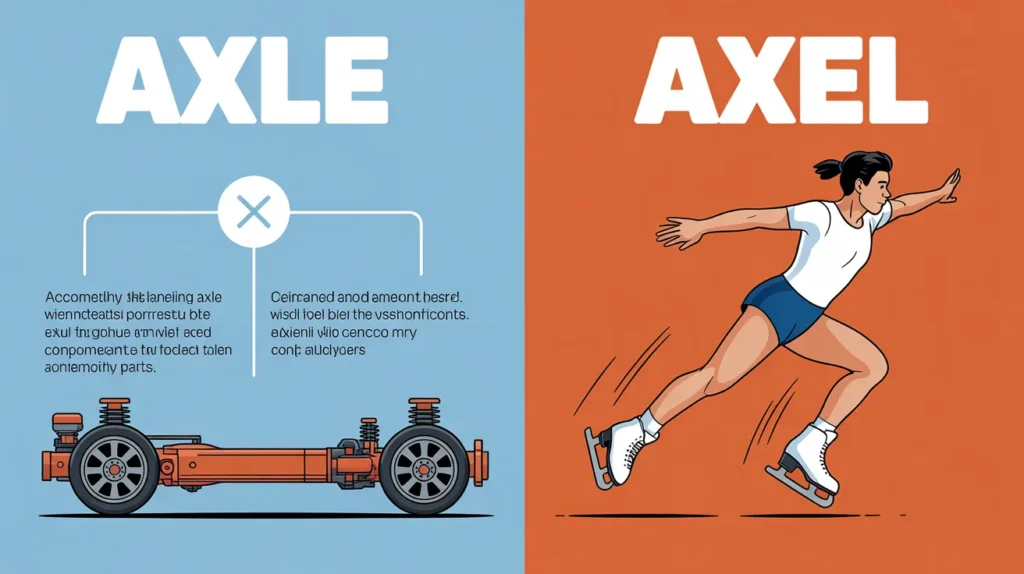
Some words trip people up not because they’re rare or technical, but because they sound exactly the same. Axle and axel are a perfect example. Say them out loud — you can’t tell them apart. But the moment you put them on paper, context separates them instantly.
One belongs to the world of gears, grease, and vehicle mechanics. The other lives entirely on ice, in the world of figure skating and athletic precision. Getting them confused won’t cause a catastrophe, but it will raise eyebrows — especially in professional writing, technical reports, or sports journalism.
So let’s settle this once and for all.
Why These Two Words Confuse So Many People
The core reason is simple: axle and axel are homophones. They share the same pronunciation — /ˈæksəl/ — which means your ears offer zero clues about the correct spelling. You have to rely entirely on context and meaning.
This kind of confusion is surprisingly common in English. Words like affect/effect, principal/principle, or complement/compliment cause the same kind of second-guessing. Axle and axel belong to that same family of tricky pairs — deceptively simple on the surface, meaningfully different underneath.
What makes this particular pair interesting is how far apart their meanings actually are. You won’t find an axel in an auto shop, and you won’t find an axle on a skating rink. The confusion only happens in writing — never in real life.
What Is an Axle? (The Mechanical Definition)
An axle is a central shaft or rod that connects a pair of wheels and allows them to rotate. It’s a foundational component of nearly every vehicle ever built — from ancient ox carts to modern electric trucks.
Without axles, wheels would spin freely with no connection, no power transfer, and no control. The axle is what ties the system together. It supports the vehicle’s weight, transmits the engine’s power to the wheels, and keeps everything aligned.
Common Types of Axles in Vehicles
- Front axle — handles steering and absorbs road shock at the front end
- Rear axle — delivers rotational power from the engine to the drive wheels
- Tandem axle — two rear axles used in heavy-duty trucks for extra load capacity
- Dead axle — non-driven axle that simply supports weight (common on trailers)
- Live axle — an axle that both supports the vehicle and transfers power
The word itself traces back to Old English eax and Latin axis, both meaning a rod or pivot point around which something rotates. It’s been part of the English language for centuries, and its meaning has stayed remarkably consistent.
Scenario: Axle Used in a Workplace Email
Subject: Fleet Maintenance — Rear Axle Replacement
Hi Marcus,
During today’s routine inspection, the technician identified a cracked rear axle on vehicle #7. The damage is significant enough that we’re pulling it from the rotation immediately.
We’ve ordered a replacement axle from our supplier, and the repair is scheduled for Thursday. I’ll send a confirmation once the vehicle is cleared for road use.
Let me know if you need the full inspection report.
Best, Jordan
Notice how naturally axle fits here. The context is mechanical — a fleet, a technician, an inspection. There’s no ambiguity.
Scenario: Axle in Everyday Conversation
Imagine you’re explaining a road trip gone wrong to a friend:
“We were two hours outside the city when something snapped under the car. Turns out the axle broke clean through — probably from hitting that pothole on the highway. The whole wheel was at an angle. We had to get towed.”
You wouldn’t write axel there. The moment you’re talking about a vehicle and its moving parts, axle is the only correct choice.
What Is an Axel? (The Figure Skating Definition)
An axel is a specific jump in figure skating — and not just any jump. It’s widely considered the most technically demanding jump in the sport.
The axel is named after Axel Paulsen, a Norwegian speed and figure skater who first performed the jump publicly at the 1882 World Figure Skating Championships in Vienna. That historical origin is why it carries the proper-noun spelling — Axel — which eventually became the standard term for the jump itself.
What makes the axel unique among skating jumps is its forward takeoff. Every other major jump in figure skating launches from a backward edge. The axel is the only jump that takes off facing forward, which forces the skater to complete an extra half rotation before landing. That’s why a single axel actually involves one and a half full rotations — not just one.
The Axel Jump Variations
| Jump | Rotations |
|---|---|
| Single axel | 1.5 rotations |
| Double axel | 2.5 rotations |
| Triple axel | 3.5 rotations |
| Quadruple axel | 4.5 rotations |
The triple axel was first landed in competition by Canadian skater Vern Taylor in 1978. It has since become a benchmark of elite-level skating — a move that separates good skaters from genuinely exceptional ones. Few skaters in history have landed it consistently and cleanly under competition pressure.
Scenario: Axel in a Sports Commentary Context
Picture a live broadcast during a major figure skating competition:
“She’s setting up for the triple axel — this is the moment the crowd has been waiting for. The approach is clean, the speed is there… and she’s up! Three and a half rotations, and she lands it with one hand extended. The judges are going to love that.”
This is where axel lives. No gears, no wheels — just athletic precision, balance, and years of dedicated training.
Scenario: Axel in a Coaching Email
Subject: Pre-Competition Training Focus
Hi Natalie,
Based on last week’s practice sessions, I want to prioritize your double axel consistency before Saturday’s event. Your rotation speed is strong, but you’re slightly off on the landing edge — you’re coming down on the flat rather than the outside edge, which is costing you points.
I’ve marked the key moments in Friday’s video review. Let’s work through the takeoff angle and see if we can correct the habit before competition day.
See you Thursday, Coach Elena
Here, axel is unmistakably correct. The context is skating, the conversation is technical (in a sports sense), and there’s no mechanical meaning anywhere near it.
Axle vs. Axel: A Side-by-Side Comparison
| Feature | Axle | Axel |
|---|---|---|
| Field | Engineering / Mechanics | Figure Skating / Sports |
| Function | Connects and rotates wheels | A forward-takeoff jump |
| Origin | Old English / Latin axis | Named after Axel Paulsen |
| Used in | Vehicles, machinery, transport | Skating routines, competitions |
| Common error | Written as axel | Written as axle |
How to Always Choose the Right Word
Here’s the mental test that works every single time:
Ask yourself: Am I talking about a machine or a skater?
- If your sentence involves wheels, a vehicle, a shaft, rotation of machinery, or transportation — write axle.
- If your sentence involves a jump, a figure skater, a competition, or a skating routine — write axel.
That one question eliminates the confusion in every scenario.
A Memory Trick Worth Keeping
Here’s a simple association that sticks:
- Axle ends in -le, like vehic-le. Think: wheels and vehicles.
- Axel ends in -el, like ath-el-ete (close enough). Think: elite skaters and athletic jumps.
It’s not a perfect mnemonic, but it’s sticky — and that’s what matters.
Why Precision in Word Choice Actually Matters
You might wonder: does it really matter that much? If a reader understands what you mean, does the spelling really count?
In casual conversation between friends — maybe not. But in professional writing, technical documents, journalism, or academic work, using the wrong word signals carelessness. It erodes trust in subtle ways. Readers notice, even if they don’t say anything.
A mechanic’s report that refers to a damaged axel looks sloppy. A skating article that mentions a broken axle is just confusing. Precision builds credibility — and credibility is hard to rebuild once it’s been questioned.
Getting homophones right is one of those quiet markers of writing quality that separates careful communicators from careless ones.
Final Word
Axle and axel are proof that English doesn’t always make things easy. Same sound, same letters — completely different worlds. One keeps your car on the road. The other lifts a skater into the air for a heart-stopping moment of athleticism.
Now that you know the difference, you’ll never second-guess yourself again. Whether you’re filing a maintenance report or writing a piece on competitive skating, the right word is always just one question away: machine or ice?