
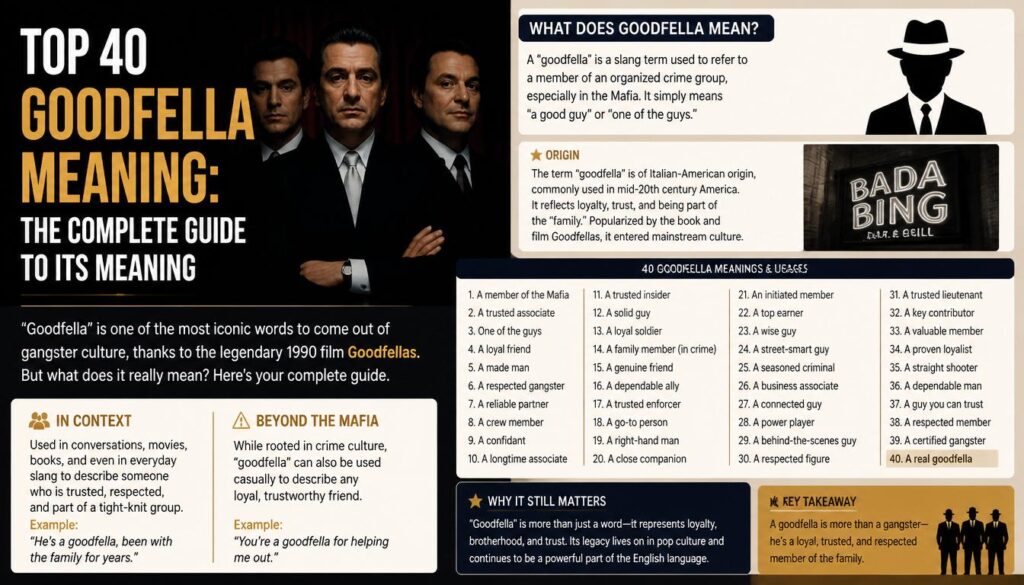
Words carry worlds inside them. And few words in modern English carry as much weight, history, and cultural complexity as “Goodfella.” It’s a term that can make you smile when a friend uses it, or send a chill down your spine depending on who’s saying it and why.
Whether you stumbled across it watching a classic crime film, heard it in a hip-hop track, or a friend casually dropped it in conversation, understanding the real Goodfella meaning goes far deeper than a dictionary entry. This guide unpacks every layer — from its Italian-American street origins to its digital-age evolution — with real-life scenarios, tone analysis, and 40 different ways the word lives and breathes in modern English.
Let’s get into it.
What Does Goodfella Actually Mean?
At its most direct, “Goodfella” is a slang term rooted in Italian-American organized crime culture. It refers to a man who is an initiated or trusted member of the Mafia — someone who has earned his place through loyalty, silence, and street credibility.
But here’s where it gets interesting.
The word didn’t stay locked inside mob circles. Over decades, it spilled into film, music, literature, and everyday conversation — picking up new shades of meaning along the way. Today, calling someone a Goodfella can mean anything from “he’s connected to dangerous people” to “he’s the most reliable guy I know.”
That’s the power of lexical evolution — when a word outlives its original context and takes on a life of its own.
The Linguistic Roots of Goodfella
Where Did the Word Come From?
Long before Martin Scorsese made it famous, the word “Goodfellow” existed in Old and Middle English. Historically, it described a cheerful, pleasant, sociable man — someone good to be around. Think of it as an early version of what we’d now call a stand-up guy.
In the late 19th and early 20th centuries, as Italian immigrants settled into American cities, particularly in New York, Chicago, and New Jersey, their communities developed their own linguistic subculture. Words were borrowed, shortened, and reshaped. “Goodfellow” became “Goodfella” — a tighter, more street-ready form that felt natural in the rhythm of Italian-American speech.
Within Mafia hierarchies, the term carried a specific and serious meaning. A Goodfella wasn’t just any criminal. He was a made man or a trusted associate — someone who had proven his allegiance under the code of Omertà, the sacred vow of silence that governed mob life.
The Semantic Shift Over Time
Here’s what makes this word linguistically fascinating. Its semantic field — the cluster of meanings surrounding it — has expanded dramatically over time:
- 1920s–1980s: Exclusively tied to organized crime and Italian-American street culture
- 1990: Exploded into mainstream consciousness through Scorsese’s film
- 1990s–2000s: Absorbed into hip-hop vocabulary as a symbol of loyalty and brotherhood
- 2010s–present: Softened into casual slang, used the way younger generations use “bro” or “homie”
This kind of diachronic shift — the change in a word’s meaning across time — is exactly what makes English such a living, breathing language.
Goodfella Meaning in Different Contexts
One word, many worlds. Here’s how “Goodfella” functions across different settings.
In Organized Crime and Mafia Culture
In its original environment, being called a Goodfella was a mark of rank and respect. It wasn’t thrown around loosely. You earned it.
Scenario Example:
Two men sit in a dimly lit Brooklyn social club. One older man leans toward the other and says quietly, “He’s a goodfella — been with us fifteen years, never said a word.” That sentence communicates volumes: loyalty, trust, and dangerous reliability.
In this context, “Goodfella” signals insider status. It’s not flattery. It’s a classification.
In Cinema and Pop Culture
The 1990 film Goodfellas, directed by Martin Scorsese and based on the life of Henry Hill, fundamentally changed how the world understood this word. Overnight, it became cultural shorthand for a certain kind of man — charismatic, dangerous, street-smart, and fiercely loyal to his circle.
The performances of Ray Liotta, Robert De Niro, and Joe Pesci didn’t just entertain audiences. They built an archetype — a character template that writers, rappers, and storytellers have referenced ever since.
Scenario Example:
A film studies student writes in her essay: “Scorsese’s Goodfellas redefined the gangster genre by humanizing its subjects — these weren’t monsters, they were goodfellas, men shaped by their environment and their choices.”
Here, “goodfellas” functions as both a noun and a moral category.
In Hip-Hop and Street Culture
Artists like Nas, Jay-Z, and The Notorious B.I.G. drew heavily from Mafia imagery. The Goodfella persona — powerful, loyal, untouchable — mapped perfectly onto the themes of brotherhood, survival, and street credibility that defined 1990s hip-hop.
Scenario Example:
A rapper freestyles: “Real goodfellas don’t fold under pressure, we hold it together — loyalty over everything, that’s our treasure.”
In this usage, the criminal edge softens slightly and what remains is the emotional core — loyalty, solidarity, and identity.
In Everyday Casual Conversation
This is where the word lives most comfortably today. Among friends, in text messages, on social media — “Goodfella” has become a term of affection, admiration, or simple camaraderie.
Scenario Example:
After helping a friend move apartments all day, Marcus gets a text: “Bro, you’re a real goodfella. Don’t know what I’d do without you.”
No Mafia. No crime. Just genuine appreciation between two people.
The Goodfella Meaning vs. Goodfellas Meaning — Clearing the Confusion
This is one of the most commonly misunderstood distinctions — and it matters.
| Term | Meaning |
|---|---|
| Goodfella | A single person — loyal, trustworthy, or Mafia-connected |
| Goodfellas | The plural form OR the 1990 Scorsese film title |
Scenario Example (showing the confusion):
Wrong: “He’s such a Goodfellas.” Right: “He’s such a Goodfella.” Right: “We watched Goodfellas last night — incredible film.”
The singular vs. plural distinction seems small, but using it incorrectly immediately signals that someone doesn’t fully understand the word’s roots.
40 Ways “Goodfella” and Its Alternatives Are Used
Understanding a word fully means seeing it in action. Here are 40 real-world usage examples — from the original slang to its polite, professional, and casual alternatives.
The Original Goodfella in Sentences
- “He’s a goodfella — known him since childhood, never once let me down.”
- “Only a true goodfella shows up when things get hard.”
- “Back in the neighborhood, being a goodfella meant something serious.”
- “Don’t worry about him — he’s one of our goodfellas.“
- “A goodfella doesn’t talk. That’s the whole point.”
- “She called him a goodfella and meant it as the highest compliment.”
- “In that world, a goodfella earns respect — it’s never handed to him.”
- “The film showed us that being a goodfella comes with a price.”
Friendly and Casual Alternatives
- “He’s my right-hand man — always there.”
- “That dude is pure gold, seriously.”
- “My bro from college — we go way back.”
- “She’s my ride-or-die, no question.”
- “He’s a solid mate, wouldn’t trade him.”
- “My homie never misses — always shows up.”
- “You’re a real one, you know that?”
- “He’s my day-one — been through everything together.”
Professional and Formal Alternatives
- “My trusted colleague handled the entire project.”
- “He’s a dependable associate in every sense.”
- “She’s been my reliable partner for six years.”
- “A valued team member who never misses a deadline.”
- “He’s our key stakeholder in this negotiation.”
- “My professional ally helped navigate the entire deal.”
- “She’s a dedicated collaborator — works until it’s right.”
- “He is, without doubt, a trustworthy professional.“
Street and Cultural Usage
- “Real goodfellas don’t broadcast their moves.”
- “In that circle, loyalty was the only currency.”
- “He carries himself like an old-school Goodfella — quiet power.”
- “The street code they lived by was loyalty above all.”
- “Call him a made man in every sense of the word.”
- “He built his reputation on trust, not fear.”
Digital and Social Media Usage
- “#GoodFella — shoutout to the ones who never left.”
- “Tag your goodfella who always picks up the phone.”
- “Feeling like a Goodfella this Monday — suit on, goals set.”
- “Real brotherhood doesn’t need a caption.”
- “He’s my online plug — sorts everything out, legend.”
Polite and Respectful Alternatives
- “He is, genuinely, a gentleman in every room he enters.”
- “My companion through some of life’s hardest chapters.”
- “A loyal friend is worth more than any title.”
- “He’s a stand-up individual — the community respects him.”
- “She calls him her anchor — steady, dependable, always present.”
Tonal Nuances — How the Same Word Carries Different Energy
This is where pragmatic linguistics gets fascinating. The word “Goodfella” can shift meaning entirely based on tone, context, and delivery.
Friendly Tone
“You’re a real goodfella, thanks for everything.” Here, the word carries warmth and gratitude. No threat. No subtext. Just affection.
Cautionary Tone
“Watch yourself around him — he’s a goodfella.” Suddenly the word carries a quiet warning. The speaker isn’t complimenting anyone. They’re flagging danger.
Nostalgic Tone
“Those guys from the old neighborhood — real goodfellas, every one of them.” This is bittersweet. It speaks to a shared past, a sense of belonging that may no longer exist.
Ironic Tone
“Oh sure, he’s a real goodfella — scammed three people last week.” Used sarcastically, it becomes a dig. The speaker is flipping the word’s positive connotations on their head.
Understanding these tonal layers is the difference between using language and truly commanding it.
Common Mistakes People Make With the Word
Using It in Formal Settings
Dropping “Goodfella” in a job interview or a boardroom presentation is a register mismatch — like wearing flip-flops to a black-tie event. The word belongs in informal, cultural, or creative contexts.
Scenario Example:
Wrong: “I’ve always been a goodfella — great with people.” Right: “I’m known for building strong, trust-based professional relationships.”
Over-Romanticizing the Mafia Connection
Some people use the term to glamorize organized crime without understanding its real-world consequences. The word carries historical and ethical weight. Using it carelessly can come across as tone-deaf.
Confusing Singular and Plural
As noted earlier — “a Goodfella” is one person. “Goodfellas” is the film title or the plural. Mixing them up is a small but telling linguistic error.
Why This Word Still Matters
Language scholars study words like “Goodfella” because they reveal how culture shapes communication. A single term can encode an entire social history — immigration, identity, loyalty, fear, and belonging.
The fact that a word born in Brooklyn mob circles now appears in London text messages, Seoul hip-hop tracks, and Mumbai social media captions tells you everything about how language travels, adapts, and survives.
It’s not just slang. It’s a linguistic fossil — preserving the culture that created it while simultaneously evolving into something new.
Final Thoughts
The Goodfella meaning is never just one thing. It’s a word that holds history in one hand and evolving street culture in the other. From the Omertà-bound silence of Mafia associates to the warm shoutout between best friends — this term has earned its place in the English lexicon.
Use it well. Use it in the right context. And if you’re in a professional setting, reach for gentleman, colleague, or trusted partner instead.
But among your people? Call them your goodfellas — and mean every syllable.