
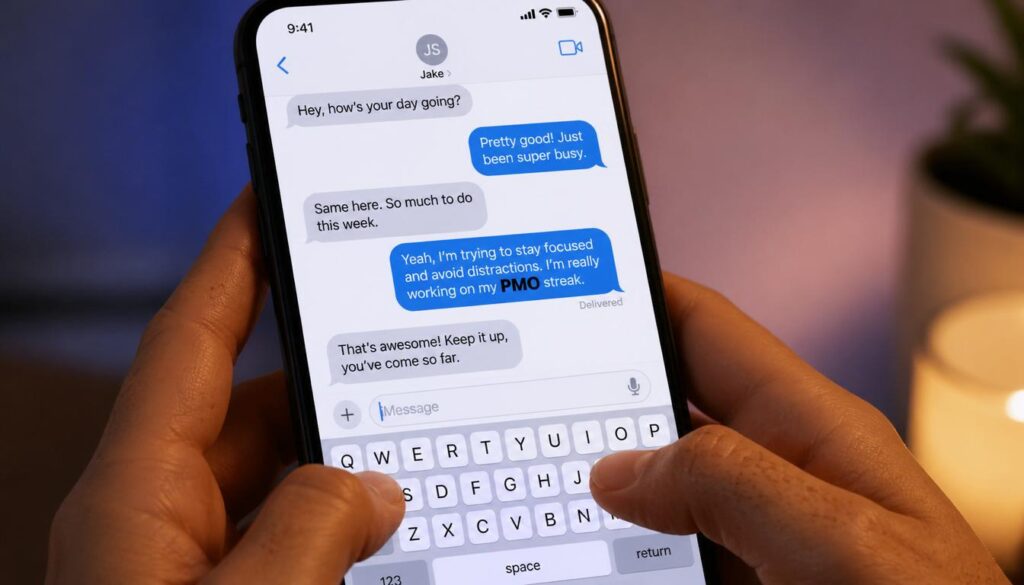
Slang doesn’t wait for permission. It shows up in your notifications, sits there looking unfamiliar, and forces you to either ask “what does that mean” or quietly Google it before anyone notices. PMO is one of those terms. If you’ve seen it pop up in a group chat or under a TikTok comment and paused mid-scroll, you’re exactly who this guide is for.
By 2026, PMO meaning texting has settled into everyday digital conversation, especially among Gen Z and younger millennials. But settled doesn’t mean simple — the phrase carries different weight depending on who’s texting, what platform they’re on, and what they’re actually asking for. This piece breaks down the real meaning, the contexts where it fits, the ones where it doesn’t, and a set of scenario examples for terms people constantly mix it up with.
What Does PMO Mean in Texting?
In texting slang, PMO stands for “Put Me On.” It’s a request — someone wants to be introduced, included, or given access to something they don’t currently have. That “something” could be a person, a playlist, a job lead, or a hidden gem of a restaurant.
The phrase didn’t start online. It has roots in everyday spoken slang, particularly in hip-hop and urban culture, long before it made the jump to text messages and comment sections. What changed is the delivery method — a phrase that used to live in conversation now lives in DMs, group chats, and captions.
Here’s the simplest way to think about it: whenever someone says “PMO to that,” they’re really saying, “I want in — can you make that happen?”
The Core Idea Behind PMO
At its heart, PMO is about access. It’s not a compliment, a complaint, or a statement — it’s a request wrapped in shorthand. That’s what makes it different from a lot of other texting abbreviations, which tend to describe a feeling (“IDK,” “SMH”) rather than ask for something specific.
Common Interpretations of PMO in Different Contexts
PMO shifts slightly depending on the setting. Understanding the context is what separates someone who uses it naturally from someone who’s clearly just learned it from a listicle.
Networking and Social Circles
In a networking sense, PMO is a casual way to request an introduction. Instead of saying “Could you introduce me to your friend who does graphic design,” someone might simply text:
“PMO with your designer friend, I need a logo.”
It softens what could otherwise feel like a formal ask.
Music, Fashion, and Culture
This is arguably where PMO shows up most. Someone drops a new song, a fit pic, or a trend, and the response is instant:
“PMO to that track right now.”
Here, PMO functions almost like “send me the link” or “where do I find this.”
Friendship and Everyday Sharing
Among friends, PMO is looser and more playful. It’s less about formal access and more about being looped in on something fun:
“PMO to the show you binged this weekend.”
Scenario Examples: Words People Often Confuse with PMO
This is where a lot of people trip up. PMO sounds like, or gets typed near, several other terms — and mixing them up changes the whole meaning of a message.
PMO vs. “PMS”
Scenario: A friend texts, “ugh I’m so PMO today,” meaning she’s dealing with premenstrual symptoms.
The confusion: Autocorrect or quick typing can easily turn PMS into PMO, especially on a small keyboard.
The fix: If the sentence describes a mood, symptom, or physical state rather than a request, it’s almost certainly PMS, not PMO.
PMO vs. “Hiatus”
Scenario: Someone posts, “Taking a PMO from social media,” when they actually mean they’re stepping back for a while.
The confusion: Both terms get used loosely in captions, and people sometimes borrow trending slang incorrectly.
The fix: A hiatus means a pause or break. PMO means the opposite — it’s a request to be added into something, not removed from it.
PMO vs. “Project Management Office”
Scenario: In a work Slack channel, someone writes, “Check with the PMO before finalizing the timeline.”
The confusion: In a corporate setting, PMO almost never means “Put Me On.” It refers to the Project Management Office, a formal department that oversees project standards and processes.
The fix: Context is everything here. Casual chat with friends? It’s slang. Corporate email or workplace software? It’s an actual department.
PMO vs. “PMO” as in “Putting Me On” (Continuous Form)
Scenario: “You’ve been PMO-ing me to good music all month” versus “PMO to that playlist.”
The confusion: People sometimes stretch the term into a verb form that isn’t standard.
The fix: The original slang is a request phrase, not a verb someone “does” to another person over time. Sticking to the classic usage keeps the message clear.
Tone and Usage: When PMO Fits and When It Doesn’t
Slang lives and dies by tone. PMO works beautifully in some rooms and falls flat — or looks unprofessional — in others.
Where PMO Works
- Texting friends or close peers
- Group chats centered on music, fashion, or shows
- Comment sections and DMs on social platforms
Where PMO Doesn’t Belong
- Work emails or professional Slack messages
- Conversations with people unfamiliar with current slang
- Formal introductions where clarity matters more than casualness
A good rule of thumb: if you’d hesitate to say it out loud in a job interview, it probably doesn’t belong in a work chat either.
Alternatives to PMO by Setting
Not every situation calls for slang, and that’s fine. Here are natural substitutes depending on the tone you’re going for.
Casual:
- “Hook me up with that.”
- “Mind plugging me in?”
Polite/Neutral:
- “Could you share that with me?”
- “Mind looping me in?”
Professional:
- “Could you connect me with…”
- “Would you be able to introduce me to…”
Why Getting PMO Right (and Its Look-Alikes) Actually Matters
Texting slang moves fast, and misreading a term isn’t just embarrassing — it can genuinely change how a message lands. Confusing PMO with PMS in the wrong moment can come across as dismissive. Confusing it with the Project Management Office in a work setting can make an email sound oddly informal, or just confusing. And mistaking it for a synonym of “hiatus” flips the entire meaning of what someone is trying to say.
The pattern across all of this is simple: short forms compress meaning, but they don’t compress context. You still need to read the room — who’s texting, what platform it’s on, and what conversation came before it — to know which version of PMO you’re actually looking at.
Final Thoughts
PMO is a small phrase carrying a specific, useful job: it asks to be let in. Whether that’s an introduction, a song, or a shared moment, the meaning stays consistent — “Put Me On.” What changes is the setting, and that’s exactly where most people go wrong, either by using it somewhere too formal or confusing it with a completely different term like PMS, hiatus, or the corporate Project Management Office.
Slang like this isn’t going anywhere. It’ll keep evolving, picking up new contexts, and occasionally colliding with unrelated acronyms that happen to share the same three letters. The best way to keep up isn’t memorizing every definition — it’s paying attention to context, the same skill that makes any conversation, digital or otherwise, actually work.