
We’ve all been there. Someone does something kind, and your fingers fly across the keyboard before your brain even catches up. Out comes TYSM — fast, familiar, and loaded with feeling. But what exactly are you saying? And are you saying it right for the moment?
In 2026, texting abbreviations aren’t going anywhere. If anything, they’ve become more embedded in how we talk, connect, and even work. But knowing what a term means is only half the battle. Knowing when to use it, when to skip it, and what to say instead — that’s where real communication skill lives.
Let’s break it all down.
What Does TYSM Mean?
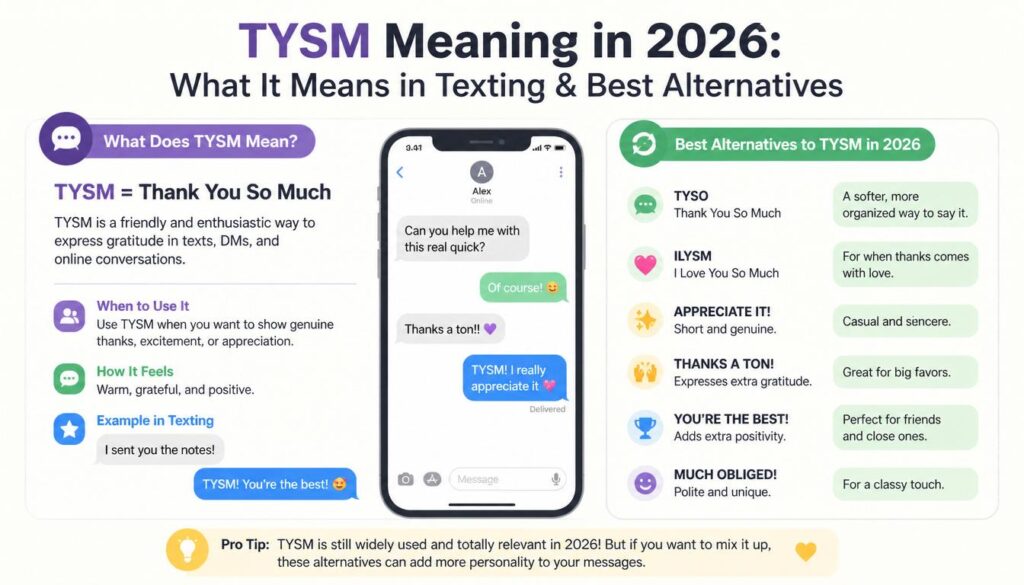
TYSM stands for “Thank You So Much.” It’s a texting abbreviation born out of the classic human need to express gratitude quickly, warmly, and without typing out every single letter.
The full form of TYSM is straightforward enough. But the weight behind it — the warmth, the sincerity, sometimes the slight casualness — depends entirely on context, tone, and who’s on the receiving end.
Think of it this way. When your best friend drives 40 minutes to help you move furniture, you might text back: “TYSM, I genuinely owe you one.” That lands perfectly. But if your department head just approved your annual leave after a formal request, firing off a “tysm!” in reply might raise an eyebrow or two.
Same letters. Very different impressions.
Where Did TYSM Come From?
Internet slang didn’t appear out of thin air. TYSM, like most texting acronyms, traces its roots back to the late 1990s and early 2000s — the golden age of SMS and early chat rooms. Platforms like MSN Messenger, AIM, and Yahoo Chat ran on short, punchy exchanges. Nobody wanted to type a full sentence when a few letters did the job.
By the mid-2000s, SMS language had fully taken hold. Abbreviations like TY, BRB, and LOL became second nature. TYSM fit right in — it was TY, but louder. More expressive. A notch above the basic “thanks.”
Fast forward to 2026, and digital communication has only accelerated. Platforms shift, apps evolve, but the human instinct to say thank you quickly hasn’t changed at all.
How TYSM Is Used in 2026
TYSM is alive and thriving, especially among Gen Z and Millennials who grew up with it baked into their vocabulary. You’ll spot it across:
- Instagram and TikTok comments — fans replying to creators, followers reacting to shoutouts
- Discord and gaming chats — teammates thanking each other mid-raid or after a clutch save
- WhatsApp and iMessage threads — everyday exchanges between friends and family
- X (formerly Twitter) — quick replies to reposts or mentions
- Slack and workplace group chats — though here, tread more carefully
What’s interesting in 2026 is that TYSM has crossed cultural lines. It’s no longer exclusive to English-speaking users. If you search TYSM meaning in Malayalam or TYSM meaning in Hindi, you’ll find the same definition — because internet slang doesn’t stop at borders. The abbreviation travels with the platform.
Tone Matters More Than You Think
Here’s where a lot of people slip up. Abbreviations strip away vocal tone, body language, and facial expression. What you feel when you type something doesn’t always reach the reader the same way.
Consider these three versions of the same message:
- “Tysm.” — reads as quick, maybe rushed, possibly sarcastic depending on context
- “Tysm 😊” — immediately warmer, clearly genuine
- “TYSM, this really helped me 🙏” — sincere, thoughtful, the right balance of casual and heartfelt
Emojis play a surprisingly big role in digital etiquette. They function almost like punctuation — shaping the emotional register of a message. Without them, TYSM can feel flat or even dismissive, even when you didn’t mean it that way.
This is what linguists call pragmatic nuance — the unspoken layer of meaning beneath the words. In written digital language, we lose a lot of that layer. So we compensate with emojis, exclamation points, and extra words.
TYSM vs. Similar Abbreviations: What’s the Difference?
People often mix up TYSM with other texting abbreviations. Here’s a clear breakdown:
TY vs. TYSM
TY simply means Thank You. It’s the most stripped-down expression of gratitude — efficient, but low on warmth. TYSM carries more emotional weight. It’s the difference between a nod and a hug.
TQ vs. TYSM
TQ is an alternative form of Thank You used more commonly in parts of Asia. It carries the same neutral sentiment, but it’s less common globally and can confuse people unfamiliar with it.
TYT vs. TYSM
This one trips people up regularly. TYT means Take Your Time — it has absolutely nothing to do with gratitude expressions. It’s supportive, not thankful. Mixing these two up in the wrong context can lead to some genuinely awkward moments.
Real Scenario Examples: How TYSM Works in Practice
This is where understanding truly clicks. Let’s walk through some real-world situations.
Scenario 1: Student to Teacher — WhatsApp
Context: A student has been struggling with an essay structure. The teacher sends a voice note explaining the concept after school hours.
Student’s reply: “Tysm for taking the time to explain that, it finally made sense 🙏 Really appreciate it.”
Why it works: The student adds context and warmth around TYSM, which keeps it from feeling lazy. The emoji signals sincerity. This is register-appropriate for an informal student-teacher relationship.
What would go wrong: Replying with just “tysm” — no context, no emoji — might read as indifferent or even perfunctory to a teacher who went out of their way.
Scenario 2: Colleague to Manager — Slack
Context: A team member just received approval for a week off during a busy project period.
What they sent: “Tysm for approving the leave! Really means a lot.”
What would’ve been better: “Thank you so much for approving the leave request. I really appreciate your flexibility.”
Why the difference matters: In a professional communication setting, spelling out the full form of TYSM signals that you took a moment to be deliberate. It shows respect and awareness of register. Workplace messaging like Slack sits in a grey zone — informal enough for casual language, but not so casual that shortcuts always fly.
Scenario 3: Fan to Content Creator — Instagram Comment
Context: A food blogger replies to a fan’s comment, compliments their recipe attempt, and shares it to their story.
Fan’s comment: “Tysm for noticing this 😭❤️ You literally made my whole week.”
Why it works perfectly: On Instagram, this tone is not just acceptable — it’s expected. The casual messaging style matches the platform’s energy. Here, TYSM lands with full warmth and zero awkwardness.
Scenario 4: Friends — iMessage
Context: One friend covered the bill at dinner without telling the other.
Reply: “Wait — you paid for everything?? TYSM omg, I’m getting it next time no arguments.”
Why it works: Capitalization of TYSM here actually amplifies emotion — it mirrors the verbal equivalent of raising your voice in pleasant shock. This is exactly the conversational tone the abbreviation was built for.
Best Alternatives to TYSM (Grouped by Tone and Context)
Sometimes TYSM just isn’t the right fit. Having a range of gratitude expressions in your toolkit makes you a more effective communicator — whether you’re texting a friend or crafting a professional email.
For Formal and Professional Settings
- “Thank you so much” — the full form; always appropriate, always polished
- “I truly appreciate it” — conveys depth without being over the top
- “Many thanks” — slightly formal, but warm enough to avoid sounding stiff
- “I’m genuinely grateful” — works well in heartfelt professional correspondence
For Casual and Friendly Conversations
- “Thanks a ton” — cheerful, light, great for everyday texting
- “Thanks a bunch” — slightly old-fashioned but carries genuine friendliness
- “Much appreciated” — relaxed and versatile, works in both peer and coworker chats
- “Cheers” — common in British and Australian English, carries breezy warmth
For Deep or Heartfelt Moments
- “I can’t thank you enough” — signals that the favor was truly significant
- “Appreciate you” — short, intimate, widely used in close friendships
- “This means more than you know” — emotionally resonant, good for written notes or meaningful messages
How to Choose the Right Expression Every Time
Three questions cut through the guesswork:
1. Who are you talking to? A close friend gets abbreviations. A senior colleague or client gets full sentences.
2. What’s the platform or channel? Instagram and Discord invite casual SMS language. Email and formal Slack threads call for proper phrasing.
3. How big was the favor? A quick “thanks a ton” works for small gestures. When someone genuinely changes your day — or your life — they deserve language that reflects that.
Matching your expression of gratitude to the moment isn’t just about politeness. It’s about making the other person feel like you actually noticed what they did.
The Cross-Cultural Reach of TYSM
One of the more fascinating aspects of internet slang evolution is how abbreviations like TYSM transcend language barriers. Searches for TYSM meaning in Malayalam, TYSM meaning in Urdu, TYSM meaning in Hindi consistently spike — because people across the globe are picking up English texting abbreviations through platforms, not classrooms.
This is global digital communication in action. The abbreviation stays English, but it becomes part of a multilingual conversation. That’s both the beauty and the complexity of how language moves in the internet age.
Final Thoughts
TYSM is a small string of letters doing a big job. It carries gratitude, warmth, and connection across billions of messages every day. But like any tool, it works best when you know how to use it — and when to reach for something else instead.
In 2026, the way we say thank you still matters. Maybe more than ever. Whether you type out every letter or abbreviate it down to four, what counts is that it feels real to the person reading it.
So before you hit send, take one second. Ask yourself: Does this match the moment? If yes, send it with confidence. If not, you now have plenty of better options.
Good communication isn’t about using the fanciest words — it’s about choosing the right ones.