
If you’ve ever paused mid-sentence, finger hovering over the hyphen key, unsure whether to write “up to date” or “up-to-date” — you’re not alone. This is one of those grammar questions that trips up native speakers and English learners alike. And honestly? The confusion makes complete sense. The two forms look nearly identical, but they serve completely different roles in a sentence.
Here’s the good news: once you understand the logic behind the rule, it clicks permanently. No more second-guessing, no more awkward pauses. Let’s break it down properly — with real scenarios, clear examples, and the kind of explanation that actually sticks.
Why Does a Tiny Hyphen Even Matter?
Most people treat hyphens as decoration. They’re not. In English grammar, a hyphen is a functional connector — it tells the reader that two or more words are working together as a single unit to describe something. Remove it or add it in the wrong place, and you subtly shift the meaning of your sentence.
Consider this pair:
- “Her records are up to date.”
- “She submitted up-to-date records.”
Both sentences talk about currency and accuracy. But the structure — and the grammatical role of the phrase — is completely different. That difference matters enormously in professional writing, academic papers, business emails, and any context where precision counts.
The Core Grammar Rule (Explained Simply)
Here’s the foundation everything else builds on:
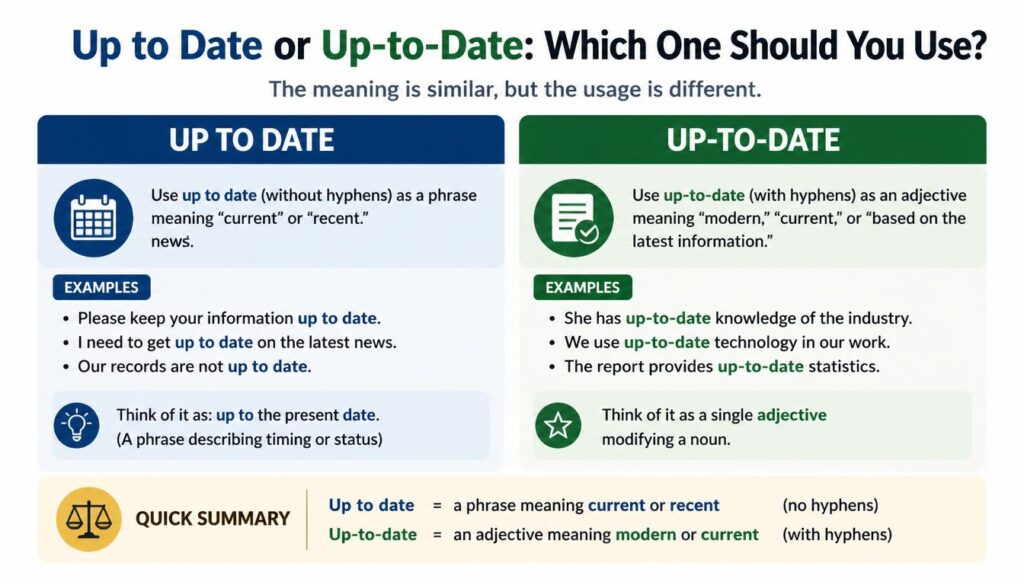
“Up to date” (no hyphen) functions as an adverbial or predicative phrase. It comes after a linking verb like is, are, was, remain, keep, stay, or bring.
“Up-to-date” (with hyphen) functions as a compound adjective or attributive modifier. It comes before the noun it describes.
Think of it this way: the hyphen is a signal that says, “These words are a team, and together they’re describing the noun right next to them.” When the phrase floats after a verb — standing on its own — the team doesn’t need to hold hands with a hyphen.
Simple test: ask yourself, is the phrase sitting before a noun, or is it following a verb?
Before a noun → hyphen required After a verb → no hyphen needed
Real-Life Scenarios That Make It Crystal Clear
Scenario 1: The Doctor’s Office
Imagine you’re at a medical clinic filling out intake forms. The receptionist leans over and says:
“Sir, we need to make sure your insurance information is up to date before the doctor sees you.”
Here, “up to date” follows the linking verb is — no hyphen. She’s describing the current state of your information.
Now imagine you walk in and the clinic has just upgraded their entire records system. A nurse mentions:
“We just switched to an up-to-date electronic records system that tracks patient history in real time.”
Here, “up-to-date” comes directly before the noun system. It’s acting as a compound modifier, describing what kind of system it is. The hyphen is essential.
Scenario 2: The Job Application
You’re reviewing your résumé before sending it out. You want to make sure everything is accurate and current. You tell a friend:
“I spent the weekend making sure my résumé is up to date.”
Post-verb placement — no hyphen.
But then your friend, who works in HR, tells you:
“Honestly, hiring managers respond better to candidates who submit an up-to-date CV with quantified achievements.”
Pre-noun placement — hyphen required.
Same concept. Different grammatical position. Different form.
Scenario 3: The Software Update
You’re troubleshooting a tech issue for a colleague. You check their computer and say:
“Your antivirus software isn’t up to date — that’s probably why it’s not catching threats.”
After the verb isn’t — no hyphen.
Later, you recommend a product to your team:
“We should invest in an up-to-date cybersecurity platform that patches vulnerabilities automatically.”
Before the noun platform — hyphenated form.
Scenario 4: The Business Meeting
A project manager sends a message in the team chat:
“Can everyone make sure their progress reports are up to date before Thursday’s review?”
Post-verb — no hyphen needed.
Then the CEO presents to investors:
“We run our operations on up-to-date data analytics software that gives us real-time market intelligence.”
Pre-noun — compound adjective with hyphen.
Common Mistakes Even Careful Writers Make
Let’s address some errors you’ll see everywhere — in emails, on websites, even in published articles.
Mistake 1: Hyphenating after a verb
❌ “Your profile is up-to-date.” ✅ “Your profile is up to date.”
Mistake 2: Dropping the hyphen before a noun
❌ “We use an up to date tracking system.” ✅ “We use an up-to-date tracking system.”
Mistake 3: Merging everything into one word
❌ “uptodate”
This form is always wrong, no matter the context. It doesn’t exist in standard English grammar. If you’ve seen it used casually online, treat it like slang — not a model to follow in any formal writing.
How This Rule Connects to Broader Hyphenation Logic
This isn’t just an isolated quirk of “up to date.” It reflects a broader pattern in English that applies to many compound modifiers:
- well-known author (before noun) vs. the author is well known (after verb)
- high-quality product (before noun) vs. the product is high quality (after verb)
- fast-moving market (before noun) vs. the market is fast moving (after verb)
Once you internalize this pattern, you’ll naturally apply the correct form across dozens of compound expressions — not just this one. It’s a transferable grammar skill that sharpens your entire writing toolkit.
“Up to Date” in Professional and Business Writing
In business communication, this distinction carries real weight. A poorly hyphenated phrase in a client-facing report or a proposal can undermine your credibility — even if the reader can’t quite put their finger on why something feels off.
Here’s a polished business email that gets it right:
Subject: Q3 Market Analysis — Ready for Review
Hi Daniel,
Please find attached the Q3 report. It contains up-to-date figures on consumer behavior, regional sales, and competitor positioning. I’ve also flagged areas where our data wasn’t up to date as of last quarter, along with recommended actions.
Let me know if you’d like to discuss before Friday’s presentation.
Best, Rachel Nguyen Senior Analyst
Notice how both forms appear naturally — one before a noun, one after a verb. That’s confident, grammatically precise writing.
Quick-Reference Guide
| Situation | Form to Use | Example |
|---|---|---|
| After a linking verb | up to date | The list is up to date. |
| Before a noun | up-to-date | An up-to-date list. |
| Merged, no spaces | uptodate | ❌ Never correct |
Synonyms Worth Knowing
When you want to vary your language without losing the meaning, these alternatives work well:
For “up to date” (adverbial/predicative use): current, accurate, refreshed, recent, modernized
For “up-to-date” (adjective/modifier use): current, contemporary, state-of-the-art, cutting-edge, latest-generation
Using synonyms strategically keeps your writing from feeling repetitive — especially in longer documents where the phrase might appear multiple times.
A Brief Historical Note
The phrase has bookkeeping roots dating to the late 19th century. Clerks would mark ledgers as “up to date” to confirm all entries were current and balanced. From there, it migrated into everyday language — first through commerce, then into journalism, education, and eventually the digital world. It’s a phrase with genuine history behind it, which explains why it’s embedded so deeply in both formal and informal English today.
Final Thoughts
The difference between up to date and up-to-date is small but meaningful. It’s the kind of detail that separates writing that merely communicates from writing that commands respect. Use the unhyphenated form after verbs. Use the hyphenated form before nouns. And never merge them into one word.
Master this rule, and you’ll carry that confidence into every other compound modifier you encounter. Because in English, precision isn’t pedantry — it’s clarity in action.