
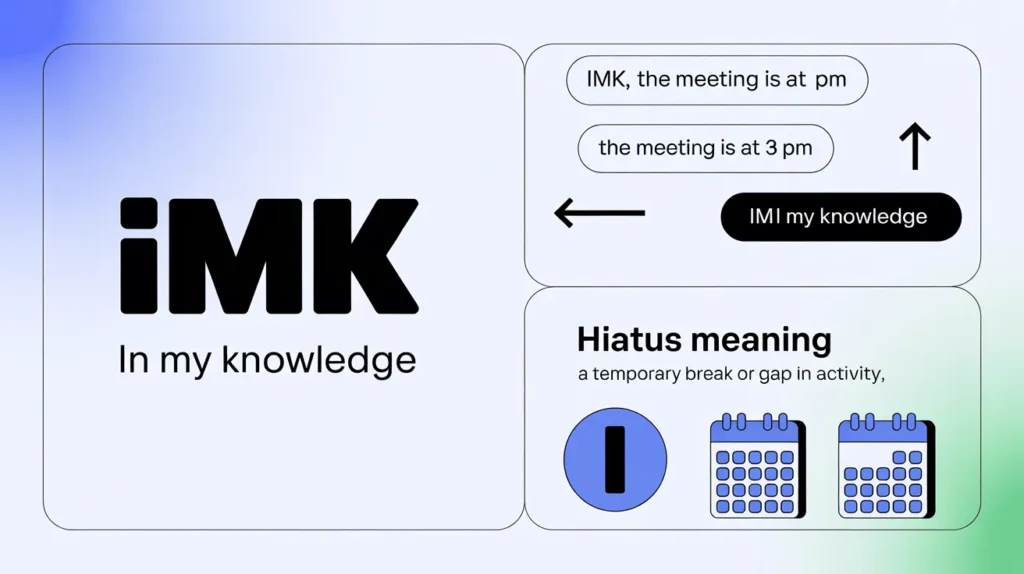
Language is a living thing. It breathes, evolves, and sometimes surprises you with words and phrases you’ve never encountered before. One day you’re reading a text from a friend and you freeze — what does IMK mean? Or you’re watching an entertainment news update and the host casually announces that your favorite show is going on hiatus, and you nod along even though you’re only half sure you understand what that means.
You’re not alone in that moment of pause. Both of these terms — IMK and hiatus — appear regularly in everyday conversation, digital communication, and professional settings, yet many people use them without fully understanding their depth, nuance, or the contexts where they truly belong.
This guide breaks both terms down completely. We’ll walk through their meanings, trace their origins, place them in real-life scenarios, and give you the confidence to use them — or their alternatives — with precision and purpose.
What Does IMK Mean? A Closer Look at Modern Texting Language
Let’s start with the one that lives in your phone. IMK stands for “In My Knowledge.” It’s a shorthand expression used in casual texting, social media conversations, and quick digital exchanges when someone wants to share information they believe to be true — but can’t fully verify.
Think of it as a conversational safety net. Instead of stating something with full confidence, IMK lets you offer information while quietly signaling, “I could be wrong, double-check this.”
The Everyday Origins of IMK in Digital Communication
IMK didn’t come from a dictionary or a grammar textbook. It grew organically from texting culture — the same culture that gave us LOL, TBH, IMO, and dozens of other internet slang acronyms that now feel completely natural in everyday speech.
Unlike IMO (In My Opinion) or FYI (For Your Information), IMK hasn’t yet reached mainstream ubiquity. But it’s steadily gaining ground, especially among younger audiences who communicate primarily through platforms like Snapchat, TikTok, Instagram DMs, and group chats.
What Does IMK Mean on Snapchat Specifically?
If you’ve landed here after seeing IMK on Snapchat and wondering what it means — the answer is the same across platforms: “In My Knowledge.” On Snapchat, where messages disappear and conversations move fast, users rely heavily on abbreviations and shorthand to communicate quickly. IMK fits right into that rhythm.
Scenario Example:
Maya snaps her friend: “Is the study group still meeting at 6?” Her friend replies: “IMK yeah, but check with Jordan.”
In that context, IMK works perfectly. It’s informal, quick, honest about uncertainty, and entirely appropriate for the casual communication style Snapchat is built for.
IMK Meaning in Text: How Context Shapes Interpretation
Here’s where things get interesting. IMK meaning in text can shift slightly depending on who you’re talking to and what the conversation is about. Some users interpret it as “In My Knowing” — which carries essentially the same meaning, just phrased differently.
The underlying message is always the same: I believe this is true based on what I currently know, but I’m not making any guarantees.
Three Real-Life Scenarios Where IMK Shows Up Naturally
Scenario 1 — The Weekend Plans Text:
Priya texts her roommate: “Do you know if the mall is open on Sunday?” Roommate: “IMK it closes at 9, but Google it just in case.”
Here, IMK softens the statement. It’s honest, helpful, and keeps the conversation moving without creating false certainty.
Scenario 2 — The Group Chat Question:
Someone in a college group chat asks: “Was the assignment due today or tomorrow?” A classmate responds: “IMK it’s tomorrow. But check the portal.”
Again, IMK works because the setting is informal and the stakes are low enough that a disclaimer feels appropriate rather than evasive.
Scenario 3 — The Workplace Slack Message (Where IMK Starts to Slip):
A manager messages the team: “Is the client report finalized?” An employee responds: “IMK, yes.”
This is where the tone mismatch becomes visible. In a professional environment, IMK can sound vague, uncommitted, or careless. The manager needs a reliable answer, and a two-letter acronym attached to a yes doesn’t inspire confidence.
Polite and Professional Alternatives to IMK
If you’re stepping out of the group chat and into the boardroom — or even a formal email thread — IMK should stay behind. Here are alternatives that carry the same meaning while sounding far more polished:
- “To my knowledge…”
- “As far as I’m aware…”
- “Based on my understanding…”
- “From what I’ve seen or heard…”
- “I believe, though I’d recommend confirming…”
These phrases do the same job as IMK — they signal informed uncertainty — but they do it with a level of professional communication that earns respect rather than raising eyebrows.
What Does Hiatus Mean? Understanding a Word With Real Weight
Now let’s shift gears — quite significantly — and talk about hiatus.
Where IMK is young and digital, hiatus is ancient and formal. The word traces back to Latin, derived from hiare, meaning to gape or to open. In its most literal sense, a hiatus is a gap — a space where something used to be and will, presumably, be again.
In modern usage, hiatus refers to a deliberate pause or temporary break in activity. The key word there is temporary. A hiatus is not an ending. It’s an interruption — purposeful, often planned, and usually with the intention of returning.
Where You’ll Hear Hiatus Used Most Often
Entertainment and Media: This is probably the most common place people encounter the word. A TV show goes on hiatus between seasons. A musician takes a creative hiatus between albums. A popular podcast announces a brief hiatus while the host deals with personal matters.
The Workplace: Projects get placed on hiatus due to budget constraints, shifting priorities, or resource shortages. It’s a professional way of saying “we’ve stopped for now, but we haven’t abandoned this.”
Personal Life: People take social media hiatuses to protect their mental health. Athletes go on fitness hiatuses due to injury. Writers take creative hiatuses when the words just aren’t coming.
Hiatus in Action: Scenarios That Show the Word’s True Meaning
Scenario 1 — The TV Show Announcement:
A network posts: “Season 3 will return after a short summer hiatus. Stay tuned.”
Here, hiatus signals a structured pause, not cancellation. Fans understand the show is coming back. The word manages expectations with precision.
Scenario 2 — The Professional Email:
“The product launch is currently on hiatus pending final approvals from the legal team.”
In this context, hiatus sounds intentional and controlled. It implies that the pause has a clear reason and an eventual endpoint — far more reassuring than saying the launch is “stuck” or “delayed.”
Scenario 3 — The Personal Social Media Post:
A lifestyle blogger writes: “I’m taking a short hiatus from posting to focus on my well-being. I’ll be back with fresh content soon.”
Using hiatus here elevates the tone of the announcement. It sounds thoughtful and deliberate — not like someone who simply ran out of ideas or got lazy with posting.
Scenario 4 — The Misuse to Watch Out For:
Someone says: “Our partnership is on hiatus.”
If they mean the partnership has ended completely, hiatus is the wrong word. A hiatus implies return. If there’s no return planned, better words would be “concluded,” “dissolved,” or simply “ended.”
IMK vs. Hiatus: Two Terms, Two Worlds, One Common Thread
On the surface, IMK and hiatus seem like they have absolutely nothing in common. One is a three-letter acronym born in the age of smartphones; the other is a centuries-old Latin-rooted word. But look closer and you’ll find they share something meaningful: both are about managing information and expectations in communication.
IMK tells your listener: “I’m sharing this, but hold it loosely.” Hiatus tells your audience: “We’re pausing, but we’re not finished.”
Both require you to read your audience, choose your communication style carefully, and understand that words carry tone beyond their literal meaning.
How to Choose the Right Expression Every Single Time
Here’s a simple framework that cuts through the confusion:
Ask yourself three questions before you speak or type:
- Who is my audience? — Friends and peers? Go casual. Colleagues, clients, or the public? Go formal.
- What is the stakes of this message? — Low stakes allow for IMK. High stakes demand precision.
- Am I signaling uncertainty or absence? — IMK signals uncertain knowledge. Hiatus signals temporary absence.
Once you run your message through those three filters, the right word — or the right professional alternative — becomes obvious.
Common Mistakes People Make With Both Terms
- Using IMK in a formal email — it immediately undermines your credibility.
- Using hiatus to mean a permanent end — it creates confusion and false hope.
- Overusing IMK in conversation — it can make you sound perpetually unsure of yourself.
- Treating hiatus as interchangeable with “break” — while similar, hiatus carries more gravity and formality. A break is something you take at lunch. A hiatus is something you announce.
Final Thoughts: Language Shapes How the World Sees You
Whether you’re dropping an IMK into a Snapchat reply or crafting a public statement about a creative hiatus, the words you choose send a signal — about your confidence, your professionalism, and your awareness of context.
IMK belongs in casual digital spaces where speed matters more than precision. Hiatus belongs in moments that deserve weight, formality, and the kind of language that says “this matters, and so does the way I’m talking about it.”
Master both. Know when to use them, when to swap them for something better, and always remember — the right word in the right moment is one of the most powerful tools a communicator has.