
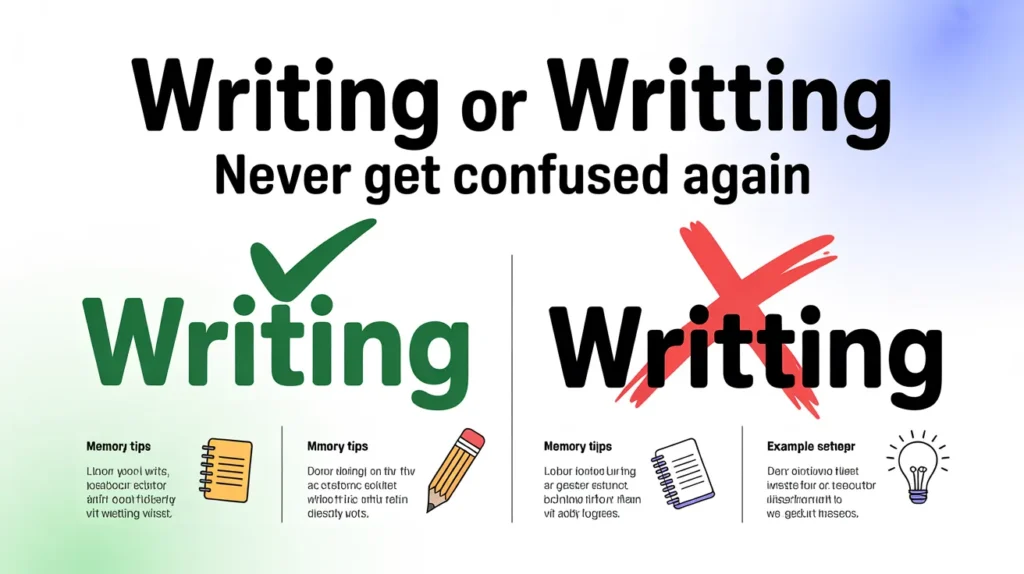
Have you ever paused mid-sentence, fingers hovering over your keyboard, wondering if you should type “writing” or “writting”? Maybe you’ve seen both spellings floating around online and questioned which one actually belongs in your essay, email, or text message. Let me clear this up for you right now: only “writing” is correct. The word “writting” doesn’t exist in standard English, despite how often it appears in everyday communication.
This confusion isn’t your fault. English spelling can feel like navigating a maze blindfolded, especially when similar words follow completely different rules. But here’s the good news—once you understand why this mistake happens and how to avoid it, you’ll never second-guess yourself again.
Understanding the Correct Spelling: Writing
Let’s start with the basics. Writing is the present participle form of the verb “write.” It describes the ongoing action of putting words, thoughts, or ideas onto paper or a digital screen. When you say “I am writing an email” or “She’s writing a novel,” you’re using the word correctly.
The confusion typically stems from English spelling rules, particularly how we form present participles. Many verbs double their final consonant before adding “-ing”—think “run” becoming “running” or “stop” becoming “stopping.” This pattern makes people assume “write” should become “writting.” But that’s where the rule breaks down.
Here’s why: Write ends with a silent “e.” When a verb ends in a silent “e,” we simply drop that “e” and add “-ing.” No doubling required. So:
- Write → Writing (not writting)
- Make → Making (not makking)
- Come → Coming (not comming)
The consonant doubling rule only applies to words with specific patterns: a single vowel followed by a single consonant, with stress on the final syllable. “Write” doesn’t fit this pattern because it has a long vowel sound (the “i” sounds like “eye”), and the silent “e” changes everything.
Why “Writting” Looks So Tempting
I get it—”writting” looks plausible. When you’re typing quickly or focusing on getting your thoughts down, that extra “t” can slip in without you noticing. Several factors contribute to this common mistake:
Pronunciation influence: When we say “writing,” that sharp “t” sound in the middle makes it feel like there should be two t’s. Our brains try to match spelling with sound, which doesn’t always work in English.
Pattern recognition: We’ve learned that words like “sitting,” “getting,” and “cutting” double their consonants. Our minds automatically apply this pattern to “write,” even though it doesn’t fit the rule.
Autocorrect fatigue: We’ve become so dependent on spell check that we don’t always internalize correct spellings. When autocorrect fixes “writting” to “writing,” we move on without learning why.
Scenario Example 1: The Job Application Email
Imagine you’re applying for your dream job. You’ve crafted the perfect cover letter, highlighting your skills and experience. Then you write this:
Incorrect: “I am writting to express my strong interest in the Marketing Manager position at your company.”
Correct: “I am writing to express my strong interest in the Marketing Manager position at your company.”
That single spelling error in the opening sentence? It could immediately undermine your credibility. Hiring managers receive hundreds of applications. A basic spelling mistake signals carelessness or lack of attention to detail—qualities no employer wants. In professional communication, accuracy matters enormously.
The Grammar Behind Writing vs. Writting
To truly understand why “writing” is correct, let’s look at the verb forms of “write”:
- Base form: write (“I write poetry every morning”)
- Past tense: wrote (“She wrote three chapters yesterday”)
- Past participle: written (“The report has been written”)
- Present participle: writing (“They are writing their thesis now”)
Notice something interesting? The past participle “written” does have a double “t,” but the present participle “writing” does not. This difference exists because these forms follow different formation rules in English.
When we create the past participle, we’re using a completely different pattern inherited from Old English. But for the present participle, we’re simply working with the base verb “write” and applying the standard “-ing” rule: drop the silent “e,” add “-ing.”
Scenario Example 2: The Student’s Dilemma
Picture a college student working late on an academic paper. Sleep-deprived and caffeinated, they type:
Incorrect: “This essay focuses on the art of creative writting in the 21st century.”
Correct: “This essay focuses on the art of creative writing in the 21st century.”
In academic settings, spelling errors carry weight. Professors use them as indicators of a student’s attention to detail, language proficiency, and overall effort. A misspelled word in your thesis title or abstract could affect how seriously readers take your research. When your credibility as a writer is on the line, every letter counts.
Common Writing vs. Writting Mistakes and How to Fix Them
Let me show you some real-world examples of this error and their corrections:
❌ “I enjoy writting in my journal every night.”
✅ “I enjoy writing in my journal every night.”
❌ “He’s been writting that novel for five years.”
✅ “He’s been writing that novel for five years.”
❌ “The art of writting requires practice and patience.”
✅ “The art of writing requires practice and patience.”
❌ “Thank you for writting back so quickly.”
✅ “Thank you for writing back so quickly.”
The pattern is consistent: there’s never a scenario where “writting” is acceptable in standard English.
Scenario Example 3: Social Media and Texting
Even in casual communication, spelling matters more than you might think. Consider this text conversation:
Friend 1: “What are you up to?”
Friend 2: “Just writting some birthday cards for next week.”
While your friend will probably understand what you mean, that misspelling creates a subtle impression. It suggests you’re either unsure of basic spelling or you’re not paying attention. In an era where written communication dominates—through texts, tweets, Instagram captions, and comments—these small details shape how others perceive you.
Now imagine you’re writing a professional social media post for your business:
Incorrect: “We’re writting a new chapter in sustainable fashion.”
Correct: “We’re writing a new chapter in sustainable fashion.”
Your brand’s credibility takes a hit with that error, especially if hundreds or thousands of people see it.
Memory Tricks to Never Misspell Writing Again
Want a foolproof way to remember the correct spelling? Try these mental shortcuts:
The “Drop and Add” method: Think “Drop the E, add ING.” Whenever you see a verb ending in silent “e,” this rule applies. Write → Drop the E → Add ING → Writing.
The rhyme trick: “When writing is right, there’s just one ‘t’ in sight.”
Visual memory: Picture the word “write” and literally cross out the “e,” then add “ing.” The visual of that single “t” remaining will stick in your mind.
Writing in Different Contexts
Understanding how to use “writing” correctly means recognizing its various applications:
As a continuous action: “I am writing a letter to my grandmother.” (present continuous tense)
As a noun (gerund): “Writing helps me process my emotions.” (the act of writing)
In perfect tenses: “I have been writing all morning.” (present perfect continuous)
In passive constructions: “The manuscript is being written by a team of experts.” (passive voice)
In every single case, it’s “writing” with one “t,” never “writting.”
Scenario Example 4: The Business Proposal
Imagine a consultant preparing a proposal for a potential client worth millions of dollars. Every word matters. Then this appears:
Incorrect: “Our team specializes in writting comprehensive market analysis reports.”
Correct: “Our team specializes in writing comprehensive market analysis reports.”
In business writing, this error could cost you the contract. Clients expect polish, professionalism, and expertise. A spelling mistake in your proposal suggests you might be equally careless with their project. When money and reputation are at stake, there’s no room for “writting.”
The Bottom Line: Writing Wins Every Time
Here’s what you need to remember: “Writting” is always wrong. “Writing” is always right. There are no exceptions, no special cases, no regional variations where “writting” becomes acceptable. It’s simply not a word in English.
Whether you’re writing an email, crafting a novel, taking notes in class, or posting on social media, the spelling remains the same. Master this one simple rule—drop the silent “e” from “write” and add “-ing”—and you’ll eliminate this error from your vocabulary forever.
The next time you find yourself questioning which spelling to use, remember the scenarios we’ve explored: the job seeker who lost credibility, the student whose academic work suffered, the business owner whose brand took a hit. These aren’t just hypothetical examples—they represent real consequences of a simple spelling mistake.
Good writing starts with correct spelling. And correct spelling of “writing” means one “t,” every single time. Now that you know the rule, the reasoning, and the real-world impact, you’ll never get confused again.