
Have you ever been mid-sentence, fingers hovering over your keyboard, suddenly frozen by doubt? You’re writing about fastening something, and you think, “Wait—is it tying or tieing?” If this sounds familiar, you’re in good company. This spelling question trips up countless writers, from students crafting essays to professionals sending important emails.
The confusion makes sense. After all, the base word is “tie,” which ends in “-ie.” So when you add “-ing,” shouldn’t it become “tieing”? Let’s dig into this common spelling dilemma and clear up the confusion once and for all.
The Quick Answer: Tying Is Correct
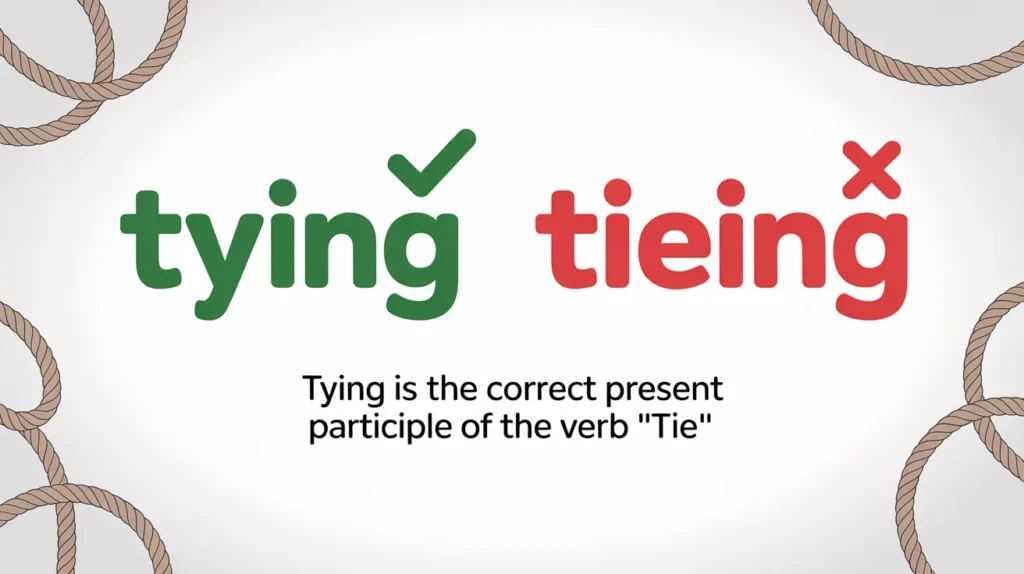
Here’s the bottom line: the correct spelling is “tying”—not “tieing.”
When you transform the verb “tie” into its present participle form, you drop the “-ie” and replace it with “-y” before adding “-ing.” This isn’t just a random quirk of English; it’s actually a consistent rule that applies to all verbs ending in “-ie.”
So whenever you’re writing about fastening shoelaces, securing a boat, or finishing up tasks, remember: it’s always tying.
Understanding the Spelling Rule
English spelling can feel like a maze, but this particular rule is straightforward once you understand the pattern. When a verb ends in “-ie,” you must change the “-ie” to “-y” before adding “-ing.”
This rule exists for a practical reason: pronunciation and readability. Imagine if we kept the “-ie” and just tacked on “-ing.” We’d end up with “tieing,” “dieing,” and “lieing”—combinations that look awkward and create confusing letter clusters that our eyes stumble over.
Here’s how the transformation works:
- tie → tying
- die → dying
- lie → lying
- vie → vying
Notice the pattern? Every single verb that ends in “-ie” follows this same transformation. It’s not an exception or a special case for “tie” alone—it’s a reliable rule you can count on.
Why “Tieing” Looks Wrong (Because It Is)
You might be thinking, “But ‘tieing’ follows the normal pattern of just adding ‘-ing’ to a word!” And you’re partially right—that is the standard rule for most verbs. However, verbs ending in “-ie” are a special category that require the “-ie” to “-y” switch.
Consider these correct examples:
✅ “I’m tying my daughter’s hair into pigtails before school.”
✅ “The surgeon spent hours tying delicate sutures during the operation.”
✅ “We’re tying up the last details before the product launch.”
Now look at these incorrect versions:
❌ “I’m tieing my daughter’s hair into pigtails before school.”
❌ “The surgeon spent hours tieing delicate sutures during the operation.”
❌ “We’re tieing up the last details before the product launch.”
See how “tieing” just looks… off? That visual awkwardness is your clue that something’s wrong with the spelling.
Real-World Scenarios: Tying in Action
Let’s explore how “tying” appears in everyday situations. Seeing the word in context helps cement the correct spelling in your memory.
Scenario 1: The Morning Rush
Sarah glanced at the clock—7:45 AM. Her son sat on the floor, struggling with his sneakers.
“Mom, I can’t do it!” he whined.
“You’ve been tying your shoes for months now,” she encouraged. “Remember the bunny ears method we practiced?”
She knelt beside him, demonstrating once more. “See? You’re getting better at tying knots every day.”
Scenario 2: The Sailing Lesson
Captain Morris addressed his students on the dock. “Before we head out, let’s review the basics. Tying proper knots isn’t just a skill—it’s a safety essential when you’re on the water.”
He held up a length of rope. “Tying a bowline knot might seem complicated at first, but with practice, your hands will remember the movements.”
One student asked, “How long did it take you to get good at tying all these different knots?”
“Years,” the captain smiled. “But I’m still tying and learning new ones.”
Scenario 3: The Wedding Preparation
The event coordinator walked through the venue, clipboard in hand. “We’re tying satin ribbons on each chair back,” she explained to her assistant. “And don’t forget—the florist will be tying baby’s breath into small bundles for the centerpieces.”
Her assistant nodded. “What about the programs?”
“Tying them with twine gives that rustic touch the couple wanted. Start tying those while I check on the caterer.”
Scenario 4: The Project Deadline
Mark’s email to his team read:
“Hi everyone,
We’re in the final stretch! I’m tying up loose ends on the budget report this afternoon. Sarah is tying together the marketing analysis, and Tom should be tying off the client presentations by 5 PM.
Great work on tying all these complex elements into a cohesive proposal. Let’s finish strong!
Mark”
Common Phrases Using Tying
Understanding idiomatic expressions that use “tying” helps you recognize the word in different contexts:
Tying the knot – This popular phrase means getting married. “After five years of dating, they’re finally tying the knot next summer.”
Tying up loose ends – Finishing remaining tasks or resolving unfinished business. “Before I leave for vacation, I need to spend Friday tying up loose ends at the office.”
Tying one on – An informal expression meaning to get drunk (though less commonly used today). “They went out tying one on after the championship win.”
Tying yourself in knots – Becoming confused or anxious while overthinking something. “Stop tying yourself in knots about the presentation—you’re well-prepared.”
Other Verbs That Follow the Same Rule
Once you understand the “-ie” to “-y” pattern, you can apply it to other similar verbs:
- Die → Dying: “The flowers are dying without water.”
- Lie → Lying: “He’s lying on the couch watching TV.”
- Vie → Vying: “Three candidates are vying for the position.”
- Untie → Untying: “She’s untying the ribbon carefully to save it.”
Notice that all these words would look strange if we wrote them as “dieing,” “lieing,” “vieing,” or “untieing.” The same principle that makes “tying” correct makes these spellings correct too.
Why This Rule Matters for Clear Writing
You might think, “Does one letter really make that much difference?” Actually, yes—it does. Correct spelling signals professionalism and attention to detail. When readers encounter “tieing” in your writing, it creates a moment of friction. They might not consciously think, “That’s spelled wrong,” but something will feel slightly off.
In professional contexts especially, small spelling errors can undermine your credibility. Whether you’re writing a cover letter, a business proposal, or an important email, using “tying” correctly shows you care about getting the details right.
A Simple Memory Trick
Here’s an easy way to remember the correct spelling: “When you tie, switch ‘ie’ to ‘y.'”
Say it aloud a few times. Better yet, the next time you’re actually tying something—your shoes, a package, a scarf—say this phrase out loud. Associating the physical act with the spelling rule creates a stronger memory connection.
Another approach: Remember that “tying has a ‘y’ just like the word ‘trying.'” Both words involve effort and action, and both use “y” before “-ing.”
Is “Tieing” Ever Acceptable?
In extremely rare cases, you might encounter “tieing” in very old texts or specialized technical writing. Some historical documents from the 18th or 19th century occasionally used “tieing,” and you might see it in very specific fishing terminology (like “tieing flies”).
However, in modern English writing, “tieing” is considered incorrect. Even in those specialized contexts, contemporary writers overwhelmingly prefer “tying flies” over “tieing flies.” If you want your writing to appear current, polished, and professional, always use “tying.”
Quick Reference: Before and After
Let’s look at some incorrect sentences transformed into correct ones:
Before: “He’s tieing his necktie in front of the mirror.”
After: “He’s tying his necktie in front of the mirror.”
Before: “The artist is tieing small brushstrokes together to create texture.”
After: “The artist is tying small brushstrokes together to create texture.”
Before: “I spent all morning tieing packages for shipping.”
After: “I spent all morning tying packages for shipping.”
Practical Application: Writing With Confidence
Now that you know the rule, practice applying it. The next time you’re writing and need to use this word, pause for just a second and recall: “tie” becomes “tying,” not “tieing.”
With repetition, this will become automatic. You won’t need to stop and think about it anymore—your fingers will just type the correct spelling naturally.
Wrapping Up
The question of “tying or tieing” has a clear answer: tying is always correct in modern English. The rule is simple—change “-ie” to “-y” before adding “-ing”—and it applies consistently to all verbs ending in “-ie.”
Whether you’re writing about tying shoelaces, tying knots on a boat, tying ribbons on gifts, or tying up loose ends at work, you now have the knowledge and confidence to spell it correctly every single time.
Remember, good writing isn’t just about having great ideas—it’s also about presenting those ideas clearly and correctly. Mastering small details like this spelling rule elevates your writing and ensures your readers focus on your message rather than getting distracted by errors.
So go ahead—start tying these spelling rules into your everyday writing habits. You’ve got this!