
You’re putting together an expense report for work, fingers flying across the keyboard, when you suddenly freeze. Should you write “I’m totalling the receipts” or “I’m totaling the receipts”? Both look right, yet something feels off. You’ve been here before with words like travelling and traveling, but the doubt creeps in anyway.
Here’s the good news: you’re not making a mistake either way. The confusion between totalling vs totaling isn’t about right or wrong—it’s about knowing your audience and understanding the quirks of English spelling across different regions.
In this guide, we’ll break down exactly when to use each spelling, explore the rules behind the double ‘l’ versus single ‘l’, and walk through real-world scenarios so you can write with absolute confidence, whether you’re drafting an email to London or Los Angeles.
What Does Totalling/Totaling Actually Mean?
Before we dive into spelling debates, let’s establish what this word does. Totalling (or totaling) is the present participle of the verb “total.” When you’re totalling something, you’re adding up numbers to find their sum or calculating how much something amounts to.
Think of it in action:
- “She’s totalling the quarterly sales figures right now.”
- “The accountant spent all morning totaling the invoices.”
- “We’re totalling donations from the charity drive.”
The word works primarily as a verb in its continuous form, but it can also function as a gerund (noun) or even as an adjective in certain contexts. The meaning stays the same regardless of whether you spell it with one ‘l’ or two—the only thing that changes is which side of the Atlantic your readers are on.
The British English vs American English Divide
Here’s where things get interesting. British English follows a different spelling rule than American English when it comes to verbs ending in a single vowel followed by ‘l’.
The British English Rule
In British English, when you have a verb that ends with a single vowel followed by ‘l’, and you’re adding a suffix that starts with a vowel (like -ing or -ed), you double the ‘l’. This applies even when the stress doesn’t fall on the final syllable.
Examples following this pattern:
- travel → travelling
- cancel → cancelling
- model → modelling
- total → totalling
The American English Rule
American English takes a simpler approach. Unless the stress falls on the final syllable, you don’t double the final consonant when adding -ing or -ed. Since the stress in “total” falls on the first syllable (TO-tal), Americans write it with a single ‘l’.
Examples:
- travel → traveling
- cancel → canceling
- model → modeling
- total → totaling
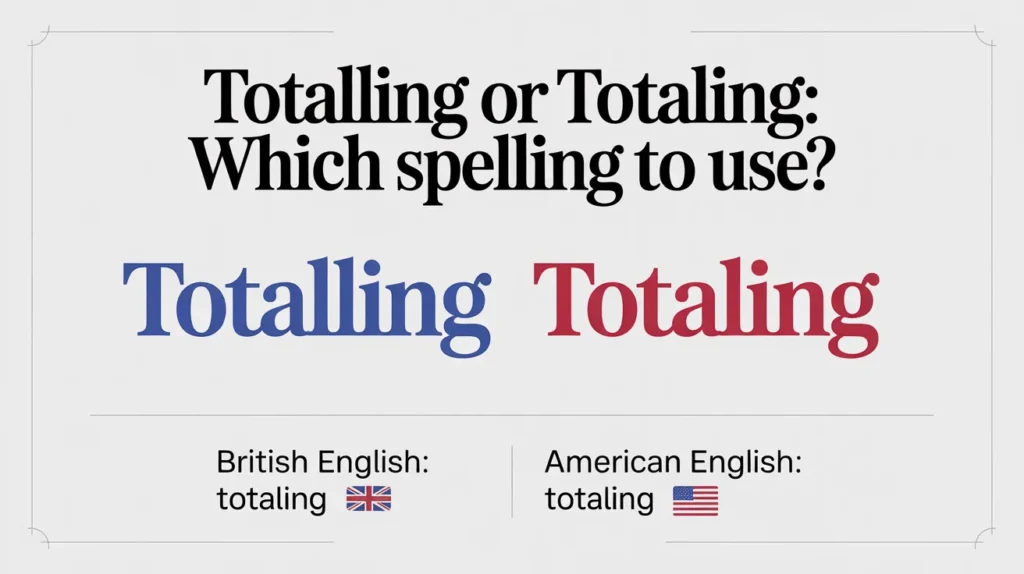
The bottom line: British English prefers totalling with double ‘l’, while American English uses totaling with a single ‘l’. Both are completely correct within their respective varieties of English.
Real-World Scenarios: When to Use Each Spelling
Let’s look at practical situations where you’d encounter this spelling decision.
Scenario 1: The International Business Email
Imagine you work for a multinational company. Your boss in Manchester emails asking for an update on project costs. You’re totalling the expenses from three different departments.
British English version (for UK colleagues):
“Good morning Rebecca,
I’m currently totalling all the expenses from the Manchester, Dublin, and Edinburgh offices. The preliminary figure is sitting at £47,500, but I’m still totalling some outstanding invoices from last week. I’ll have the complete breakdown on your desk by Thursday afternoon.”
Now, the same scenario but you’re reporting to your supervisor in Chicago:
American English version (for US colleagues):
“Good morning Rebecca,
I’m currently totaling all the expenses from our regional offices. The preliminary figure is sitting at $47,500, but I’m still totaling some outstanding invoices from last week. I’ll have the complete breakdown on your desk by Thursday afternoon.”
Notice how the only difference is that single letter? The message, tone, and professionalism remain identical.
Scenario 2: The Academic Research Paper
You’re a graduate student writing your dissertation. Your university is in Sydney, Australia (which follows British conventions), and you’re describing your methodology for calculating data.
British English approach:
“The research team began by totalling the survey responses from all 1,200 participants. After totalling the scores across five different categories, we noticed a significant pattern emerging in the third quartile.”
But if you’re studying at UCLA and writing for an American academic journal:
American English approach:
“The research team began by totaling the survey responses from all 1,200 participants. After totaling the scores across five different categories, we noticed a significant pattern emerging in the third quartile.”
Both versions would be accepted—as long as you’re consistent throughout your entire paper.
Scenario 3: The Accounting Department Memo
Picture this: You’re the finance manager, and you need to send a department-wide memo about quarterly procedures.
For a London-based company:
“All department heads are responsible for totalling their team’s expenses by the 25th of each month. When totalling these figures, please ensure you’re including both direct and indirect costs. The finance team will be totalling the company-wide expenditures the following week.”
For a New York-based company:
“All department heads are responsible for totaling their team’s expenses by the 25th of each month. When totaling these figures, please ensure you’re including both direct and indirect costs. The finance team will be totaling the company-wide expenditures the following week.”
Scenario 4: The Insurance Claim Report
An insurance adjuster is documenting damages after a storm. The context matters here because the spelling choice affects credibility with your audience.
British insurance company:
“After inspecting the property, I began totalling the damage to the roof, windows, and foundation. The initial assessment shows we’re totalling approximately £23,000 in covered damages.”
American insurance company:
“After inspecting the property, I began totaling the damage to the roof, windows, and foundation. The initial assessment shows we’re totaling approximately $23,000 in covered damages.”
Common Mistakes and How to Avoid Them
Mistake #1: Mixing Spellings in the Same Document
The problem: You start with “totalling” in paragraph one, then switch to “totaling” in paragraph four because autocorrect got involved.
The fix: Choose your spelling at the start based on your primary audience, then stick with it. If you’re writing for an international audience, pick one style guide (AP for American, Oxford for British) and follow it consistently.
Mistake #2: Assuming One Spelling is “Wrong”
The problem: You mark “totalling” as incorrect because your American spellchecker flags it, or you think “totaling” looks incomplete.
The fix: Understand that both spellings are legitimate. Your spellchecker reflects its language settings, not universal truth. British English isn’t outdated, and American English isn’t sloppy—they’re just different.
Mistake #3: Not Considering Your Audience
The problem: You’re writing content for a UK-based client but using American spellings throughout because that’s what you’re used to.
The fix: Know your audience. If you’re writing for British readers, use British spellings. If your company style guide specifies American English, use that version. When in doubt, ask.
Quick Memory Tricks
Struggling to remember which is which? Try these mental shortcuts:
The Currency Trick: If you see British pounds (£) in your document, think of the double ‘l’ in totalling. If you see American dollars ($), go with the single ‘l’ in totaling.
The Geography Trick: British English keeps extra letters (colour, honour, totalling). American English simplifies (color, honor, totaling).
The Stress Pattern Trick: Americans only double the final consonant when stress falls on the last syllable. Since we say “TO-tal” (not “to-TAL”), American English uses totaling.
Other Words That Follow the Same Pattern
If you’ve mastered totalling vs totaling, you’ve actually learned a pattern that applies to many words:
- travelling vs traveling
- modelling vs modeling
- cancelling vs canceling
- signalling vs signaling
- labelling vs labeling
The rule stays the same: British English doubles the ‘l’, American English doesn’t.
What About Other Forms of the Word?
The spelling difference extends beyond just the -ing form:
British English:
- totalled (past tense)
- totalling (present participle)
American English:
- totaled (past tense)
- totaling (present participle)
But here’s something both agree on: the base form is always total (one ‘l’), and totally (the adverb) uses double ‘l’ in both varieties.
Synonyms When You Want Variety
Sometimes you don’t want to use “totalling” or “totaling” repeatedly. Here are natural alternatives:
- Adding up: “She’s adding up the monthly expenses.”
- Calculating: “He’s calculating the final costs.”
- Summing: “We’re summing the quarterly results.”
- Counting: “They’re counting the votes now.”
- Tallying: “I’m tallying the receipts from last week.”
These alternatives work in both British and American English without spelling concerns.
The Final Word
So, should you use totalling or totaling? The answer isn’t about correctness—it’s about context and consistency.
Choose totalling when writing for British, Australian, Canadian, or other Commonwealth audiences. Choose totaling for American readers. And if you’re writing for a global audience? Pick one and stick with it throughout your entire document.
Remember, language serves communication. Whether you’re totalling expenses in pounds or totaling invoices in dollars, the goal is the same: clear, professional writing that your audience trusts. The spelling is just the wrapping paper—the substance of your message is what truly matters.
Next time you pause over that extra ‘l’, you’ll know exactly what to do. And that confidence? That’s worth more than any spelling debate.