
Have you ever been typing an email or working on an essay when you suddenly stopped and thought, “Wait, is it journeys or journies?” If so, you’re in good company. This seemingly simple question trips up countless writers, from students to professionals. The English language has a knack for throwing curveballs at us, and plural forms are one of its favorite ways to keep us guessing.
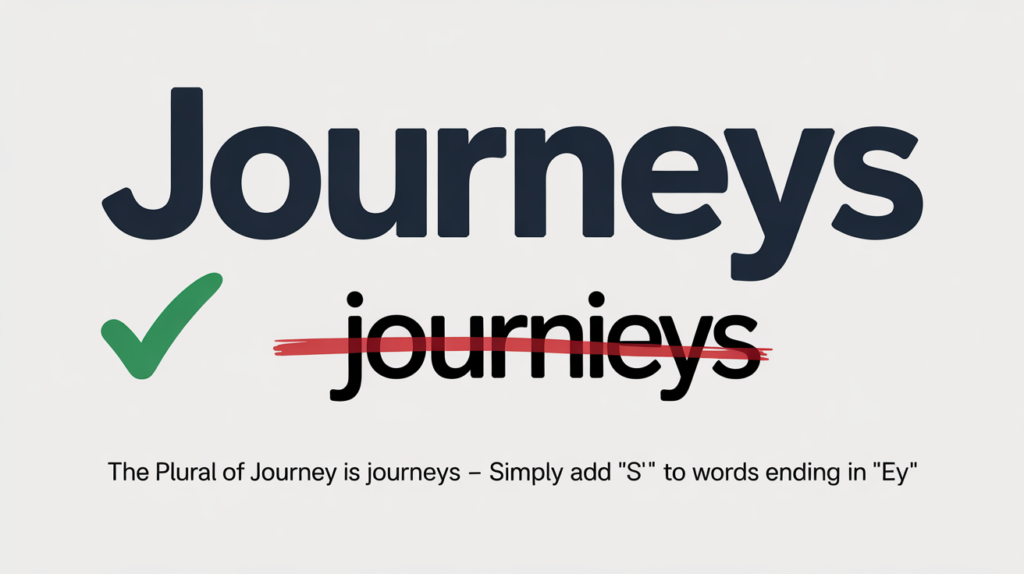
Let me clear this up for you right now: the correct plural of journey is journeys, not journies. But understanding why this is the case will help you avoid similar mistakes with other words. In this article, we’ll explore the spelling rules behind this plural form, look at real-world scenarios where you might use it, and give you the confidence to use this word correctly every single time.
Why the Confusion Between Journeys and Journies?
The confusion around journeys or journies isn’t random. It stems from a legitimate spelling pattern in English that many of us learned in school. Here’s the rule that causes all the trouble:
When a word ends in -y preceded by a consonant, you change the y to -ies to form the plural.
Think about words like:
- city → cities
- baby → babies
- party → parties
- story → stories
This pattern is so common that our brains automatically want to apply it to every word ending in -y. But here’s the catch: this rule doesn’t apply when the y follows a vowel.
The word “journey” ends in -ey, where the y follows the vowel “e”. In these cases, you simply add -s without changing anything else. That’s why we write journeys, not journies.
The Simple Rule That Solves Everything
Let me break down the plural of journey rule in the clearest way possible:
If a vowel (a, e, i, o, u) comes before the y, just add -s.
Examples:
- journey → journeys
- key → keys
- boy → boys
- valley → valleys
If a consonant comes before the y, change y to -ies.
Examples:
- city → cities
- baby → babies
- lady → ladies
- trophy → trophies
Once you internalize this pattern, you’ll never second-guess yourself again.
What Does Journey Actually Mean?
Before we dive deeper into usage, let’s make sure we understand what journey means. At its core, a journey is an act of traveling from one place to another, typically involving a considerable distance. But the beauty of this word is that it carries both literal and metaphorical weight.
Literal meaning: A physical trip or expedition. “We planned our journey through Southeast Asia for months.”
Metaphorical meaning: A process of personal growth, change, or development. “Her journey to becoming a doctor was filled with sacrifice and dedication.”
This dual nature makes “journey” one of the most versatile and evocative words in English. Writers love it because it implies movement, transformation, and purpose.
Real-World Scenario Examples
Let’s look at situations where you might need to use the plural form of journey correctly.
Scenario 1: Planning a Travel Blog Post
Imagine you’re a travel blogger writing about your adventures:
❌ Incorrect: “I’ve documented all my journies across South America on Instagram.”
✅ Correct: “I’ve documented all my journeys across South America on Instagram.”
In this context, you’re referring to multiple trips you’ve taken. Since journey follows the vowel + y pattern, you add -s to make it plural.
Scenario 2: Writing a College Essay
You’re applying to graduate school and need to discuss your academic path:
❌ Incorrect: “My academic journies have taught me the value of persistence.”
✅ Correct: “My academic journeys have taught me the value of persistence.”
Here, you’re using the metaphorical sense of journey to describe your educational experiences. The plural form is still journeys, never journies.
Scenario 3: Business Presentation
You’re presenting customer success stories to your team:
❌ Incorrect: “Let’s examine the customer journies that led to our highest satisfaction scores.”
✅ Correct: “Let’s examine the customer journeys that led to our highest satisfaction scores.”
In marketing and business contexts, “customer journey” is a popular term referring to the complete experience a customer has with a brand. When discussing multiple customers, you need the proper plural.
Scenario 4: Book Review
You’re reviewing a memoir for your book club:
❌ Incorrect: “The author’s journies through grief and healing were beautifully written.”
✅ Correct: “The author’s journeys through grief and healing were beautifully written.”
Literary discussions often use journey metaphorically to describe character development or thematic elements. Getting the spelling right matters, especially in written reviews.
Scenario 5: Social Media Caption
You’re posting a photo collage on Instagram:
❌ Incorrect: “Three years, five countries, countless journies. #wanderlust”
✅ Correct: “Three years, five countries, countless journeys. #wanderlust”
Even in casual social media posts, correct spelling helps you appear educated and thoughtful.
Other Words That Follow the Same Pattern
Understanding that journey isn’t alone in this pattern can reinforce the rule. Here are similar words where y follows a vowel, so you simply add -s:
- key → keys (not keies)
- boy → boys (not boies)
- toy → toys (not toies)
- alley → alleys (not alleies)
- monkey → monkeys (not monkeies)
- attorney → attorneys (not attorneies)
- donkey → donkeys (not donkeies)
- essay → essays (not essaies)
Notice the pattern? When you see -ey, -ay, or -oy at the end of a word, you know immediately that the plural will just add -s.
Common Mistakes to Avoid
Let me show you some frequently made errors and their corrections:
Example 1:
❌ “The book chronicles the hero’s journies across three continents.” ✅ “The book chronicles the hero’s journeys across three continents.”
Example 2:
❌ “Our company values the unique journies each employee brings to the table.” ✅ “Our company values the unique journeys each employee brings to the table.”
Example 3:
❌ “These spiritual journies changed their perspectives on life.” ✅ “These spiritual journeys changed their perspectives on life.”
Example 4:
❌ “I’ve saved money for future journies abroad.” ✅ “I’ve saved money for future journeys abroad.”
Synonyms to Enrich Your Writing
While it’s important to know the correct plural of journey, sometimes you want variety in your writing. Here are excellent alternatives:
- Trip – shorter, more casual travel
- Voyage – typically by sea, sounds more formal
- Expedition – suggests exploration or research
- Adventure – emphasizes excitement and risk
- Quest – implies searching for something specific
- Odyssey – suggests a long, eventful journey
- Trek – usually involves difficult terrain
- Pilgrimage – a journey with spiritual significance
Each synonym carries slightly different connotations, so choose based on the tone and context you need.
A Brief Look at the Etymology
Understanding where a word comes from can help it stick in your memory. Journey traces back to the 12th century, originating from the Old French word journée, which literally meant “a day’s work” or “a day’s travel.” This came from the Vulgar Latin diurnum, meaning “day,” derived from dies.
Originally, a journey referred specifically to the distance someone could travel in one day. Over centuries, the meaning expanded to include any travel regardless of duration, and eventually took on metaphorical meanings related to life experiences and personal growth.
The fact that journey has maintained its -ey spelling throughout this evolution means we maintain that same pattern when forming the plural today.
Quick Reference Guide
Here’s a handy table you can bookmark:
| Question | Answer |
|---|---|
| What is the plural of journey? | journeys |
| Is journies ever correct? | No, never |
| Why not journies? | The y follows a vowel (e) |
| What’s the rule? | Vowel + y = just add -s |
| What about consonant + y? | Change y to -ies (city → cities) |
Final Thoughts
The plural of journey is journeys, plain and simple. There’s no situation in English where “journies” is correct. By remembering that the y in journey follows a vowel, you’ll automatically know to just add -s.
This spelling rule extends beyond just this one word. Once you understand the vowel-before-y pattern, you’ll correctly pluralize dozens of other words without even thinking about it. Keys, boys, valleys, monkeys—they all follow the same logic.
Whether you’re writing about your travels, describing personal growth, or crafting professional documents, you can now use journeys with complete confidence. The English language may be full of exceptions and quirks, but this particular rule is actually quite straightforward once you know it.
So the next time you’re typing and that little moment of doubt creeps in, remember: if there’s a vowel before the y, just add -s. Your journeys through the complexities of English spelling just got a little bit easier.