
You’re typing an email to confirm a delivery, and suddenly you freeze. Should you write “I’ll pick up the package,” “arrange a pick-up time,” or mention the “pickup location”? Before you know it, you’ve spent five minutes Googling something that should be straightforward.
Here’s the thing: all three versions are correct, but they’re not interchangeable. Using the wrong form won’t cause a grammatical disaster, but it might make your writing look less polished than you’d like. The good news? Once you understand the pattern, you’ll never hesitate again.
Let me walk you through exactly when to use each version, with real-world examples that’ll stick in your memory.
The Quick Breakdown: Three Forms, Three Functions
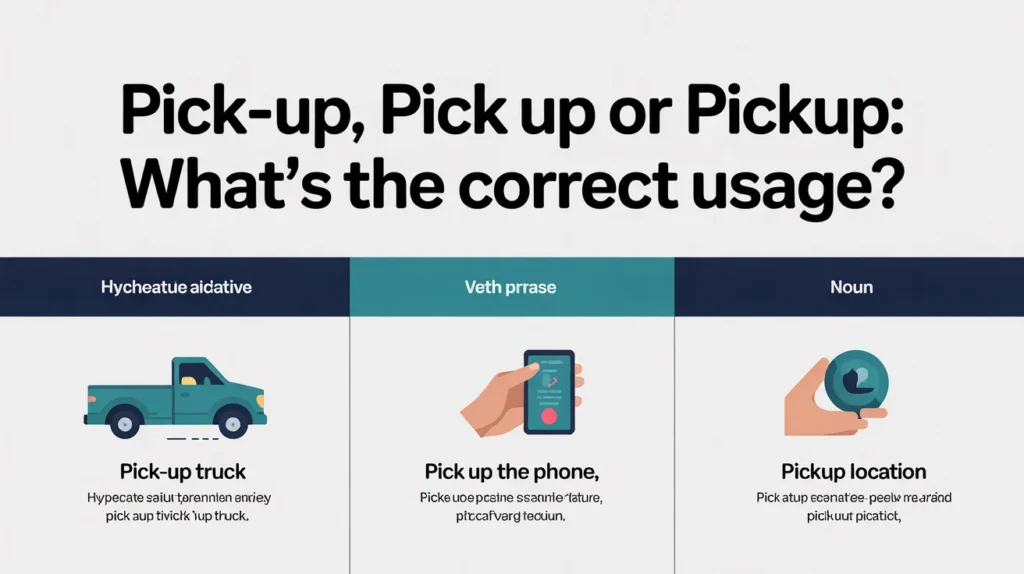
Think of pick up, pick-up, and pickup as triplets with distinct personalities. They look similar, but each has its own job:
Pick up (two words) works as a phrasal verb. It describes an action—the actual doing of something. When you’re telling someone to collect, retrieve, or lift something, this is your go-to form.
Pick-up (hyphenated) functions as an adjective or compound modifier. It describes or modifies another noun, typically appearing right before that noun. You’ll see this in phrases like “pick-up service” or “pick-up basketball.”
Pickup (one word, no hyphen) stands alone as a noun. It refers to a thing: a vehicle, an improvement in business, or even a type of game. When you’re naming something rather than describing an action, this is the version you want.
The confusion makes sense when you consider that English loves turning verb phrases into nouns over time. What started as two words eventually merges into one, often with a hyphenated stage in between.
When to Use “Pick Up” as a Verb Phrase
This version describes action in progress or action that needs to happen. If you can replace it with “collect,” “retrieve,” or “grab,” you’re probably dealing with the two-word phrasal verb.
Here’s a simple test: Can you split the words apart in a sentence? If yes, it’s the verb form.
- “I need to pick my daughter up from school.”
- “I need to pick up my daughter from school.”
Both work because it’s functioning as a verb phrase.
Everyday Scenarios Using “Pick Up”
Scenario 1: The Grocery Run
Sarah sends a quick text to her husband: “Can you pick up milk on your way home? We’re completely out.”
Her husband replies: “Sure, I’ll pick up a gallon. Need anything else?”
Notice how both uses describe an action—the physical act of getting something from the store.
Scenario 2: The Office Request
Email Subject: Quick Favor?
Hey Marcus,
I left some documents on my desk that I need for tomorrow’s meeting. Would you mind swinging by the office to pick up those files? I’d really appreciate it. Just grab the blue folder near my computer.
Let me know if that works!
Thanks, Jennifer
Here, “pick up” clearly indicates an action Marcus needs to perform.
Scenario 3: Learning a New Skill
“My daughter seems to pick up languages incredibly fast. She started learning Spanish three months ago and she’s already having basic conversations.”
In this case, “pick up” means to learn or acquire something, but it’s still functioning as a verb phrase describing what she does.
When to Use “Pick-Up” as an Adjective
The hyphenated version shows up when you’re modifying or describing another noun. It typically appears directly before that noun, creating a compound adjective.
The hyphen signals to readers that these two words are working together as a single descriptive unit. Without it, the meaning could become unclear.
Real-World Examples of “Pick-Up” as a Modifier
Scenario 1: Hotel Confirmation Email
Subject: Your Reservation Confirmation
Dear Mr. Rodriguez,
Thank you for booking with Coastal Suites. Your reservation details are below:
- Check-in: Friday, March 15th
- Pick-up service: Complimentary airport shuttle available
- Pick-up time: Please confirm your flight arrival time
- Pick-up location: Meet your driver at Terminal 2, Door 5
We look forward to welcoming you!
Best regards, The Coastal Suites Team
Notice how “pick-up” modifies “service,” “time,” and “location.” It’s describing the type of service, not performing an action.
Scenario 2: School Transportation Notice
Attention Parents:
Due to construction on Maple Street, we’ve changed our afternoon pick-up procedures. The new pick-up zone will be on the east side of the building. Pick-up hours remain 3:00-3:30 PM.
Please use the designated pick-up lane and display your identification placard.
Each instance uses the hyphenated form because it’s modifying another noun (procedures, zone, hours, lane).
Scenario 3: Sports Context
“We organize pick-up basketball games every Saturday morning at the community center. It’s super casual—just show up and play.”
“Pick-up games” refers to informal, spontaneous sporting events. The hyphen joins these words to create a compound adjective describing the type of game.
When to Use “Pickup” as a Noun
The single-word version names something. It’s not describing an action or modifying another word—it’s standing on its own as the subject or object of a sentence.
Common Uses of “Pickup” as a Noun
Scenario 1: Vehicle Shopping
Text conversation:
James: I’m thinking about buying a new vehicle. What do you think about trucks?
Rachel: A pickup might be perfect for you, especially with all those camping trips you take. Have you looked at the new Ford models?
James: Yeah, I test-drove a pickup truck last weekend. The cargo space is incredible.
Here, “pickup” is a noun referring to a type of vehicle. You could also say “pickup truck” where “pickup” functions as a noun modifier of “truck.”
Scenario 2: Business Performance Report
Quarterly Meeting Notes:
“We’ve seen a significant pickup in online sales since launching the new website. The pickup began in early February and has continued steadily throughout the quarter. Marketing attributes this pickup to improved mobile optimization and faster checkout processes.”
In business contexts, “pickup” means an increase or improvement—it’s a noun describing a thing that happened, not the action itself.
Scenario 3: Delivery Service
Customer Service Call:
Customer: “I need to arrange a pickup for my package return.”
Representative: “Absolutely! I can schedule a pickup for tomorrow between 10 AM and 2 PM. The driver will handle everything—you just need to have the package ready.”
Wait—shouldn’t this be “pick-up“? Actually, both forms are acceptable as nouns in American English. You’ll see “pickup” (one word) used more frequently in American English, while British English tends to favor “pick-up” (hyphenated) even when it’s a noun. The one-word version has become increasingly standard, especially in logistics and delivery contexts.
The Tricky Part: When “Pickup” Can Be Hyphenated
Here’s where things get slightly complicated. In American English, there’s been a shift toward using pickup (one word) even in some adjectival contexts. You might see “pickup truck” written as two separate words without a hyphen.
Why? Because “pickup truck” has become such a common phrase that it functions as a fixed compound noun. Think of it like “fire truck” or “dump truck”—you don’t hyphenate those either.
However, for consistency and clarity, especially in professional writing, the hyphenated form (pick-up) before other nouns is still preferred: pick-up service, pick-up time, pick-up location.
Common Mistakes and How to Avoid Them
Mistake #1: Using “pickup” as a verb
❌ Wrong: “I’ll pickup the kids from soccer practice.”
✅ Correct: “I’ll pick up the kids from soccer practice.”
Remember: if it’s an action, split it into two words.
Mistake #2: Forgetting the hyphen in compound adjectives
❌ Wrong: “What’s the pick up time for the event?”
✅ Correct: “What’s the pick-up time for the event?”
The hyphen shows these words are working together to modify “time.”
Mistake #3: Hyphenating the vehicle noun
❌ Less common: “He drives a red pick-up truck.”
✅ More standard: “He drives a red pickup truck.”
While both versions appear in print, the one-word noun form has become standard in American English.
Helpful Memory Tricks
For “pick up” (verb): Can you physically do it? If yes, keep it as two words. “I can pick up a book” versus “I own a pickup truck.”
For “pick-up” (adjective): Does it come right before another noun? Add the hyphen. “Pick-up basketball” or “pick-up service.”
For “pickup” (noun): Is it a thing you can point to or measure? Use one word. “That’s my pickup” or “We saw a pickup in sales.”
Why This Matters in Professional Communication
In casual texts or social media, mixing these up probably won’t cause confusion. But in professional settings—emails to clients, business reports, formal correspondence—using the correct form shows attention to detail.
Imagine you’re a delivery company sending customer confirmations. Writing “Your pickup service is scheduled” instead of “Your pick-up service is scheduled” isn’t technically wrong, but the hyphenated form is more precise and grammatically traditional.
Bottom Line: Context Is Everything
The difference between pick up, pick-up, and pickup isn’t about memorizing arbitrary rules. It’s about understanding function: Is it describing action (verb), modifying something (adjective), or naming something (noun)?
Once you see the pattern, it becomes second nature. You wouldn’t say “I need to pickup my laundry” any more than you’d write “I drive a pick up.” Your brain already knows the difference—you just needed someone to map it out clearly.
So next time you’re drafting that email or text, take a quick second to ask yourself: Am I describing an action, modifying a noun, or naming a thing? The answer will tell you exactly which form to use.