
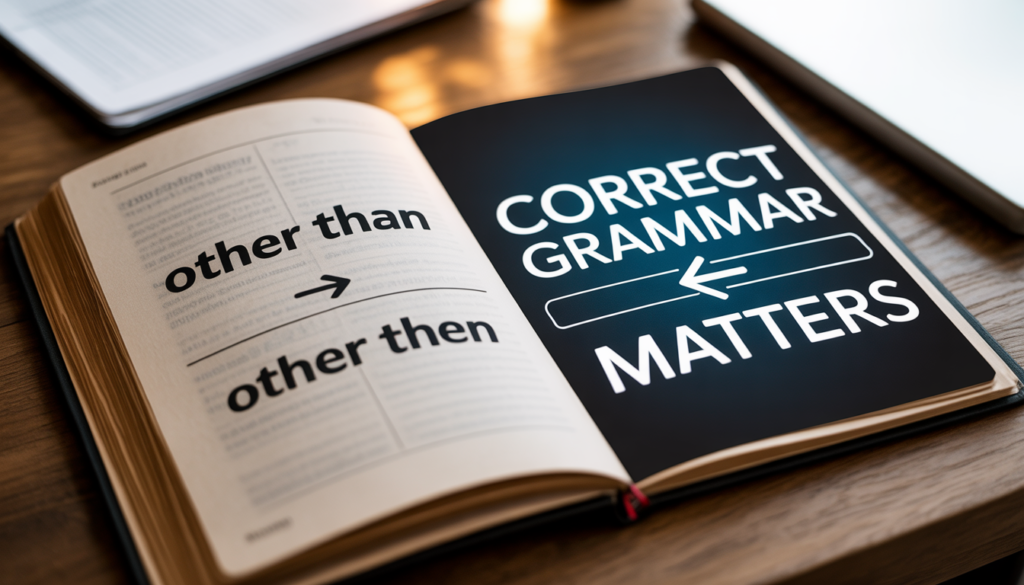
You’ve probably scrolled through social media, read an email from a colleague, or glanced at a blog post and spotted it: “other then” instead of other than. It’s one of those tiny mistakes that sneaks in everywhere, yet it can make even the most confident writer look careless. In professional emails, job applications, academic papers, or even casual texts, getting this wrong subtly undermines your message. The good news? Once you understand the difference, it becomes second nature to pick the right one every time.
Let’s break it down clearly, with real-world scenario examples, so you can spot the error instantly and write with more confidence.
The Quick Answer You Need Right Now
Other than is the correct phrase in standard English. Other then is almost always a grammatical mistake.
The mix-up happens because than and then are homophones—they sound virtually identical in everyday speech, especially when spoken quickly. Add in fast typing or autocorrect playing tricks, and “other then” slips through. But grammatically, they serve completely different roles.
Why Do People Mix Up “Other Than” and “Other Then”?
The confusion is understandable. Here’s why it trips so many people up:
- Than and then look nearly the same.
- In casual conversation, they blend together (think: “I’d rather have tea then coffee”—no, wait!).
- Spell-checkers sometimes miss it because both are real words—just not together in that order.
- Muscle memory from typing quickly takes over, and one wrong keystroke changes everything.
But beneath the surface, these words have distinct purposes in English grammar.
Understanding “Than” vs. “Then”
To fix the phrase, first nail the root words.
Than is all about comparison or exception. It acts as a conjunction or preposition that sets one thing apart from another.
Examples:
- She runs faster than her brother.
- I’d prefer staying home rather than going out in the rain.
Then deals with time, sequence, or consequence. It’s an adverb that answers “when?” or “what next?”
Examples:
- Finish your homework, then you can play video games.
- Back then, life felt simpler.
Simple rule: If the sentence involves excluding or contrasting, go with than. If it’s about timing or order, use then.
Why “Other Than” Wins Every Time
Other than is a fixed prepositional phrase meaning except for, besides, apart from, or in addition to (depending on context). It highlights an exception within a larger group or idea.
Correct examples in everyday use:
- Everyone in the office loved the new policy other than Sarah, who thought it was too strict.
- I don’t watch much TV other than documentaries on weekends.
See how it excludes one item cleanly? That’s the job of than here.
Why “Other Then” Almost Never Works
Combining other (which sets up contrast or exception) with then (which signals sequence) creates a grammatical clash. It’s like trying to use a fork as a spoon—technically possible in a pinch, but awkward and wrong in standard use.
Incorrect examples you’ll see online or in emails:
- No one showed up other then Mike.
- I have nothing planned other then relaxing tonight.
These feel off because then pulls the sentence toward time/order instead of exception. Readers pause, reread, and lose trust in the writer’s attention to detail.
Rare Cases Where “Other Then” Might Appear (But Isn’t the Phrase You Think)
Technically, other and then can sit next to each other in a sentence if they belong to separate parts:
- We covered marketing first, other strategies then followed in the meeting.
Here, other modifies “strategies,” and then marks sequence. But this is not the idiomatic phrase other then—it’s coincidental adjacency. In 99.9% of cases, if someone writes “other then” intending exception, it’s flat-out wrong.
Real-Life Scenario Examples to Make It Stick
Let’s see these in practical situations where the choice really matters.
Scenario 1: Professional Email (Correct vs. Incorrect)
Correct: Subject: Feedback on the Proposal Hi Team, We’ve incorporated most of your suggestions other than the budget reallocation, which needs further approval from finance. Let me know your thoughts. Best, Alex
Incorrect version (that undermines professionalism): Hi Team, We’ve incorporated most of your suggestions other then the budget reallocation…
That single slip makes the sender seem rushed or inattentive—exactly what you don’t want in client or boss communication.
Scenario 2: Social Media Post or Text Message
Correct: “Just got back from vacation. No souvenirs other than a killer tan and too many photos 😂”
Incorrect: “Just got back from vacation. No souvenirs other then a killer tan…”
Even in casual writing, the wrong version looks sloppy and pulls focus from the fun vibe.
Scenario 3: Job Application or Resume Cover Letter
Correct: “I have experience in project management other than software development, where I’m still building skills.”
Incorrect: “I have experience in project management other then software development…”
Hiring managers notice these things. Small errors suggest weak proofreading, which can hurt credibility when competing for roles.
Scenario 4: Academic or Blog Writing
Correct: “The study found positive results across all groups other than participants over age 65, who showed no significant change.”
Incorrect: “The study found positive results across all groups other then participants over age 65…”
In formal contexts, precision matters. One wrong word can make readers question the entire argument.
The Common Trap: “Other Than That” vs. “Other Then That”
Another frequent variation is other than that (meaning “aside from that” or “apart from this”).
Correct: The car runs smoothly. Other than that, everything checks out.
Incorrect: The car runs smoothly. Other then that, everything checks out.
This one sneaks in because “then” feels chatty, but grammar doesn’t care about vibe—stick with than.
Quick Comparison Table
| Phrase | Correct? | Meaning | Example |
|---|---|---|---|
| other than | Yes | exception/exclusion | Everyone came other than Tom. |
| other then | No | grammatical error | ❌ Everyone came other then Tom. |
| other than that | Yes | aside from that | Other than that, looks good. |
| other then that | No | error | ❌ Other then that, looks good. |
Mnemonic to Never Forget Again
Here’s an easy hook: Than compares (or excludes). Then times (or sequences).
If you can swap in except for, besides, or apart from, use than. If you mean next or afterward, use then.
Test it: “No choice except for leaving” → other than leaving. “No choice next leaving” → doesn’t make sense, so other then is wrong.
Why This Tiny Mistake Matters More Than You Think
In today’s world of quick emails, instant messages, and online everything, grammar signals competence. A repeated other then mistake suggests:
- Rushed work
- Poor editing habits
- Lack of detail orientation
In resumes, client pitches, or published content, these perceptions can cost opportunities. Clear, precise writing builds trust fast.
Proofreading Tips to Catch It Every Time
- Read aloud: Awkward spots jump out when spoken.
- Search for “then”: Scan documents for “other then” specifically.
- Use tools smartly: Grammarly or similar flags this often, but always double-check context.
- Practice replacements: When in doubt, rewrite with except for—if it fits, other than is your winner.
Final Takeaway
Other than is correct for exceptions and exclusions. Other then is a common slip that almost never belongs in standard English.
Master this, and your writing sharpens instantly. Next time you type that phrase, pause for a split second. Choose wisely. Your words will carry more weight, sound more polished, and—best of all—feel authentically you.