
We’ve all been there. You’re typing a quick email to your colleague, responding to a friend’s text, or drafting an important message, and suddenly you pause. Is it “of course” or “ofcourse”? Your fingers hover over the keyboard as doubt creeps in. After all, when you say it out loud, it sounds like one smooth word. So why wouldn’t it be spelled that way?
This seemingly small question trips up even confident writers. The confusion makes sense—English pronunciation doesn’t always match spelling, and plenty of words that sound connected actually are (like “therefore” or “nevertheless”). But here’s the simple truth: only one spelling is correct, and using the wrong one can make your writing look careless.
Let’s settle this once and for all. By the end of this guide, you’ll know exactly which form to use, why the confusion exists, and how to avoid this common mistake in every piece of writing you produce.
The Correct Answer: Of Course or Ofcourse?
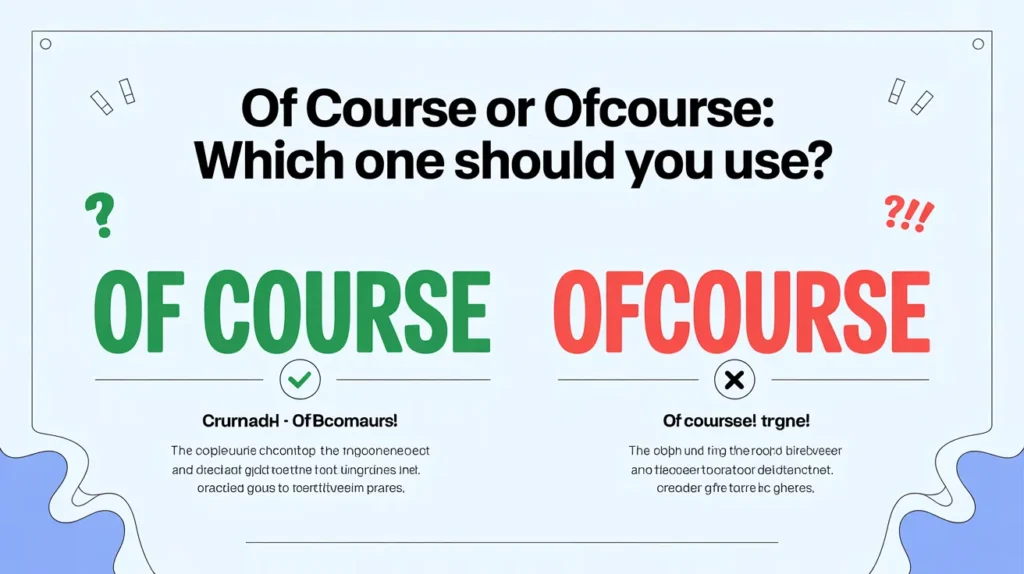
Let’s cut straight to it: of course is always written as two separate words.
The single-word version, “ofcourse,” is not a word in English. You won’t find it in any reputable dictionary—not Merriam-Webster, not Oxford, not Cambridge. It’s simply a misspelling of of course that has persisted because of how we pronounce the phrase.
Think of it this way:
- Of = a preposition indicating relationship or possession
- Course = a noun meaning direction, path, or series of actions
When combined, these two words create a phrase that means “certainly,” “naturally,” or “as expected.” But they never merge into one.
So if you’ve been writing “ofcourse” in your emails, texts, or documents, it’s time to break that habit. Your spell-checker might not always catch it (especially in quick messages), but readers who know proper English usage definitely will.
Why This Confusion Exists in the First Place
English is notoriously tricky, and the of course vs ofcourse debate is a perfect example of why. When we speak, we don’t pause between “of” and “course.” The words flow together smoothly, almost as if they’re one unit. This natural speech pattern tricks our brains into thinking they should be written together too.
Adding to the confusion is the existence of genuine compound words in English. We write “notebook,” not “note book.” We write “somewhere,” not “some where.” Given these patterns, assuming “ofcourse” follows the same rule seems logical. But English doesn’t always follow logic, does it?
There’s another layer to this confusion: the phrase “off course,” which actually exists and has a completely different meaning. Let’s clarify:
- Of course = definitely, naturally, certainly (Example: “Of course I’ll help you move.”)
- Off course = not on the intended path or route (Example: “The plane went off course during the storm.”)
Notice that “off course” is also two words, but it uses “off” instead of “of.” And before you ask—yes, “offcourse” as one word is also incorrect. The spelling matters because the meaning changes entirely.
What Does “Of Course” Actually Mean?
Of course is what linguists call an adverbial phrase—a group of words that modifies a verb, adjective, or entire sentence. It serves several purposes in communication:
Expressing Certainty or Agreement
When someone asks if you’re available Friday night, responding with “of course” signals complete agreement without hesitation. It’s stronger than “yes” but more casual than “absolutely” or “certainly.”
Acknowledging the Obvious
Sometimes of course introduces information that should be self-evident. “Of course, you should save your work before shutting down your computer.” It gently reminds someone of something they probably already know.
Granting Permission Politely
“Can I borrow your notes?” “Of course!” In this context, of course makes permission sound warm and generous rather than grudging or hesitant.
Softening Statements
Compare these two sentences:
- “I’ll finish the report by Monday.”
- “Of course, I’ll finish the report by Monday.”
The second version sounds more reassuring and confident, doesn’t it? That’s the subtle magic of this phrase.
Real-World Scenarios: Of Course in Action
Let’s look at how of course functions in actual communication situations. These examples will show you the natural rhythm and placement of this phrase.
Scenario 1: Professional Email Response
Subject: Question About Project Timeline
Hi Marcus,
Thank you for reaching out about the Q2 deliverables. Of course, I can provide you with the updated timeline by end of day tomorrow. I’ve been working closely with the development team, and we’re on track to meet the original deadline.
Of course, if anything changes, I’ll notify you immediately. Please let me know if you need any additional information.
Best regards, Sarah
Why this works: The phrase appears naturally in two different contexts—granting a request and offering reassurance. It makes Sarah sound helpful and professional without being overly formal.
Scenario 4: Academic or Formal Writing
“The study yielded significant results. Of course, these findings must be replicated in larger sample sizes before drawing definitive conclusions. The researchers noted that, of course, external variables could have influenced the outcome.”
Why this works: Even in formal writing, of course helps connect ideas and acknowledge limitations or obvious considerations.
Common Mistakes People Make (And How to Fix Them)
Let’s address the typical errors surrounding this phrase and their corrections:
Mistake #1: Writing It as One Word
Wrong: “Ofcourse I’ll attend the meeting.”
Right: “Of course I’ll attend the meeting.”
The fix: Always use two separate words. No exceptions.
Mistake #2: Confusing “Of Course” with “Off Course”
Wrong: “Of course, the ship deviated from its path.”
Right: “Off course, the ship deviated from its path.”
The fix: If you’re talking about direction or navigation (literal or metaphorical), use “off course.” For everything else, use “of course.”
Mistake #3: Overusing the Phrase
Awkward: “Of course, I’ll help you. Of course, I have time. Of course, it’s no problem.”
Better: “I’ll help you—I have time, and it’s no problem.”
The fix: While of course is useful, repeating it too often makes your writing sound robotic. Mix in alternatives like “certainly,” “absolutely,” or “naturally.”
Alternatives to Keep Your Writing Fresh
Variety makes writing more engaging. Here are some synonyms for of course you can rotate through:
- Certainly – slightly more formal
- Absolutely – adds emphasis
- Definitely – sounds confident
- Naturally – implies something is expected
- Without a doubt – very emphatic
- Sure – casual and friendly
- Indeed – formal and literary
- By all means – granting strong permission
Example transformation:
Original: “Of course, I can review your proposal. Of course, I’ll have feedback by Friday.”
Revised: “Certainly, I can review your proposal. I’ll definitely have feedback by Friday.”
The Historical Journey of “Of Course”
Here’s something interesting: the phrase of course has nautical origins. Centuries ago, sailors used “of course” to mean “on the natural course” or “following the expected route.” A ship traveling “of course” was going exactly where it should be.
Over time, this literal meaning evolved into our modern figurative usage. When something happens “of course,” it follows the natural or expected path—not of a ship, but of logic or social norms. Pretty cool how language transforms, right?
Why Getting This Right Actually Matters
You might think, “Does anyone really care about this distinction?” The answer is: yes, especially in professional contexts.
Small errors signal bigger problems. When you write “ofcourse” in a business email, it doesn’t just show a spelling mistake—it suggests you haven’t paid attention to detail. In competitive fields, that tiny error could be the difference between looking polished and looking careless.
Credibility depends on correctness. If you’re building a personal brand, writing articles, or managing client communications, proper spelling builds trust. Readers may not consciously notice when you spell of course correctly, but they’ll definitely notice when you don’t.
Professional writing standards matter. In formal documents, proposals, or academic papers, nonstandard spellings like “ofcourse” can actually affect your grades or credibility ratings.
Quick Memory Tricks
Having trouble remembering? Try these mental shortcuts:
The Space Trick: If you can fit a word between “of” and “course,” they’re separate words. “Of the course” makes sense (referring to a path or class), so “of course” stays separated.
The Compound Test: Real compound words usually can’t be separated without losing meaning. “Notebook” doesn’t work as “note book.” But “of course” can be analyzed as two meaningful words, so they stay apart.
The Autocorrect Reality Check: Most word processors won’t flag “ofcourse” because they might think it’s a typo or name. Don’t trust autocorrect alone—learn the rule.
Final Thoughts: Make the Right Choice
So, is it of course or ofcourse? By now, the answer should be crystal clear: always use of course as two separate words. This isn’t a matter of style or personal preference—it’s standard English spelling.
Every time you write it correctly, you’re demonstrating attention to detail and respect for your readers. Every time you choose of course over the incorrect “ofcourse,” you’re building credibility in your communication.
The next time you’re drafting an email, responding to a text, or writing anything important, take that extra second to check. Your writing—and your professional image—will be better for it.
Of course, you’ve got this now.