
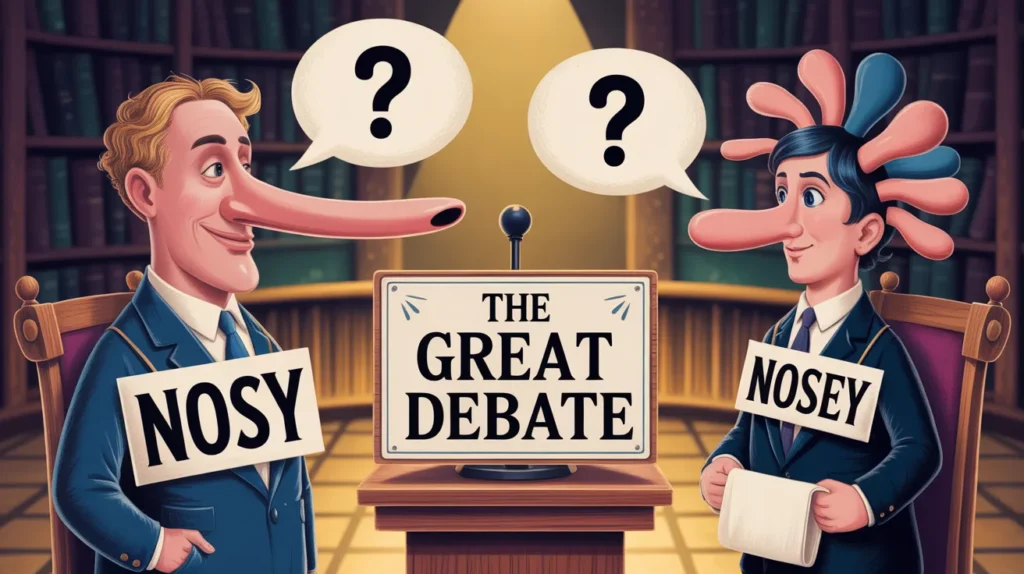
You’re typing out a message to a friend about your overly inquisitive neighbor, and suddenly you stop. Is it nosy or nosey? Both look familiar. Both feel right. And yet, something makes you second-guess yourself before hitting send.
This is one of those small but surprisingly persistent spelling dilemmas that catches even confident writers off guard. The good news is that this isn’t really a matter of one being right and the other being wrong. It’s more nuanced than that — and once you understand the why behind each spelling, you’ll never hesitate again.
What Do “Nosy” and “Nosey” Actually Mean?
Before diving into the spelling debate, let’s get grounded in meaning. Both nosy and nosey describe the same type of person — someone who pokes into other people’s business a little more than they should. We’re talking about the colleague who hovers near your desk when you’re on a personal call, or the relative who always asks about your salary at holiday dinners.
The word itself carries a mildly negative tone. It’s not the harshest insult in the English language, but it does signal intrusive behavior — curiosity that crosses the invisible line between genuine interest and outright prying.
So if the meaning is the same, what’s actually different? The answer comes down to geography, convention, and audience.
American English vs. British English: A Spelling Divided
This is the heart of the debate. American English strongly favors the spelling nosy — clean, compact, and consistent with the way Americans typically handle adjectives ending in a vowel sound. You’ll find this version in U.S. dictionaries, news outlets, academic writing, and everyday digital communication.
British English, on the other hand, leans toward nosey. This spelling shows up regularly in U.K. publications, literature, and casual conversation. Australia, New Zealand, and other Commonwealth countries tend to follow the British preference as well.
Neither version is grammatically incorrect in an absolute sense. What matters is consistency and context — writing for an American audience while using “nosey” might feel slightly off, and vice versa.
Real-Life Scenario Examples
This is where things get interesting. Let’s look at how these words play out in actual situations, because understanding usage through real examples sticks far better than any rulebook.
Scenario 1: The Workplace Email
Imagine you’re a team lead at a company in Chicago, and you want to give a new hire a gentle heads-up about a curious coworker.
“Hey Daniel, just wanted to give you a quick heads-up — Marcus can be a bit nosy about ongoing projects. You might want to avoid discussing confidential details near his desk until things are finalized.”
This feels natural, professional, and perfectly suited for an American work environment. Now flip the setting to a London office:
“Hi Daniel, fair warning — Marcus tends to be quite nosey around anything project-related. Worth keeping sensitive details close to your chest for now.”
Same message. Same meaning. Different spelling — and each feels right at home in its respective cultural setting.
Scenario 2: The Family Group Chat
Family dynamics are a goldmine for this word. Picture a sibling texting the family group chat before a surprise party:
“Can everyone PLEASE not tell Gran about the party?? She’s so nosy, she’ll have it figured out by Tuesday.”
This is casual, warm, and unmistakably American in its tone. A British cousin sending the same message might write:
“Don’t breathe a word to Nan — you know how nosey she gets. She’ll have the whole thing worked out before the weekend.”
Both are conversational and accurate. The spelling shifts, but the affection (and mild exasperation) comes through either way.
Scenario 3: A Formal Report
This scenario is where spelling consistency really matters. Suppose a human resources professional in Sydney is documenting a workplace incident:
“Several employees demonstrated nosey behavior during the confidential review process, which created unnecessary disruption and raised concerns about data privacy.”
Because this is a formal document prepared in Australia — a Commonwealth country — nosey fits the regional standard. Using nosy here wouldn’t be wrong, but it might raise an eyebrow or two from an Australian reader.
Scenario 4: Social Media
Social media blurs regional lines more than almost any other platform, since your audience could be anywhere. That said, your own natural spelling preference tends to shine through.
“My neighbor is SO nosy. She was literally staring at my Amazon delivery from across the street. 👀”
This kind of post reads as authentically American. A British user might express the same frustration as:
“My neighbour is absolutely nosey, been clocking every parcel that arrives at my door for weeks now.”
Note that even “neighbour” vs. “neighbor” follows the same regional pattern — British English holds onto that extra ‘u’, just as it holds onto the ‘e’ in nosey.
Common Mistakes Writers Make
One of the most frequent errors isn’t choosing the wrong regional spelling — it’s mixing both spellings in the same piece of writing. Using “nosy” in paragraph two and “nosey” in paragraph seven signals carelessness, and it quietly undermines your credibility as a writer.
Another common slip is assuming nosey is simply a misspelling of nosy. Many American spell-checkers will flag “nosey” as incorrect, which reinforces this misconception. But it’s not a typo — it’s a legitimate regional variant with a long history in British English.
Pronunciation: Does It Even Change?
Here’s one thing both sides of the Atlantic agree on completely — the pronunciation is identical. Whether you write nosy or nosey, you say it the same way: /ˈnoʊ.zi/. The extra ‘e’ in nosey is purely a spelling convention. It doesn’t affect how the word sounds in speech.
This is actually useful to know, because it means in spoken conversation, this debate is entirely invisible. It only surfaces the moment pen meets paper — or fingers meet keyboard.
How to Choose the Right Spelling Every Time
When you’re unsure which spelling to use, ask yourself three quick questions:
Who is my audience? If you’re writing for American readers, go with nosy. For British, Australian, or Commonwealth audiences, nosey is the safer bet.
What does the style guide say? Many publications and companies have house style guides that specify preferred spellings. Always defer to those when they exist.
Am I being consistent? Whichever spelling you choose, stick with it throughout the entire piece. Consistency signals professionalism and attention to detail.
A Quick Note on “Nosy” as a Personality Trait vs. a Momentary Action
There’s also a subtle difference worth mentioning in how people use this word beyond just spelling. Calling someone “a nosy person” implies it’s a defining characteristic — part of who they are. But saying someone “is being nosy” in a specific situation is gentler; it suggests a temporary behavior rather than a permanent label.
This distinction matters in sensitive conversations. If you’re addressing the behavior of a colleague or family member, framing it as situational rather than identity-based tends to land better and cause less friction.
Final Thoughts: It’s Not About Being Right or Wrong
The nosy vs. nosey debate isn’t one that needs a winner. Both spellings are correct within their respective regional contexts. What separates good writers from careless ones isn’t always knowing every rule — it’s knowing why the rules exist and who they’re written for.
The next time you pause mid-sentence wondering which version to use, remember: location matters, audience matters, and consistency matters most of all. Whether you land on nosy or nosey, use it with intention — and you’ll always come across as someone who genuinely knows their craft.
And honestly? The fact that you stopped to think about it at all means you’re already paying closer attention to language than most people ever do. That’s never a bad thing.