
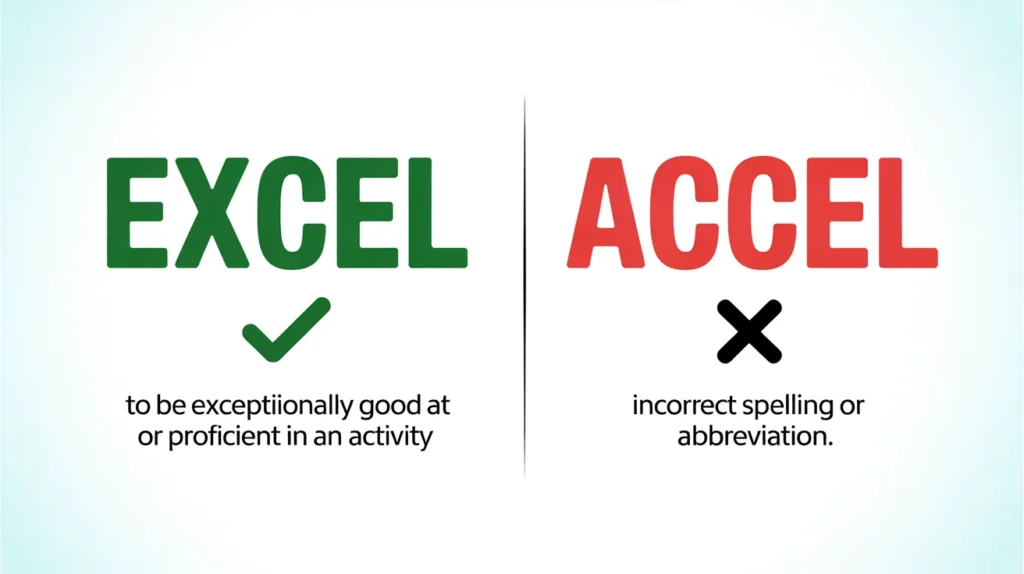
If you’ve ever paused mid-sentence wondering whether to write “excel” or “accel,” you’re not alone. These two words sound remarkably similar, yet they carry completely different meanings. Using the wrong one can make your writing look careless, especially in professional or academic settings.
Let me clear this up for you once and for all.
The Simple Answer: Excel Is Correct
When you want to express that someone performs exceptionally well or surpasses others in achievement, the correct word is excel. This verb comes from Latin excellere, which means “to rise above” or “to be superior.”
Here’s a straightforward example:
“Sarah worked diligently to excel in academics and earned a scholarship to her dream university.”
Now, what about “accel”? Well, accel isn’t actually a standard English verb. It’s simply an abbreviation for “accelerate,” meaning to increase speed. You’ll encounter it in casual conversations about cars, gaming, or technology, but it doesn’t belong in formal writing.
Consider this example:
“The sports car’s accel from 0 to 60 mph is absolutely breathtaking.”
The bottom line? Use excel when discussing achievement and performance. Reserve accel for informal contexts involving speed and acceleration.
Understanding the Core Difference
Let’s break down what makes these words distinct:
Excel = To perform at an exceptionally high level, to outperform others, to demonstrate outstanding ability.
Accel = A shortened form of “accelerate,” referring to increasing velocity or speeding something up.
Think of it this way: excel is about excellence, while accel is about acceleration. They’re not interchangeable, even though they might sound similar when spoken quickly.
When Should You Use Excel?
The word excel appears in numerous contexts where achievement and superior performance matter. Here are the most common situations:
Academic and Educational Settings
Students and educators frequently use “excel” when discussing scholastic achievement:
“Marcus demonstrates exceptional problem-solving ability and consistently excels in mathematics courses.”
“The school’s mission is to help every student excel academically while developing strong character.”
Professional and Career Contexts
In the workplace, excelling relates to career success and professional performance:
“Our company culture encourages employees to excel in innovation and pursue continuous improvement.”
“Jennifer’s ability to excel in leadership skills made her the obvious choice for the promotion.”
Sports and Athletic Achievement
Athletes and coaches talk about excelling in sports performance:
“With dedicated training, young athletes can excel in sports and reach their full potential.”
“The team captain excels at motivating her teammates during challenging matches.”
Creative and Artistic Pursuits
Artists, musicians, and creative professionals also excel:
“David’s determination to excel in artistic talent led him to study under renowned masters.”
“She excels at graphic design and has won multiple industry awards.”
When Might You Use Accel?
While accel isn’t appropriate for formal writing, it does appear in specific informal contexts:
Automotive and Racing Discussions
Car enthusiasts often shorten “acceleration” to “accel”:
“The new electric vehicle’s accel is incredible—it reaches highway speeds in under three seconds.”
“Drag racers obsess over every detail that might improve their car’s accel curve.”
Gaming Communities
Gamers frequently use “accel” when discussing character abilities or vehicle performance:
“This upgrade gives your character better accel stats, making it easier to dodge attacks.”
“The motorcycle in this game has insane accel but poor handling.”
Technical and Engineering Conversations
Engineers might use “accel” as shorthand in casual workplace discussions:
“We need to improve the accel on this prototype before the next round of testing.”
Real-World Scenario Examples
Let me show you how these words function in actual situations.
Scenario 2: College Recommendation Letter
To the Admissions Committee,
I’m delighted to recommend Lisa Chen for admission to your engineering program. Throughout her four years at our school, Lisa has consistently demonstrated the drive to excel academically while maintaining impressive extracurricular involvement.
Her outstanding performance in advanced physics and calculus courses reflects not just intelligence, but genuine passion for language acquisition in technical fields. Lisa doesn’t simply complete assignments—she seeks to excel in innovation by approaching problems from creative angles.
Beyond academics, Lisa excels in leadership skills as president of our Robotics Club, where she mentored younger students and led the team to regional championships. Her ability to excel in sports performance as a varsity swimmer shows her commitment to excellence in all areas of life.
I’m confident Lisa will excel in business growth mindset and economic development understanding, making her an asset to your program.
Sincerely,
Dr. Robert Thompson
Scenario 3: Casual Text Conversation About Cars
Jake: Dude, did you test drive that new Tesla?
Mike: Yeah! The accel is absolutely insane. Goes from 0 to 60 in like 2 seconds.
Jake: No way! How’s it compare to your old Mustang?
Mike: Not even close. The electric motor gives it way better accel off the line. The Mustang sounds better though.
In this informal context, “accel” works fine as casual shorthand among friends.
Scenario 4: Student’s Personal Statement
Growing up in a bilingual household sparked my passion for language acquisition and cross-cultural communication. I’ve worked hard to excel in academics, maintaining a 4.0 GPA while taking the most challenging courses available.
My goal isn’t just to succeed—I want to excel in innovation and contribute meaningful research to the field of linguistics. I believe my demonstrated ability to excel in problem-solving ability and my genuine enthusiasm for learning make me an ideal candidate for your program.
Through volunteering as a tutor, I’ve discovered that I also excel at teaching complex concepts in accessible ways. This experience has strengthened my leadership skills and deepened my commitment to education.
Common Mistakes and How to Fix Them
Let me show you some frequent errors and their corrections:
❌ Wrong: “I want to accel in my studies this semester.”
✅ Correct: “I want to excel in my studies this semester.”
❌ Wrong: “The company needs employees who accel in customer service.”
✅ Correct: “The company needs employees who excel in customer service excellence.”
❌ Wrong: “Her ability to accel at sports is impressive.”
✅ Correct: “Her ability to excel at sports performance is impressive.”
❌ Wrong: “This program helps students accel academically.”
✅ Correct: “This program helps students excel academically.”
Don’t Forget: Excel the Software
There’s another meaning of “Excel” you should know about. Microsoft Excel is the world’s most popular spreadsheet application, used for data analysis, financial modeling, business growth planning, and countless other tasks.
When referring to the software, always capitalize it:
“I used Microsoft Excel to create a comprehensive financial forecast for our economic development project.”
“Learning to excel at using Excel has dramatically improved my productivity at work.”
See what I did there? You can excel (perform well) at using Excel (the software)!
Why This Confusion Happens
The mix-up between “excel” and “accel” stems from their phonetic similarity. When spoken quickly, they sound nearly identical. Both words also carry positive connotations—one suggests outstanding performance, while the other implies speed and efficiency.
However, confusing them in writing reveals a misunderstanding of their distinct meanings. In formal writing, professional emails, academic essays, resumes, or cover letters, using “accel” instead of “excel” would be considered an error.
Quick Memory Tricks
Here are some mental shortcuts to keep these words straight:
Excel contains “EXCELlence”—both start with “excel.”
Accel is short for “ACCELeration”—both relate to speed.
If you’re talking about someone’s artistic talent, career success, or academic achievement, you need “excel.”
If you’re discussing a car’s acceleration curves, gaming speeds, or anything involving velocity, “accel” might appear in casual contexts.
The Professional Writing Rule
Here’s my straightforward advice: In any formal writing, always use “excel.” Never use “accel” in:
- Professional correspondence
- Academic papers or essays
- Job applications or resumes
- Business proposals
- Official reports or presentations
Save “accel” exclusively for informal conversations about speed, vehicles, or gaming—and even then, recognize it as slang rather than proper English.
Final Thoughts
Understanding the difference between excel and accel isn’t just about spelling—it’s about precision in communication. When you want to describe outstanding performance, professional achievement, or the ability to surpass others, excel is your word.
Remember: Excel is for excellence. Accel is for acceleration.
Master this distinction, and you’ll excel in professional writing while avoiding a common mistake that trips up many English learners and native speakers alike. Your teachers, colleagues, and readers will notice the difference, and your writing will reflect the attention to detail that defines true customer service excellence in communication.