
Scroll through any comment section in 2026 and you’ll bump into MBN within seconds. It sits under vacation photos, promotion announcements, and even mundane “I slept in today” posts. If you’ve ever paused mid-scroll wondering what this three-letter combo actually means, you’re definitely not alone — and you’re about to get the full picture.
This guide breaks down the MBN meaning in text, walks through real scenario examples, clears up words people often confuse it with, and shows you exactly when to use it (and when to leave it alone).
What Does MBN Mean in Text?
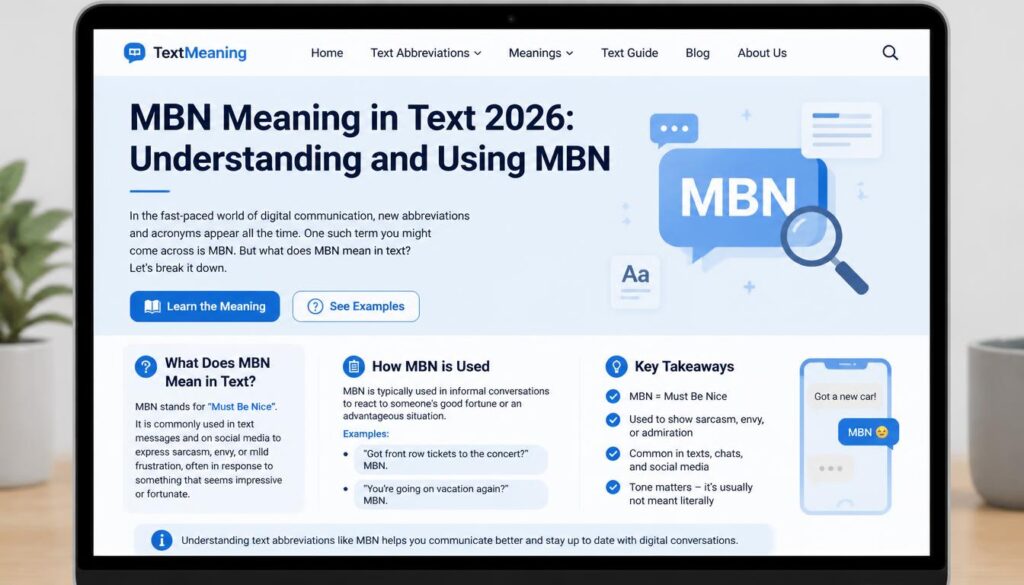
MBN stands for “Must Be Nice.” It’s a compact way of reacting to someone else’s good fortune, achievement, or lucky break without typing out a full sentence.
Someone posts about a spontaneous beach trip, and the top comment reads “MBN 😩.” Someone mentions their boss gave them a bonus, and a coworker fires back “wow, MBN.” In both cases, the acronym is doing the same job: acknowledging that something good happened to somebody else, usually with a hint of envy, humor, or admiration mixed in.
The phrase existed long before texting culture shortened it. “Must be nice” has been a go-to sarcastic remark in everyday speech for decades. What changed is the delivery — three letters replaced an entire sentence once mobile messaging and social platforms rewarded speed over spelling everything out.
The Emotional Range Behind MBN
Here’s where most people trip up: MBN isn’t a single-emotion word. It shifts meaning depending on tone, punctuation, and who’s saying it.
Supportive MBN
Used when someone genuinely means “good for you.”
Scenario: Your friend texts, “I finally got into grad school!” You reply, “MBN, so proud of you!!” Here, the acronym carries warmth, not jealousy.
Sarcastic MBN
Used when the speaker is a little annoyed or envious.
Scenario: A coworker says, “My manager let me leave two hours early.” You respond with a flat “MBN.” No exclamation, no emoji — just quiet resentment tucked into three letters.
Humorous MBN
Used between friends who are joking around, often self-deprecating.
Scenario: Someone posts a picture of a five-course homemade dinner. You comment, “MBN, I just had cereal for the third time this week.”
Often Confused Words and Acronyms
Because internet slang moves fast, MBN gets mixed up with a handful of similar-sounding or similarly-used terms. Let’s clear up the confusion with direct comparisons.
MBN vs. NBD
These look nothing alike on paper, but people sometimes misuse them interchangeably in casual chats.
- MBN (“Must Be Nice”) reacts to someone else’s good fortune.
- NBD (“No Big Deal”) downplays your own situation or effort.
Scenario: Friend: “Thanks for helping me move all weekend!” You: “NBD, happy to help.” That’s completely different from replying “MBN,” which wouldn’t make sense here since nothing good happened to you.
MBN vs. IJS
Another pairing that trips people up because both can carry a sarcastic edge.
- MBN expresses envy or admiration toward someone else’s news.
- IJS (“I’m Just Saying”) is used to soften or justify an opinion, often after a mildly critical comment.
Scenario: “You’ve canceled plans three times this month, IJS.” Swapping in “MBN” here would confuse the entire sentence, since there’s no lucky event being reacted to.
MBN vs. “MB” (My Bad)
Because they share the same first two letters, newer texters sometimes type one when they mean the other.
- MBN reacts to good news.
- MB is a quick apology, short for “my bad.”
Scenario: “Forgot to send the file, MB!” versus “You got the promotion? MBN!” Confusing these two mid-conversation can genuinely derail the tone of a chat.
Where MBN Shows Up Most in 2026
Social platforms remain the biggest breeding ground for this acronym. A few consistent patterns:
- TikTok comment sections — reacting to lifestyle or luxury content
- Instagram Stories — replies to vacation, food, or achievement posts
- Group chats — casual banter among friends
- Gaming lobbies — reacting to rare drops or lucky wins
- Workplace Slack channels (informally) — among peers, rarely with management
Tone Matters More Than the Words Themselves
Since text strips away vocal inflection, the same three letters can read as sweet or spiteful depending on what surrounds them.
| Style | Example | Feels Like |
|---|---|---|
| Excited | “MBN!! Congrats!!” | Genuine happiness |
| Flat | “MBN.” | Passive-aggressive |
| Playful | “MBN 😅 jealous” | Lighthearted envy |
| Formal (avoid) | “MBN, sir.” | Inappropriate |
A quick rule that holds up well: add emojis or exclamation points when you mean it warmly, and skip both when the sarcasm is intentional.
When to Avoid Using MBN
Despite how common it’s become, MBN isn’t universally appropriate. A few situations where it’s better left out:
- Professional emails — swap it for “Congratulations” or “That’s wonderful news.”
- Conversations with older relatives or colleagues unfamiliar with internet shorthand.
- Formal customer service exchanges.
- Any moment where sincerity really matters — sarcasm doesn’t always translate well in writing.
Instead, lean on polite alternatives like “That sounds amazing,” “I’m genuinely happy for you,” or “You deserve this” when the setting calls for warmth without ambiguity.
Why This Acronym Has Stuck Around
Three things keep MBN alive well into 2026:
- Speed: Typing three letters is faster than crafting a full sentence, especially mid-scroll.
- Universality: Everyone has felt a flicker of envy or admiration toward someone else’s good luck — the acronym captures that instantly.
- Flexibility: It bends to fit humor, sincerity, or light sarcasm without needing extra explanation.
Quick Recap
MBN means “Must Be Nice,” and its emotional tone shifts based on context, punctuation, and relationship. It’s easy to confuse with similar-looking acronyms like NBD, IJS, and MB, so paying attention to context keeps conversations clear. Use it freely with friends, swap it out in professional settings, and always let tone-setting cues like emojis do some of the heavy lifting.
Language keeps evolving, and MBN is a small but telling example of how three letters can still carry a full sentence’s worth of feeling.