
If you’ve spent any time texting, DMing, or scrolling through Snapchat, you’ve probably typed or seen the letters “hbu” flash across your screen. It looks simple enough, but for anyone unfamiliar with digital shorthand, it can feel like a tiny puzzle dropped in the middle of a sentence. So let’s clear it up properly — what hbu meaning actually refers to, where it came from, and when you might want to reach for something a little more polished instead.
What Does “hbu” Mean?
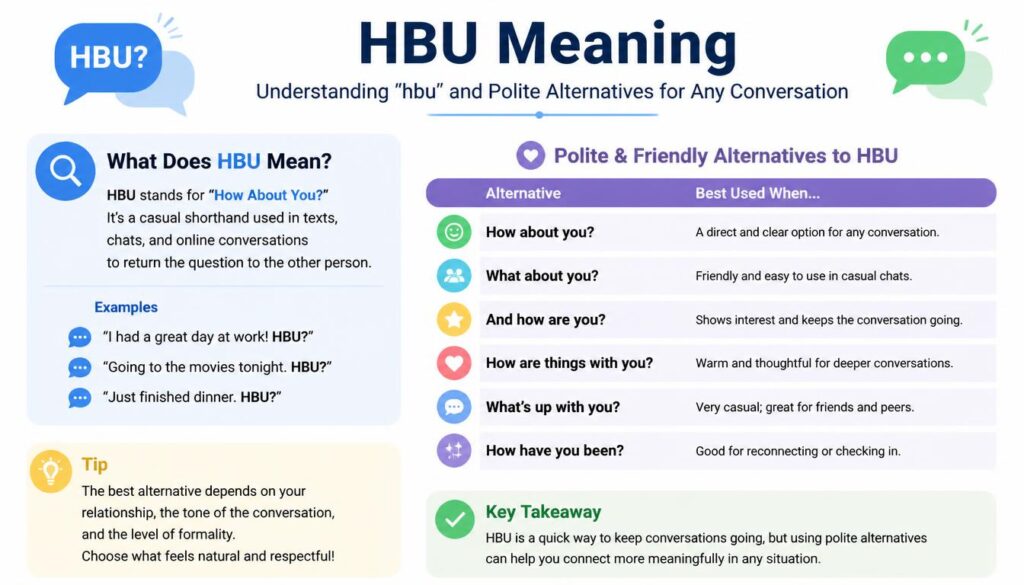
In plain English, hbu stands for “how about you?” That’s it. No hidden meaning, no secret code. It’s simply a way of tossing a question back to whoever you’re talking to, without retyping the whole phrase.
Here’s a quick scenario to picture it in action:
Sara: Just got home from work, hbu?
Jake: Still stuck in traffic lol
In that exchange, Jake instantly understands that “hbu” means Sara wants to know what he’s up to. No confusion, no need to ask “wait, what does that mean?”
You’ll come across the hbu meaning in text conversations constantly — in casual DMs, group chats, and especially in hbu meaning in chat threads where people are replying quickly and don’t want to overthink their wording. It’s also extremely common as the hbu meaning on snapchat, where streaks and rapid-fire replies reward short, snappy language over full sentences.
A few quick notes worth knowing:
- It’s almost always typed in lowercase (hbu), since all-caps can come across as shouting or oddly formal.
- It’s built for casual, familiar conversations — not board meetings.
- It answers the unspoken question: “I told you about my day, now what about yours?”
So when someone types out what does hbu mean in texting, the honest answer is: it’s just a compact, friendly way of keeping the conversation flowing both ways.
Where Did “hbu” Come From?
Believe it or not, this little abbreviation has real history behind it — it didn’t appear out of nowhere.
The SMS Era
Back when phones had physical keypads and every text was capped at 160 characters, typing “how about you?” letter by letter was a genuine hassle. People needed shortcuts, and hbu became one of many — alongside classics like brb (be right back) and idk (I don’t know).
Instant Messaging and Forums
Long before smartphones, platforms like AIM and MSN Messenger trained an entire generation to type fast and type short. Abbreviations spread through these chatrooms the way slang spreads through a schoolyard — quickly, and without anyone officially “approving” them.
Social Media’s Role
Then came Twitter, with its strict character limits, followed by Snapchat and Instagram, both built around speed and immediacy. These platforms didn’t invent “hbu,” but they absolutely cemented it into everyday digital vocabulary, especially among younger users.
Why “hbu” Doesn’t Always Fit the Moment
Here’s the thing about shorthand: what feels natural in one setting can feel jarring in another. Hbu is a great example of this.
Picture this scenario:
You’re emailing a new client, and you write: “I’m available Thursday afternoon, hbu?”
That single lowercase abbreviation can undo the professional tone you just spent three sentences building. It’s not that “hbu” is disrespectful — it’s just mismatched. It reads casual in a space that calls for polish.
A few situations where “hbu” tends to backfire:
- Professional emails or Slack messages to people outside your close team
- Conversations with older relatives who may not recognize the shorthand at all
- First-time conversations where tone hasn’t been established yet
Compare these two replies:
- “I’m good, hbu?” — quick, breezy, familiar
- “I’m doing well, how about yourself?” — warmer, more considered, safer for unfamiliar company
Same question. Very different impression.
Polite and Alternative Ways to Say “hbu”
If you’d rather diversify your language — or just avoid sounding repetitive — there are plenty of natural substitutes. Think of these as tone dials you can adjust depending on who’s on the other end of the conversation.
Formal Alternatives
Best for emails, interviews, or professional messaging:
- “And how about you?”
- “What about yourself?”
- “How are things on your end?”
- “How have you been?”
Neutral, Everyday Alternatives
Comfortable for friends, coworkers, or casual acquaintances:
- “What about you?”
- “And you?”
- “Your turn?”
- “Same for you?”
Casual, Friend-Group Alternatives
Perfect for close friends, group chats, or Snapchat streaks:
- “Sup with you?”
- “You good?”
- “Whatcha up to?”
- “How’s life treating you?”
Scenario Examples: Choosing the Right Version
Let’s walk through a few real-world situations to see how word choice shifts with context.
Scenario 1 — Texting a Best Friend
“Just binged three episodes, hbu?”
This feels effortless and natural. No one raises an eyebrow here.
Scenario 2 — Messaging a Manager
Instead of: “Free after lunch, hbu?”
Try: “I’m free after lunch — how does your afternoon look?”
The second version keeps things courteous without sounding stiff.
Scenario 3 — Chatting with a Grandparent
Instead of: “At the mall rn, hbu?”
Try: “I’m at the mall right now — what are you up to today?”
Spelling things out avoids any confusion about abbreviations they may not recognize.
Scenario 4 — Networking on LinkedIn
Instead of: “Doing well, hbu?”
Try: “Doing well, thank you — how have things been on your end?”
This keeps the exchange professional while still feeling personable.
Reading the Tone Behind “hbu”
Small formatting changes can shift how “hbu” actually lands:
- hbu — relaxed, everyday tone
- HBU? — can come across as urgent or impatient
- hbu?? — signals genuine curiosity, almost prodding for a reply
- hbu lol — playful, lighthearted, low-stakes
This is one of the more overlooked parts of digital communication: punctuation and capitalization carry emotional weight, even in something as small as a three-letter abbreviation.
Common Mistakes People Make With “hbu”
Even though it’s a simple shorthand, a few missteps come up again and again:
- Using it in formal writing, like cover letters or client proposals
- Overusing it until conversations start to feel repetitive or robotic
- Sending it to someone who’s unfamiliar with internet slang, leading to a confused pause
- Forgetting that, without context, it can sometimes read as rushed or dismissive
Why Mixing Up Your Language Matters
Constantly typing “hbu” in every single conversation can start to feel a little flat, almost like autopilot. Rotating between “hbu,” “what about you,” and warmer options like “how’s life treating you?” keeps your conversations sounding genuine rather than copy-pasted. It also shows the other person you’re actually engaged, not just going through the motions of a reply.
Quick Tips for Using “hbu” Wisely
- Match the platform: Fine for Snapchat, risky for LinkedIn.
- Know your audience: Save the slang for people who’ll actually recognize it.
- Add warmth when needed: A quick emoji or extra word can soften a short reply.
- Don’t lean on it too heavily: Variety keeps conversations feeling human.
Frequently Asked Questions
Is “hbu” considered rude?
Not inherently — but it can feel abrupt in formal or unfamiliar settings.
Can I use “hbu” at work?
Only in relaxed chats with close colleagues. Stick to full phrases in emails or official communication.
Is “hbu” still used in 2025?
Yes — despite new slang constantly emerging, it remains one of the most common texting abbreviations out there.
What does hbu mean on Snapchat specifically?
Exactly the same as everywhere else — “how about you?” — just used heavily in streaks and quick back-and-forth chats.
Final Thoughts
At its heart, the hbu meaning boils down to one simple, friendly question: how about you? It’s fast, it’s familiar, and it works beautifully in the right setting — texts, Snapchat streaks, casual group chats. But like most slang, it has limits. In professional emails, first-time conversations, or messages to someone unfamiliar with texting culture, a fuller phrase almost always lands better.
The real skill isn’t memorizing what “hbu” means — it’s knowing when to use it, and having a few solid alternatives ready when the moment calls for something more thoughtful.