
Language never sits still. Every generation reshapes it, compresses it, and breathes new life into old ideas. Today, a single acronym can carry the weight of an entire sentence — and HY is a perfect example of that. If you’ve spotted it in a comment section, a Discord server, or a quick text from a friend, you probably paused and thought: wait, what does that even mean?
You’re not alone. This little two-letter combo has quietly made its way across platforms, fandoms, and group chats — and understanding it properly means more than just looking it up. It means knowing when to use it, when to avoid it, and what to say instead.
Let’s unpack all of it.
What Does HY Mean in Text?
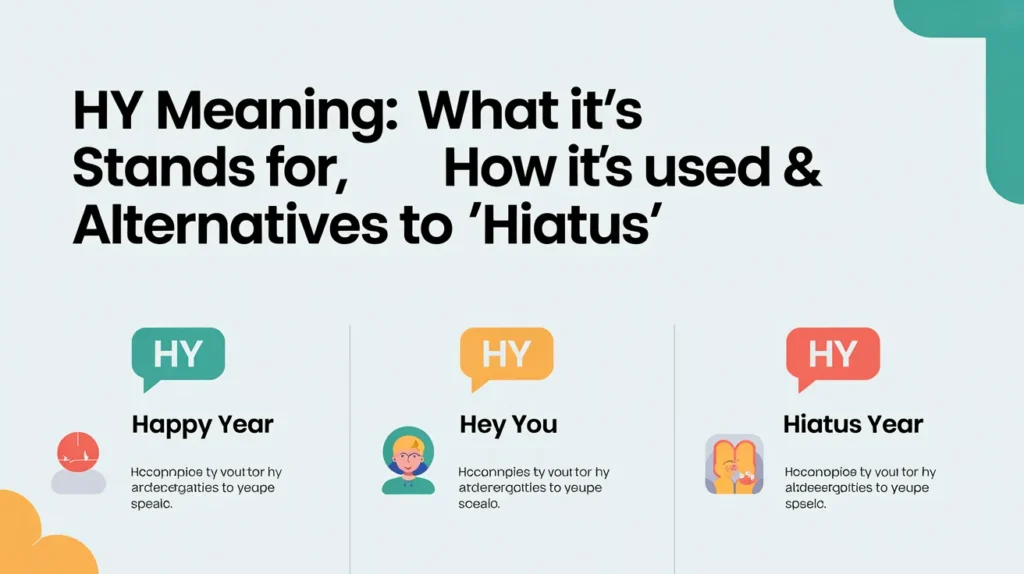
The most widely recognized HY meaning in text is simply “hiatus.” That’s it. Two letters doing the heavy lifting for a six-letter word that most people already find slightly formal.
Picture this: it’s 11 PM, you’ve just finished your last exam, and you want to tell your followers you’re stepping back from posting for a while. Are you going to type out “I am officially going on a hiatus” — or just drop “HY for a bit, back soon” and call it a night? Most people choose the latter.
That’s the culture HY comes from. It’s fast, it’s familiar, and within the right communities, everyone already knows exactly what you mean.
The Root Word: What Does “Hiatus” Actually Mean?
Before going deeper, it’s worth understanding the word hiatus itself — because HY only makes sense when you know what it’s shorthand for.
Hiatus comes from Latin, from the verb hiare, meaning “to gape” or “to open.” In classical Latin, it referred to a gap or opening in something — literally a space between things. Over time, English borrowed it to describe a pause or break in continuity, whether in speech, writing, work, or activity.
It’s not a permanent stop. That distinction matters. When a TV show goes on hiatus, it’s coming back. When a musician announces a creative hiatus, they’re not retiring — they’re stepping away temporarily to breathe, reset, or refocus.
This is what separates hiatus from words like quit, end, or retire. It carries an implicit promise of return.
Other Things HY Can Stand For
While hiatus is the dominant meaning, especially in online and social media spaces, HY does occasionally appear with other definitions depending on the context:
- Hell Yeah / Heck Yes — used in casual texting as an enthusiastic response
- High Yield — common in finance and investment discussions, referring to high-return assets
- Hydrogen — in scientific or chemistry contexts, though H is the more standard symbol
- Hell You — a rare slang twist, mostly seen in very informal or humorous exchanges
The rule of thumb here is simple: if you’re on Instagram, TikTok, Twitter/X, or a fandom forum, HY almost certainly means hiatus. If someone in a finance thread says HY bonds, they’re talking about high-yield investments. Context is everything.
How HY Is Used Across Different Situations
HY in Social Media Posts
This is where HY thrives. Character limits on platforms like Twitter/X push people toward abbreviations naturally. Creators and everyday users alike drop HY into captions, bios, and story updates without thinking twice.
Scenario: Layla runs a popular bookstagram account. After months of daily posting, she’s overwhelmed and needs a break. She writes: “Taking an HY — mental health comes first. Back when I’m ready.” Her followers understand immediately. No confusion, no explanation needed.
That’s the power of established online shorthand within a community that shares the same language.
HY in Fandom and Creative Communities
Writers, fan artists, and content creators have fully adopted HY as part of their vocabulary. Fanfiction platforms, artist alleys, and YouTube communities use it constantly.
Scenario: A popular fanfiction writer is three chapters into a story when life gets hectic. They post an author’s note: “Story on HY until further notice — thank you for your patience.” Readers nod knowingly. They’ve seen it a hundred times. The story isn’t abandoned — it’s just on pause.
This is HY in its most natural habitat: creative communities where everyone speaks the same internet dialect.
HY in Personal Texting
Among close friends, HY slots comfortably into everyday conversation.
Scenario: Marcus texts his group chat: “Going on HY from social media for the next two weeks. Finals are destroying me.” His friends reply with encouragement. Nobody asks what HY means because in their circle, it’s second nature.
Casual, low-effort, and perfectly clear — exactly what texting is supposed to be.
HY in Professional Settings — Proceed with Caution
Here’s where things get complicated. Using HY in a workplace email, a LinkedIn post, or a formal announcement is risky. Not everyone is plugged into internet slang, and the last thing you want is your manager googling what you meant.
Scenario: Priya sends an email to her team: “I’ll be on HY next month while I handle some personal matters.” Half her colleagues have no idea what that means. One assumes it’s a project name. Another thinks it’s a typo. The message lands awkwardly, and Priya has to follow up with clarification.
The lesson? In professional communication, clarity always wins over cleverness. Spell out “hiatus” — or better yet, use a more formal alternative altogether.
Hiatus vs. Similar Words: Understanding the Differences
One of the most common points of confusion is how hiatus compares to other “break” words. They’re not interchangeable — each carries its own tone, weight, and implied duration.
Hiatus vs. Break
Break is the everyday, no-frills version. You take a break from a video game, a conversation, or a cup of coffee. It’s immediate and informal.
Hiatus, on the other hand, implies something more deliberate and public-facing. You don’t announce a break — you announce a hiatus.
Scenario: “I’m taking a break” sounds like you stepped away for five minutes. “I’m going on hiatus” sounds like you made a decision, communicated it intentionally, and plan to return on your own terms.
Hiatus vs. Sabbatical
Sabbatical is the professional, almost prestigious cousin of hiatus. Originally rooted in academic culture — professors taking sabbaticals to research and write — it’s now used more broadly in corporate settings too.
Scenario: A university professor tells colleagues: “I’m on sabbatical this semester, working on my second book.” That carries a completely different energy than saying “I’m on hiatus.” One signals productive withdrawal; the other signals rest.
Hiatus vs. Leave of Absence
Leave of absence is formal, HR-approved, and workplace-specific. It has legal and organizational weight behind it.
Scenario: “She’s on a leave of absence for three months following surgery.” You’d never say “she’s on HY following surgery.” The gravity of the situation demands proper language.
Hiatus vs. Downtime
Downtime is flexible — it works for people and machines. In tech, server downtime is a scheduled pause. In personal use, it’s the quiet space between activities.
Scenario: “I need some downtime after that project” feels lighter and more casual than announcing a hiatus. Downtime implies rest; hiatus implies a structured pause with return intentions.
Alternatives to “Hiatus” Worth Knowing
Depending on your audience and context, one of these alternatives may serve you better:
- Break — casual, universal, zero confusion
- Pause — suggests a short interruption, often temporary
- Time off — neutral, works in both casual and professional settings
- Sabbatical — academic or professional, implies purposeful retreat
- Downtime — relaxed and low-key, great for personal updates
- Breather — light and conversational, signals a short rest
- Intermission — great for creative or performance-based pauses
- Recess — informal, often school or event-related
- Cooling-off period — used in legal or contractual contexts
- Mental health break — honest and increasingly normalized in online spaces
- Leave of absence — formal and workplace-appropriate
Choosing the right word isn’t just about meaning — it’s about tone, audience, and intent.
When Should You Use HY vs. Spelling It Out?
Here’s a simple way to decide:
Use HY when:
- You’re texting a friend who knows internet slang
- You’re posting in a fandom community where HY = hiatus is common knowledge
- You’re on a platform with tight character limits
- Your audience is younger and digitally native
Avoid HY when:
- You’re writing a professional email or formal announcement
- Your audience includes people outside online communities
- Clarity matters more than brevity
- You’re addressing a mixed or older demographic
The golden rule: if there’s any doubt about whether your reader will understand HY, spell it out.
Why Word Choice Shapes How People See You
This might sound dramatic, but the words you choose — whether HY, hiatus, or sabbatical — quietly signal something about who you are and how you communicate.
HY says: I’m part of this community, I speak your language, and I’m keeping things casual.
Hiatus says: I’m being intentional, I respect your attention, and I’ll be back.
Sabbatical says: I’m stepping away with purpose — this pause means something.
None of these is wrong. They’re just different registers of the same language, suited to different relationships and situations. The most skilled communicators know how to move fluidly between registers — texting HY to a friend and writing “leave of absence” to HR without skipping a beat.
That’s linguistic intelligence. And it’s more valuable than most people realize.
Final Thoughts
HY is a small acronym with a surprisingly layered story. At its core, it means hiatus — a deliberate, temporary break from something. But how and where you use it says a lot about your audience awareness and communication style.
In the right setting, it’s efficient and culturally fluent. In the wrong one, it creates confusion that a single extra word could have prevented.
So the next time you’re about to hit send — whether it’s “Going on HY” or “I’ll be on a leave of absence” — pause for just a second and ask yourself: will my reader understand this immediately? If yes, go for it. If not, choose clarity.
Because the best communicators aren’t the ones who know the most words. They’re the ones who know which word to use and when.