
You’re scrolling through your phone, and suddenly a friend texts you “ICL this is actually amazing” — and for a split second, you pause. You understand the feeling behind it, but the abbreviation itself makes you hesitate. That tiny moment of confusion is more common than most people admit.
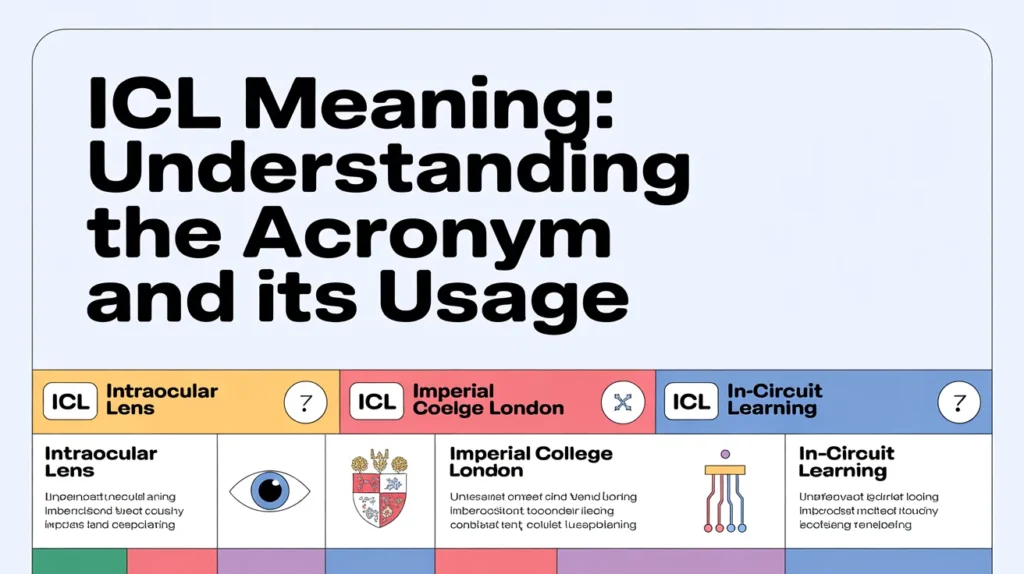
ICL is one of those acronyms that means different things in different worlds. In a casual group chat, it signals raw honesty — a shorthand for “I Can’t Lie.” But walk into a medical clinic or a sports forum, and those same three letters point somewhere else entirely.
This article breaks down every meaning of ICL — from internet slang to eye surgery to football culture. By the end, you’ll know exactly how to read it, use it, and never misinterpret it again. Context is everything, and we’re here to give you all of it.
What Does ICL Actually Mean?
Language has never been a still pond. It moves, shifts, and reinvents itself — especially in the age of social media. New abbreviations surface almost daily, and most people encounter them mid-scroll with zero context. ICL is one of those acronyms that stopped a lot of people mid-read and made them think, “Wait, what does that mean?”
The honest answer is: it depends entirely on where you see it.
In casual digital conversation, ICL most commonly stands for “I Can’t Lie.” It’s a phrase people drop to signal raw honesty — like they’re cutting through the usual social filters and saying something real. But that’s not the whole story. ICL also carries other meanings depending on whether you’re reading a medical journal, following a sports forum, or scrolling through a Gen Z group chat at midnight.
Understanding ICL meaning isn’t just about memorizing a definition. It’s about reading the room — or in digital terms, reading the context.
ICL Meaning in Slang: “I Can’t Lie”
This is the version you’ll encounter most. Across TikTok, Snapchat, Twitter/X, and Instagram, ICL functions as an honesty marker — a verbal nudge that says, “I’m being completely straight with you right now.”
It often appears before or after a strong opinion, a surprising confession, or an unexpectedly genuine compliment.
Example scenarios:
“ICL, that was the best episode they’ve aired in three seasons.”
Here, the speaker isn’t just sharing an opinion — they’re emphasizing sincerity. The ICL adds emotional weight. It transforms a casual take into something that feels considered and real.
“Your cooking has improved so much, ICL.”
When placed at the end, it lands like a quiet, genuine afterthought — as if the person almost didn’t want to admit how impressed they were, but couldn’t hold it back.
“ICL I didn’t think we’d actually pull this off.”
This usage blends surprise with honesty. It’s the kind of thing a friend says after a stressful project finally works out. The ICL here isn’t decorative — it’s doing real communicative work.
This is ICL slang meaning at its most natural. It flows the way real spoken language does, which is exactly why it caught on so fast.
The Lesser-Known Version: ICL as “I Care Less”
Not everyone uses ICL to signal honesty. A smaller but real portion of online slang usage flips it into “I Care Less” — an expression of dismissal or indifference.
Example scenarios:
“They kept talking about me behind my back. ICL at this point.”
The tone here is completely different. There’s no warmth, no sincerity — just a quiet, firm exit from caring. This version of ICL functions almost like emotional armor.
“ICL what the algorithm thinks of my posts anymore.”
Creatives and content makers often use this variant when they’re consciously detaching from validation-seeking behavior online. It signals a deliberate shift in mindset.
The risk? These two meanings can easily be confused. Imagine someone texts you: “ICL you’re always right.” Depending on their tone, that could be a sincere compliment — or devastating sarcasm. Context is everything with this acronym.
How ICL Compares to Similar Slang Expressions
ICL doesn’t exist in isolation. It sits alongside a whole family of honesty-signaling phrases in digital communication. Understanding how they differ helps you use each one with precision.
| Phrase | Full Form | Tone | Best Used When |
|---|---|---|---|
| ICL | I Can’t Lie | Direct, unfiltered | Blunt opinion or genuine reaction |
| NGL | Not Gonna Lie | Casual, slightly softer | Mild confession or relatable moment |
| TBH | To Be Honest | Reflective, measured | Sharing a considered opinion |
| FR | For Real | Emphatic, validating | Agreeing strongly or reacting |
| Lowkey | — | Subtle, understated | Quiet admission of something |
ICL hits harder than TBH. Where TBH softens what follows, ICL sharpens it. It’s the difference between “To be honest, I liked it” and “I Can’t Lie — I genuinely loved it.” The second version feels like a door swinging open.
ICL in Professional and Technical Contexts
Here’s where things shift dramatically. Step outside the group chat and into a medical office or a corporate meeting, and ICL takes on entirely different identities.
ICL in Medicine: Implantable Contact Lens
In ophthalmology, ICL stands for Implantable Contact Lens — a surgical procedure where a corrective lens is placed inside the eye, just in front of the natural lens. It’s commonly recommended for patients who aren’t ideal candidates for LASIK due to high prescription levels or thin corneas.
Scenario example:
A patient visits an eye clinic and the surgeon says, “Based on your corneal thickness, I’d recommend we explore ICL rather than LASIK.”
If you walked into that consultation thinking ICL meant “I Can’t Lie,” you’d have a very confusing afternoon. This is a high-stakes medical context where precision in terminology matters enormously.
ICL in Sports: International Champions League
In football (soccer) communities, particularly in fan forums and discussion threads, ICL sometimes refers to the International Champions League — a pre-season tournament featuring elite clubs from around the world.
Scenario example:
“Did you catch the ICL fixtures this summer? The matchups looked insane.”
Here, slang interpretation would make zero sense. The sports context instantly signals a different definition.
ICL in Business and Technology
Historically, ICL also stood for International Computers Limited, a major British computing company that played a significant role in the UK’s technology industry during the latter half of the 20th century. You’ll still find ICL referenced in tech history articles, archived business documents, and academic writing on the evolution of the British IT sector.
Why Context Is the Real Key to ICL Meaning
One of the most important principles in linguistics and natural language processing is that words and abbreviations are not self-contained units of meaning. They draw meaning from everything around them — the platform, the relationship between speakers, the tone, and the subject matter.
ICL is a perfect case study in this principle.
Consider these three sentences:
- “The doctor discussed ICL as a long-term solution.” → Medical term
- “ICL this song has been living in my head rent-free.” → Slang: I Can’t Lie
- “ICL was a pioneer in enterprise computing.” → Business: International Computers Limited
Same three letters. Three completely different worlds. Misreading the context doesn’t just cause confusion — it can cause real miscommunication, especially in professional environments.
A well-known example of this going wrong: a university student once submitted a project report and included the line, “ICL this assignment tested my limits.” The professor, unfamiliar with Gen Z internet slang, read it as an organizational abbreviation and flagged it as an error. The student’s informal register completely clashed with the formal academic writing context.
When Should You Use ICL — And When Should You Avoid It?
Use ICL When:
- You’re texting friends or messaging in a casual group chat
- You’re writing a social media caption and want to add authenticity
- You want to emphasize a genuine reaction without sounding overly formal
- You’re engaging with meme culture or internet humor
Avoid ICL When:
- Writing a professional email or business report
- Communicating with someone from a different generation who may not recognize the abbreviation
- The topic is medically or legally sensitive — where clarity is non-negotiable
- You’re unsure of the reader’s digital literacy level
The golden rule: know your audience before you abbreviate.
How ICL Spread So Quickly Across Platforms
ICL gained significant traction around 2020–2021, at a time when digital communication was accelerating faster than ever. Lockdowns pushed more conversations online, and platforms like TikTok became cultural accelerators — spreading language, aesthetics, and trends at speeds older platforms never achieved.
Short-form content rewards short-form language. A TikTok caption has limited space. A Snapchat streak lives in seconds. These formats didn’t just accommodate abbreviations like ICL — they demanded them.
Twitter/X played a different but equally important role. Its character limits and hot-take culture made ICL a natural fit for blunt, punchy commentary. Drop an ICL before a controversial opinion and it immediately feels less aggressive — more like candid sharing than provocation.
The viral nature of relatable content also helped. When someone posted “ICL I cried at that movie and I’m not sorry” and thousands related, the phrase spread through social reinforcement — people saw it, understood it from context, and started using it themselves. That’s how internet slang adoption has always worked.
A Quick-Reference Summary
- ICL in slang = I Can’t Lie (dominant meaning across all major social platforms)
- ICL in slang (secondary) = I Care Less (dismissive or indifferent tone)
- ICL in medicine = Implantable Contact Lens (ophthalmology/eye surgery)
- ICL in sports = International Champions League (football/soccer communities)
- ICL in business/tech = International Computers Limited (UK computing history)
Final Thoughts
ICL is three letters carrying five different lives. Most of the time, when a friend drops it in a chat, they’re being real with you — telling you something they genuinely mean. That’s the beauty of “I Can’t Lie” as a phrase. It disarms. It humanizes. It cuts through the noise of curated, filtered online communication.
But step into a different context — a clinic, a boardroom, a tech history paper — and those same three letters mean something entirely different. Language doesn’t change its rules; it changes its setting. And the setting changes everything.
So the next time someone asks “what does ICL mean on Snapchat?” — you’ll know the answer. And the next time you’re reading an eye care article, you’ll know that too. That dual awareness is exactly what makes someone a sharp, confident communicator in the modern digital world.