
English verbs have a habit of catching you off guard exactly when you need them most. You’re writing a quick email, finishing an assignment, or telling a story to a friend — and suddenly the question hits you: Did I say tore? Or was it torn? And what about teared — is that even a real word?
If this sounds familiar, you’re in very good company. The past tense of tear is one of those small but surprisingly tricky grammar questions that confuses native speakers and English learners alike. And honestly? The confusion is completely justified.
Here’s why — tear is an irregular verb. It doesn’t play by the simple rules. You can’t just slap an -ed at the end and call it done. Instead, it shifts its form depending on how and where you use it in a sentence. Tore, torn, teared — all three exist, but each one belongs in a very specific grammatical situation. Use the wrong one, and your sentence quietly falls apart.
In this guide, you’ll get a clear, no-fluff breakdown of every past form of tear — when to use tore, when torn is the correct choice, and the one situation where teared is actually acceptable. Real-life examples, practical scenarios, and easy memory tricks included. By the end, this verb will never trip you up again.
The Verb That Trips Up Even Fluent Speakers
English has a way of humbling even the most confident writers. You’re typing an email, composing an essay, or telling a story — and suddenly you freeze. Did I tore it? Did I tear it? Has it been torn? And what on earth is teared?
You’re not making a careless mistake. You’re wrestling with one of English’s classic irregular verbs — a verb whose past forms refuse to follow the predictable “-ed” rule that learners rely on. The verb tear is one of the most frequently misused words in everyday writing and speech, and the confusion makes complete sense once you understand why it exists.
This guide will walk you through every form, every rule, and every real-life scenario — so the next time you need to use tear in the past tense, you’ll know exactly what to reach for.
First, Let’s Settle the Meaning — Because Tear Has Two Faces
Before you can master the past tense, you need to appreciate something unusual about this word: tear is a homograph. That means it’s spelled the same way but carries two entirely different meanings — and it’s even pronounced differently depending on which meaning you intend.
- Tear (/tɛr/) — to rip, pull apart, or damage something with force
- Tear (/tɪr/) — the drop of liquid that falls from your eye when you cry
This distinction matters more than people realize. The confusion around tore, teared, and torn almost always involves the ripping sense of the word. Native speakers rarely mix up the crying sense because teared up is a fixed informal phrase, and it doesn’t cross over into the ripping meaning.
For this article, we’ll focus primarily on tear meaning “to rip” — the one that causes the real grammatical headaches.
The Short Answer: Tore, Torn, or Teared?
Here is the rule in plain English:
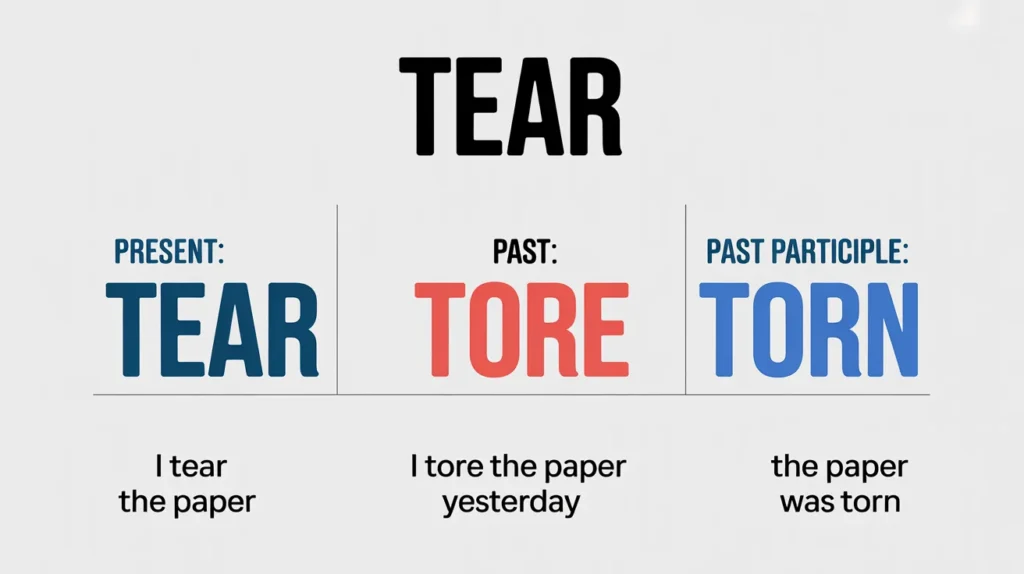
- Tore = simple past tense (She tore the paper)
- Torn = past participle (The paper has been torn)
- Teared = only acceptable in the emotional phrase teared up — never used to mean “ripped”
Tear is an irregular verb, which means it doesn’t form its past tense by simply adding -ed. Instead, the verb changes its internal vowel sound — a pattern called ablaut, common in Old English-derived verbs. Think of similar patterns: wear → wore → worn, swear → swore → sworn, bear → bore → borne. Tear follows the exact same mold: tear → tore → torn.
Complete Verb Conjugation of Tear
| Verb Form | Example |
|---|---|
| Base form | I don’t want to tear this page. |
| Simple past | He tore the envelope open. |
| Past participle | The envelope has been torn. |
| Present participle | She is tearing the receipt carefully. |
| Past perfect | They had torn down the sign before we arrived. |
| Passive voice | The document was torn during transit. |
Notice how tore and torn each live in a specific grammatical space. Swapping them produces errors that a native speaker immediately notices — even if they can’t always explain why.
When to Use “Tore” — Simple Past Tense
Use tore when you’re describing a completed action in the past. No helping verb. No auxiliary. Just the action, done and finished.
Examples:
- He tore the contract in half and threw it across the room.
- I accidentally tore my favorite jacket on the fence.
- The children tore through the wrapping paper in seconds.
- She tore the page out of her notebook and handed it to me.
Real-Life Scenario: The Workplace Email
Subject: Damaged Document During Filing
Hi Sarah,
I wanted to give you a heads-up — I accidentally tore one of the client agreements while sorting the files this afternoon. I’ve already made a clean photocopy and placed it in the folder. The original information is fully intact.
Please let me know if you’d like me to print a fresh copy for the record.
Best, Daniel
Here, tore is the right call because Daniel is describing a single, completed past action. Simple, direct, correct.
When to Use “Torn” — Past Participle
Torn is the past participle of tear. It never stands alone as a simple past verb. It always works alongside a helping verb such as have, has, had, was, were, or been. This is a critical distinction that catches many writers off guard.
Examples in perfect tenses:
- I have torn this page three times now — something’s wrong with the paper.
- She had torn the letter before she realized it was addressed to her sister.
- By the time we arrived, he had already torn down the decorations.
Examples in passive voice:
- The receipt was torn and completely unreadable.
- Several pages had been torn from the library book.
- The banner was torn by the wind overnight.
Real-Life Scenario: A Customer Complaint Email
Subject: Torn Packaging on Delivery — Order #48291
Dear Support Team,
I received my order this morning, but the outer packaging had been torn significantly — likely during transit. Fortunately, the product inside appears to be undamaged. However, I wanted to flag this issue in case it reflects a broader packing problem.
Could you advise on the best way to proceed?
Kind regards, Priya Mehta
Notice the difference in feel. Had been torn tells us the tearing happened at some point before the delivery arrived — classic past perfect passive construction, and torn is doing exactly the job it’s meant to do.
What About “Teared” — When Is It Acceptable?
This is where most people get tripped up. Teared sounds like it should be correct — after all, we regularly add -ed to verbs in English. But with tear, that logic breaks down.
Teared is not a valid simple past tense for the ripping meaning of tear. Full stop.
However, teared up is widely accepted in informal English as a phrasal verb describing the emotional response of eyes filling with tears — not crying fully, but getting close.
Acceptable uses of teared:
- She teared up the moment she heard the announcement.
- He teared up watching his daughter walk across the graduation stage.
- I totally teared up during that final scene — I’m not ashamed.
Real-Life Scenario: A Text Message Exchange
Rania: Did you watch the documentary last night?
Khalid: Yes! I completely teared up at the ending. Didn’t expect that at all.
Rania: Same! The whole family was emotional.
This usage feels natural and human in casual conversation. But the moment you write “I teared my shirt” or “He teared the paper,” you’ve made a grammatical error. In those contexts, tore is the only correct choice.
Side-by-Side Comparison: Tore vs. Torn vs. Teared
| Word | Grammatical Role | Correct Usage | Incorrect Usage |
|---|---|---|---|
| Tore | Simple past | She tore the letter. | She has tore the letter. |
| Torn | Past participle | The letter has been torn. | She torn the letter. |
| Teared | Informal phrasal verb | He teared up. | He teared the paper. |
Common Mistakes — And Why People Make Them
Mistake 1: Using “Tore” as a Past Participle
❌ He has tore the page. ✅ He has torn the page.
This is the single most common error. Writers correctly identify tore as a past form but forget that the past participle requires torn, especially after have, has, or had.
Mistake 2: Using “Teared” for Ripping
❌ She teared the envelope open. ✅ She tore the envelope open.
The temptation to regularize the verb is understandable, but tear does not follow the regular conjugation pattern for its ripping meaning.
Mistake 3: Using “Torn” Without a Helping Verb
❌ He torn his trousers during the hike. ✅ He tore his trousers during the hike.
Torn cannot function as a standalone simple past verb. It always needs a companion auxiliary to make grammatical sense.
Memory Trick That Actually Works
Here’s a simple mental anchor to lock this in permanently:
“I tore it — now it’s torn.”
Say it out loud a few times. The first half gives you your simple past. The second half gives you your past participle. Two forms. One sentence. Done.
Tear in Idioms and Everyday Expressions
The verb tear also shows up in idiomatic expressions that English speakers use constantly:
- Tear one’s hair out — to feel extreme frustration “I was tearing my hair out trying to fix that spreadsheet.”
- On a tear — performing at an unusually high level or moving very fast “She’s been on a tear this quarter — three new clients in two weeks.”
- Tear into someone — to criticize harshly “The manager tore into the team after the missed deadline.”
- Tear apart — to destroy or critique thoroughly “The critics tore the film apart, though audiences loved it.”
- Burst into tears — to suddenly start crying “He burst into tears when he heard the news.”
Recognizing these fixed expressions and collocations helps you understand how native speakers actually use the verb — not just in textbooks, but in offices, group chats, and everyday conversations.
Synonyms for Tear (Ripping Sense)
When tear feels repetitive, these synonyms carry similar meaning:
- Rip — He ripped the page from the notebook.
- Shred — She shredded the documents.
- Split — The seam split under pressure.
- Rend — (formal/literary) He rent his garments in grief.
- Lacerate — (medical/formal) The sharp edge lacerated the material.
Each carries a slightly different connotation and register — rip is casual, lacerate is clinical, rend is poetic. Choosing the right synonym depends on the tone of your writing.
Quick Pronunciation Reminder
- Tear (rip) — rhymes with bear, care, dare → /tɛr/
- Tear (cry) — rhymes with beer, fear, near → /tɪr/
- Tore — rhymes with more, floor, shore → /tɔːr/
- Torn — rhymes with born, corn, worn → /tɔːrn/
In spoken English, the pronunciation alone eliminates most ambiguity. The grammatical errors happen more in writing — which is exactly why this guide exists.
Final Takeaways
Mastering the past tense of tear isn’t complicated once you see the full picture. Here’s everything distilled:
- Use tore when describing a completed past action standing alone
- Use torn with helping verbs — have, has, had, was, been
- Use teared only in the emotional phrase teared up
- Never write teared when you mean ripped — it’s always wrong in that context
- Remember the anchor: “I tore it — now it’s torn”
Good grammar isn’t about following rules for their own sake. It’s about being understood clearly and being taken seriously in your writing. A small distinction like tore vs. torn can quietly signal whether you’re a careful, confident writer — or someone who hasn’t quite gotten there yet.