
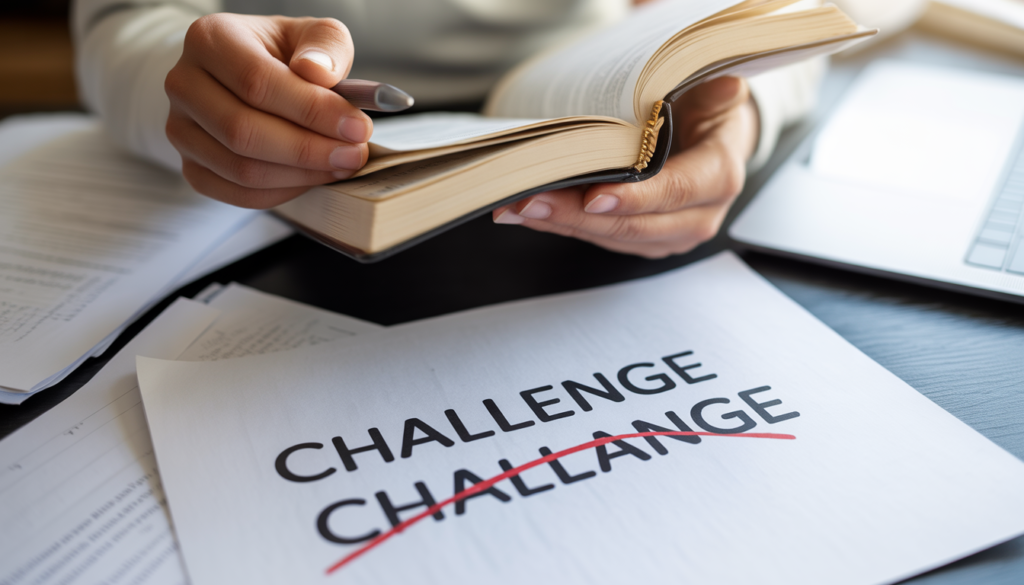
If you’ve ever been mid-sentence and suddenly froze — wait, is it challenge or challange? — you’re in good company. This is one of those sneaky spelling trips that catches even confident writers off guard. English spelling doesn’t always follow the rules our brains expect, and this word is a perfect example of that.
Let’s clear it up once and for all, with real context, practical examples, and tips you’ll actually remember.
The Correct Spelling: Challenge
No debate here. Challenge is the correct spelling. “Challange” is simply a misspelling — one that happens often, but a mistake nonetheless.
The word comes from Old French chalenge and Latin calumnia, meaning a false accusation or claim. Over centuries, it evolved into the modern English word we use today. Knowing its roots actually makes the spelling easier to remember — it was never “challange” in any stage of its history.
So if you’ve been writing “challange” in emails, essays, or text messages, now’s the time to correct that habit. It’s a small fix with a big impact on how your writing comes across.
Why Do So Many People Misspell It?
The honest answer? Because of how it sounds.
When you say “challenge” out loud, the middle syllable carries an “a” sound — chal-lenj. That “a” fools the brain into thinking the word contains an “a” where it doesn’t belong. Writers who rely on phonetic spelling — writing what they hear — often land on “challange” without realizing the error.
Add in the pressure of fast typing, autocorrect quirks, and the fact that we rarely slow down to double-check common words, and you’ve got a recipe for a repeated mistake.
It’s not a sign of poor intelligence. It’s just one of English’s many quirks — and now that you’re aware of it, you won’t fall for it again.
Challenge in Professional and Workplace Settings
In professional environments, spelling accuracy directly reflects your credibility. A single typo in a client email or business report can quietly undermine the confidence people have in your work.
Scenario 1: Email to a Supervisor
Subject: Resource Challenge on the Carter Project
Hi Daniel,
I wanted to flag a challenge we’re running into on the Carter account. The design team is stretched thin this week, and we may need to shift the deadline by a few days. I’d love to get your input on how to handle this before Thursday.
Thanks, Rachel
Now imagine that same email with “challange” in the subject line. It’s a small thing, but it sticks out. Clients and managers notice these details — even if they don’t say anything. Correct spelling is part of professional communication, full stop.
Challenge in Education and Academic Writing
Students face this word constantly — in essays, assignments, and exam responses. Academic writing holds spelling to a high standard, and errors like this can affect grades and overall impressions.
Scenario 2: College Application Essay Excerpt
“The greatest challenge I faced during high school wasn’t academic — it was learning to ask for help. Growing up in a household where self-reliance was everything, admitting I was struggling felt like failure. But reaching out changed everything.”
This kind of writing is personal and powerful. Misspelling “challenge” as “challange” in a college essay would be a jarring distraction from an otherwise compelling story. In academic contexts, every word counts — including how it’s spelled.
Challenge in Sports and Personal Growth
Athletes, coaches, and fitness enthusiasts use this word all the time — in training logs, motivational posts, and goal-setting journals. The word carries energy and determination, and it deserves to be spelled right.
Scenario 3: Fitness Journal Entry
“Week three of the running challenge is done. My knees ached, my motivation dipped on Thursday, but I showed up anyway. That’s the whole point — showing up when it’s hard.”
There’s something grounding about writing your goals down correctly. Spelling “challenge” right in your personal writing reinforces the seriousness of what you’re pursuing. It’s a small act of respect for your own effort.
Challenge in Legal and Formal Documentation
Legal professionals deal with challenges constantly — evidentiary challenges, procedural challenges, constitutional challenges. In this field, precision in language is non-negotiable.
Scenario 4: Legal Brief Excerpt
“The defense has filed a formal challenge to the admissibility of the financial records presented by the prosecution. We argue that the documentation lacks proper chain of custody verification.”
One spelling error in a legal document doesn’t just look careless — it can affect interpretation, create ambiguity, and in rare cases, complicate proceedings. In legal writing, the standard for accuracy is absolute.
Challenge in Everyday Conversation and Casual Writing
Even outside formal contexts, spelling matters. Text messages, social media captions, personal blogs — these all shape how people perceive you.
Scenario 5: Text Message to a Friend
“This week has been a real challenge, honestly. New job, new city, trying to figure out where the grocery store is. Send help. And snacks.”
Casual writing still benefits from correct spelling. It keeps the message clear and makes sure the reader focuses on what you’re saying — not on a typo that pulls their attention away.
Easy Ways to Remember the Correct Spelling
Here are a few tricks that actually stick:
- Think of “change” — challenge contains the word change inside it: cha-llenge. No, wait — better trick: notice that challenge ends in -enge, like avenge or revenge. That “-enge” ending is your anchor.
- Say it slowly: chal — len — ge. Three syllables. No hidden “a” after the “ch.”
- Write it five times right now. Muscle memory is underrated.
- Use it in a sentence today — in an email, a note, or even a text. Active use locks spelling into long-term memory faster than passive reading.
Common Contexts Where This Word Appears
To really internalize the correct spelling, it helps to see the range of ways challenge shows up in real life:
- Work: “This quarter’s biggest challenge is customer retention.”
- Relationships: “Long-distance is a challenge, but we make it work.”
- Health: “Managing sleep deprivation is a real challenge for new parents.”
- Technology: “Cybersecurity remains a growing challenge for small businesses.”
- Environment: “Climate change is the defining challenge of our generation.”
In every single one of these cases, the word is challenge — never “challange.”
Quick Reference: Challenge vs. Challange
| Spelling | Correct? | |
|---|---|---|
| ✅ | Challenge | Yes — always use this |
| ❌ | Challange | No — common misspelling |
Final Thoughts
Language is a living thing, and spelling mistakes happen to everyone. But the difference between a writer who improves and one who doesn’t is simply awareness. Now that you know challenge is always spelled with an “e” — not an “a” — after the double “l,” you have one less thing to second-guess.
Proofread your work. Read it aloud. Use it often. And the next time someone asks you “is it challenge or challange?” — you’ll know exactly what to tell them.