
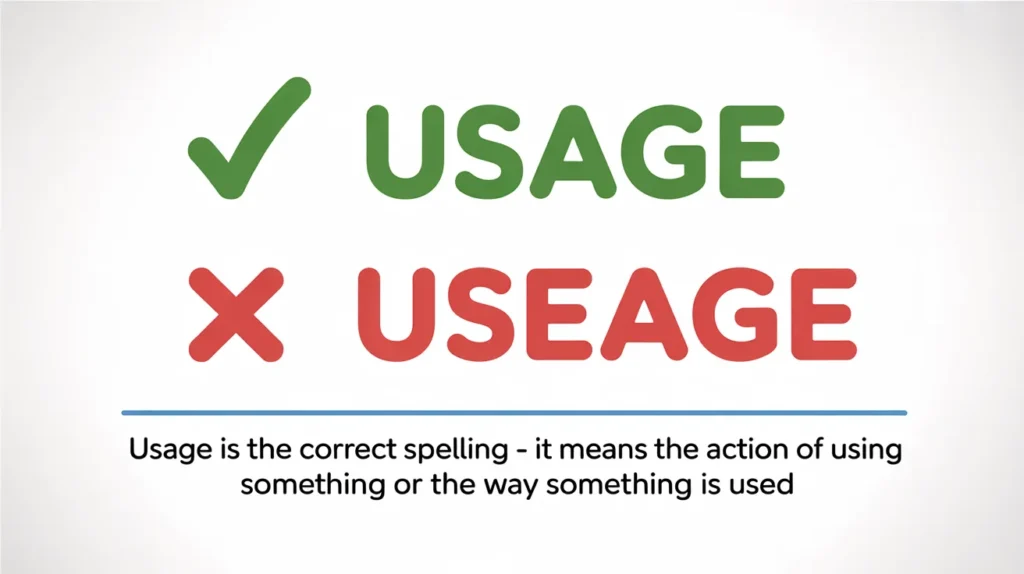
Let’s be real — English spelling can feel like a minefield sometimes. You’re typing an important email, drafting a report, or finishing up an academic paper, and suddenly you stop. Wait — is it usage or useage? You type both versions and stare at the screen, unsure which one looks right. Sound familiar?
You’re not alone. This is one of those small but surprisingly common spelling dilemmas that trips up even experienced writers. And while the confusion is understandable, the answer is actually straightforward once you know where to look.
So let’s settle this once and for all.
The Short Answer: Only One Is Correct
If you’ve been writing useage, it’s time to stop. The correct spelling is usage — full stop. There is no version of useage that appears in any standard English dictionary, whether it’s Merriam-Webster, Oxford, or Cambridge. It has never been officially recognized, and using it in professional or academic contexts can quietly undermine your credibility.
Useage is simply a misspelling, born from a natural but incorrect instinct to add an e after the word use before the -age suffix. It feels logical — after all, the word use ends in an e, so why drop it? But that’s not how English morphology works in this case, and the sooner you internalize the correct form, the better your writing becomes.
Where Does the Word “Usage” Come From?
Understanding the etymology of usage makes it easier to remember the correct spelling. The word traces back to the Latin root usus, meaning “the act of using,” which later passed through Old French as usage before entering Middle English. The -age suffix in English typically transforms a verb or noun into a concept that describes an action, practice, or condition — think language, passage, marriage.
So use plus -age becomes usage, not useage. The e is dropped, following a well-established pattern in English word formation. Once you see this pattern, it clicks.
What Does “Usage” Actually Mean?
Usage carries a broader meaning than most people realize. It doesn’t just mean “the use of something.” More specifically, it refers to the habitual or customary way in which something is used — particularly language, tools, or practices over time.
In linguistics, for example, language usage describes how words and expressions are actually used by speakers in real-world contexts, as opposed to how grammar rules say they should be used. This is a meaningful distinction in the study of English.
Here’s a simple breakdown of what usage can refer to:
- Linguistic usage — how words, phrases, and grammar are used in everyday speech or writing
- Technical usage — how a tool, software, or device is operated
- Cultural usage — how customs or practices are followed within a community
- Data usage — the amount of data consumed on a digital device or network
Real-Life Scenarios: Usage in Action
Sometimes the best way to understand a word is to see it working in context. Below are several realistic scenarios that show how usage appears naturally — and how useage creates a problem.
Scenario 1: The Professional Email
Imagine you’re a project manager writing to your team about a new software tool your company has adopted.
Incorrect version:
“Please review the attached guide on the useage of our new CRM platform. Let me know if you have any questions regarding useage limits or access rights.”
Correct version:
“Please review the attached guide on the usage of our new CRM platform. Let me know if you have any questions regarding usage limits or access rights.”
The misspelling in the first version is subtle, but it’s the kind of thing a senior colleague or client notices. It signals a lack of attention to detail — not the impression you want to give.
Scenario 2: The Academic Essay
A university student is writing a literature paper and wants to analyze how a particular author uses figurative language.
Incorrect version:
“This paper examines the useage of symbolism in Fitzgerald’s The Great Gatsby, particularly in how color is employed to reflect social class.”
Correct version:
“This paper examines the usage of symbolism in Fitzgerald’s The Great Gatsby, particularly in how color is employed to reflect social class.”
Academic writing demands precision. A misspelling like useage in a thesis or research paper can affect how seriously your work is taken — even if the argument itself is strong.
Scenario 3: The Tech Manual
A software company is writing documentation for its new app.
Incorrect version:
“Improper useage of the application may result in data loss. Please follow the instructions carefully.”
Correct version:
“Improper usage of the application may result in data loss. Please follow the instructions carefully.”
In technical documentation, clarity and accuracy are non-negotiable. A spelling error here doesn’t just look careless — it can damage the company’s professional reputation.
Scenario 4: Everyday Conversation Turned Written
You’re texting a friend about your phone’s data plan running out.
“My data usage this month was insane — I’ve been streaming too much.”
Even in casual writing, usage is the natural, correct choice. Nobody writes useage in a text and expects it to go unnoticed by an eagle-eyed friend.
Common Reasons People Write “Useage” by Mistake
It’s worth understanding why this misspelling happens so frequently, because it’s not random.
1. The influence of the base word The word use ends in a silent e, and writers instinctively carry that e forward when adding a suffix. This leads to useage instead of usage.
2. Phonetic reasoning Both usage and useage are pronounced the same way: YOOZ-ij. Because there’s no audible difference, the spelling feels negotiable to some writers — but it isn’t.
3. Over-reliance on spellcheck Here’s a trap many writers fall into: spellcheck doesn’t always catch contextual or less common errors. In some older or less sophisticated word processors, useage might slip through undetected. Never rely on spellcheck alone.
4. Analogy with other words Some writers think of words like useable (an accepted variant of usable) and apply the same logic to usage, producing useage. But these are different words with different suffix rules.
A Quick Grammar Tip to Remember This Forever
Here’s a simple memory trick: think of the word language. Nobody writes languagee or languige — the word just exists as it is. Usage works the same way. It’s a standalone noun with its own fixed spelling, not a compound of use + age that you build on the fly.
Also, remember this rule: when adding the suffix -age to a word ending in a silent e, the e is typically dropped. This applies to other words too — store becomes storage, pass becomes passage, mile becomes mileage (though mileage retains the e due to pronunciation — yes, English has exceptions, but usage is not one of them).
Why This Matters Beyond Just Spelling
Some people shrug off spelling mistakes as trivial. But written language is a reflection of how carefully you think. In professional environments especially, small errors accumulate into a larger impression — one that can affect how your ideas are received, how credible you appear, and even how your career is perceived.
A single misspelling won’t end a career. But consistent inaccuracies in writing signal to readers that you either don’t know the rules or don’t care enough to check. Neither is a good look.
Getting word usage right — including the spelling of the word usage itself — is part of building a reputation as someone who communicates with precision and care.
Final Verdict
The debate between usage or useage has a clear winner: usage, every single time. It’s the only form recognized by dictionaries, the only one with etymological roots, and the only one that will serve you well in any writing context — professional, academic, or casual.
Useage is not an alternative spelling. It’s not an older variant. It’s simply a mistake — an easy one to make, but an equally easy one to fix once you know better.
So the next time you’re mid-sentence and that doubt creeps in, trust this: it’s always usage. No e after the s, no exceptions, no debate.
Now go write something great — and spell it right.