
If you’ve ever stopped mid-sentence wondering whether to write afterward or afterwards, you’re in good company. Even seasoned writers pause at this one. The two words look nearly identical, sound the same, and mean exactly the same thing — so why do both exist? And more importantly, which one should you actually use?
The answer is more interesting than you might expect. It touches on the history of the English language, the quiet rivalry between American and British spelling conventions, and the surprisingly human way language evolves differently across continents. Let’s break it all down.
What Do Afterward and Afterwards Actually Mean?
Both words function as adverbs of time. They mean “later” or “following a particular event.” Simple as that. There’s no hidden nuance, no secret grammatical rule that makes one more correct than the other in terms of meaning.
Consider these two sentences:
- She finished her work and went for a walk afterward.
- She finished her work and went for a walk afterwards.
Read them both. They’re identical in meaning, rhythm, and feel. The only difference is that last letter — the s. And yet that one letter has been confusing writers for decades.
The Real Difference: It’s All About Where You’re Writing From
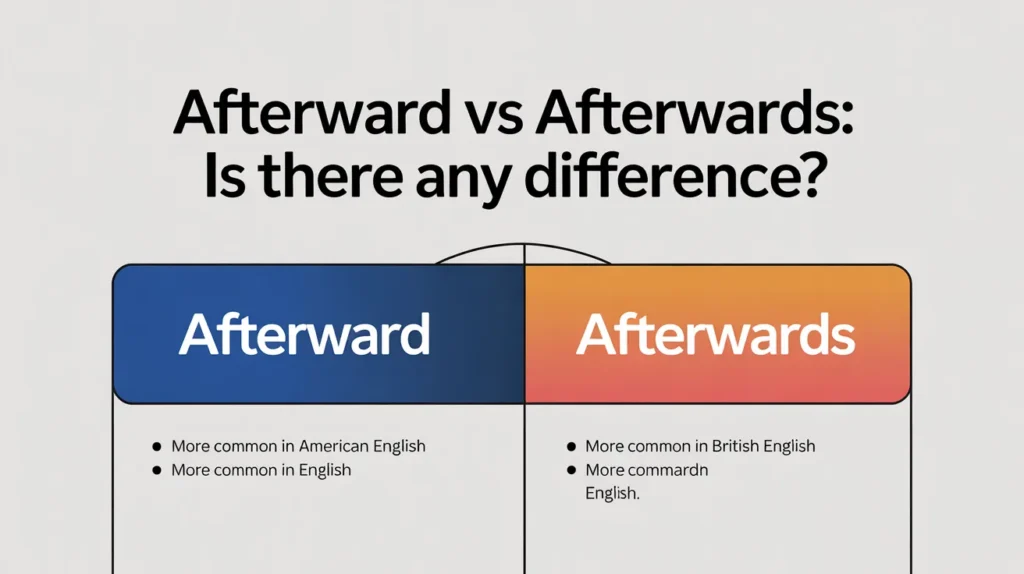
Here’s the honest truth: the choice between afterward and afterwards is largely a matter of geography.
American English Prefers “Afterward”
In the United States, afterward is the dominant form. You’ll find it in newspapers, corporate emails, academic journals, and published novels. American style guides, including those used by major publishers, lean toward the shorter form without the trailing -s.
This isn’t arbitrary. Americans have historically preferred the -ward ending over -wards in adverbs. You see this same pattern everywhere:
- Toward (not towards)
- Upward (not upwards)
- Forward (not forwards)
- Backward (not backwards)
It’s a consistent stylistic leaning toward simplicity and economy of language — drop what isn’t strictly necessary.
British English Prefers “Afterwards”
Cross the Atlantic, and the preference flips. In British English, afterwards is the natural, comfortable choice. British writers, journalists, and everyday speakers reach for the -s form almost instinctively. It sounds more conversational, more fluid to the British ear.
The same holds for Commonwealth countries — Australia, Canada, New Zealand, South Africa — where afterwards tends to appear more frequently, though both forms are accepted and understood.
A Quick Dive Into Word History
The split between these two forms isn’t a modern accident. Both trace back to Old English, specifically to the word æfterwearde, meaning “toward the after part” or “in the direction of what follows.”
Over centuries of language evolution, English developed two competing suffixes for directional adverbs: -ward and -wards. The -s in -wards is what linguists call the adverbial genitive — a grammatical remnant from Middle English where the -s ending was used to indicate manner or direction.
Think of it like a fossil in the language. The genitive -s no longer has an active grammatical job, but it survived in certain words and became standard in some dialects while fading in others.
This explains why we have parallel pairs like toward/towards, forward/forwards, and afterward/afterwards — each pair carrying the same meaning, just wearing different regional clothes.
Real-Life Scenario Examples
Nothing clarifies word usage like seeing it in actual context. Here are several everyday scenarios where these words naturally appear.
Scenario 1: Workplace Email (American Style)
Hi Marcus, Thanks for presenting the quarterly report today. I’d love to connect afterward to discuss the numbers in more detail. Does 4 PM work for you?
Here, afterward fits naturally in a professional American context. It’s clean, direct, and in line with US business writing norms.
Scenario 2: Casual Text Message (British Style)
“Just leaving the gym now. Want to meet up afterwards and grab some food?”
This is exactly how a British or Australian speaker might text a friend. Afterwards feels warm and conversational here — it’s the natural rhythm of everyday speech in those regions.
Scenario 3: News Report (Neutral/Formal Tone)
The building was evacuated following the fire alarm. Emergency services arrived and inspected the premises; afterward, residents were allowed to return to their floors.
In formal reporting, afterward works well regardless of region because formal writing often trends toward conciseness.
Scenario 4: Fiction Writing (Storytelling)
They argued all evening — sharp words, long silences, the kind of tension that fills a room. Afterwards, they sat together on the back steps and watched the stars without saying a word.
In narrative writing, afterwards can feel slightly more lyrical and reflective. British and literary fiction writers often reach for it naturally in emotional or contemplative moments.
Scenario 5: Academic Paper
The participants completed the initial assessment. Afterward, they were given a fifteen-minute break before beginning the second phase of the study.
In academic writing, especially for American journals, afterward is the cleaner, more expected choice.
What About Global or Mixed Audiences?
If you’re writing for an international readership — say, a global blog, a multinational company’s internal documents, or content published across different markets — the best advice is simple: pick one form and stay consistent throughout.
Mixing afterward in one paragraph and afterwards in the next doesn’t create an error, but it can create a subtle sense of inconsistency that careful readers notice. Consistency signals professionalism and attention to detail.
Helpful Synonyms to Keep Your Writing Fresh
Using either word repeatedly can make your writing feel monotonous. Depending on the context, these alternatives carry the same temporal meaning and can add variety:
- Later — casual and universally understood
- Subsequently — formal, often used in legal or academic writing
- Thereafter — formal and slightly archaic, but elegant in the right context
- Following that — clear and direct
- Soon after — implies a shorter gap in time
- Eventually — suggests more time passing or a gradual development
- In the wake of — works well when something significant has happened
Each of these fits different tones and registers, so choose based on the mood of your writing.
Common Mistakes to Avoid
Mistake 1: Switching between both forms in the same document. Choose one and stick with it.
Mistake 2: Treating one as “more correct” than the other. Neither is wrong. Both are recognized by every major dictionary and style guide.
Mistake 3: Overthinking it. If you’re writing for an American audience, use afterward. British or Commonwealth audience? Go with afterwards. Not sure? Either works — just be consistent.
Quick Reference Summary
| Context | Preferred Form |
|---|---|
| American English | Afterward |
| British English | Afterwards |
| Australian/Canadian/NZ English | Afterwards (generally) |
| Global/Mixed Audience | Either — stay consistent |
| Formal Academic Writing (US) | Afterward |
| Casual Conversation or Fiction | Afterwards (common) |
Final Thoughts
The debate around afterward vs afterwards is one of those pleasant reminders that English isn’t a single, monolithic language — it’s a living, breathing collection of regional voices, historical influences, and evolving preferences. Neither form is incorrect. Neither is old-fashioned. They’re simply two versions of the same word that developed differently on different shores.
The next time you’re writing and this word comes up, don’t second-guess yourself into a spiral. Ask one question: Who is my audience? Let that guide your choice, stay consistent, and move on. Your readers — wherever they are — will follow along just fine.