
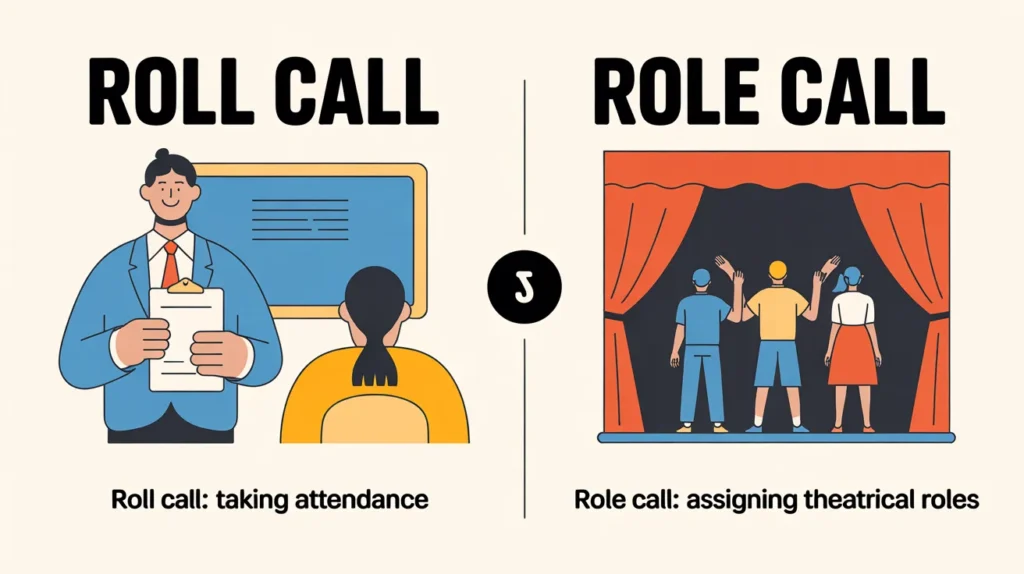
If you’ve ever typed a quick email before a meeting and stopped dead in your tracks wondering — wait, is it “roll call” or “role call”? — you’re in good company. This is one of those sneaky little mix-ups that trips up even confident writers. Both phrases sound exactly the same when spoken aloud, which makes the confusion completely understandable. But in writing, only one of them is correct for checking attendance, and getting it wrong can quietly undermine your professionalism.
Let’s clear this up once and for all.
Why Do People Confuse These Two Words?
The honest answer is simple: English homophones are tricky. “Roll” and “role” are pronounced identically, so when someone hears “roll call” in a meeting or classroom, their brain files it away phonetically. Later, when they write it down, they spell what sounds most familiar — and for many people, “role” feels more natural because it shows up constantly in professional settings. Roles and responsibilities. Role-play. Role model. The word “role” has a strong presence in workplace vocabulary, which makes the substitution feel intuitive even when it’s wrong.
Add to that the fact that autocorrect won’t always catch it — both are real words — and you’ve got a recipe for a very persistent mistake.
What Does “Roll Call” Actually Mean?
Roll call is the correct term when you’re reading through a list of names to confirm who is present. The word “roll” here refers to an old-fashioned scroll or register — a physical list of names that was literally rolled up when not in use. Think of ancient military records, school registers, and parliamentary attendance logs. Reading that list aloud became known as calling the roll, and over time, that evolved into the compound phrase roll call.
So when your teacher went through every name before class started, that was a roll call. When a sergeant confirmed soldiers were present at dawn, that was a roll call. The practice is about verifying presence, plain and simple.
What About “Role Call”?
Here’s the thing — “role call” is not a standard English term. It doesn’t appear in major dictionaries as a defined phrase. The word “role” means a function, duty, or part that someone performs — like a job role, a lead role in a film, or a supporting role on a team. It has nothing to do with checking attendance.
That said, people do use “role call” informally, and in some creative contexts, you might see it used playfully — like a blog post listing the roles of different team members. But if you’re writing professionally, academically, or formally, always use “roll call” when referring to attendance.
Scenario Examples That Make It Crystal Clear
Sometimes the best way to internalize a grammar rule is to see it in action. Here are several real-world scenarios that show exactly how each term works — and where the confusion sneaks in.
Scenario 1: The Classroom
Ms. Reeves walks into her third-grade class on a Monday morning. Before anything else, she opens her attendance register and begins reading names aloud.
“Alright everyone, let’s start with our morning roll call. When I call your name, say ‘present.'”
Here, roll call is used correctly. She’s reading a list. She’s confirming who showed up. That’s exactly what the phrase was built for.
Now imagine a parent emails the school and writes: “Could you let me know if my daughter was present during today’s role call?” — that’s the mistake. Sounds the same, means the wrong thing on paper.
Scenario 2: The Corporate Meeting
A project manager sends a calendar invite for a Monday team sync with the following note:
“We’ll kick things off with a quick roll call to make sure everyone’s dialed in before we move to the agenda.”
That’s correct and professional. She’s checking attendance before the meeting begins.
Compare that to a different manager who writes: “Before we discuss everyone’s role call for Q3…” — now it’s ambiguous and slightly confusing. Is he talking about checking who’s present, or reviewing everyone’s responsibilities? The meaning breaks down because the wrong word was used.
Scenario 3: The Theater Rehearsal
This one is interesting because theater is where both “roll” and “role” actually belong — just in different sentences.
A director might say: “Let’s do a quick roll call before we begin tonight’s rehearsal” — checking if all actors showed up.
But then five minutes later, the same director says: “Okay, now let’s go over everyone’s role for Act Two” — now discussing what each actor performs.
Both words appear in the same setting, doing completely different jobs. This is probably the clearest illustration of why keeping them straight actually matters.
Scenario 4: The Military Briefing
Roll call has deep military roots. Historically, before a unit moved out or began a mission, a commanding officer would read from a physical register — a roll — to account for every soldier. If a name went unanswered, it triggered immediate follow-up.
“Sergeant Malik conducted the evening roll call and noted two soldiers unaccounted for.”
Using “role call” in this context would not only be grammatically wrong — it would sound completely out of place to anyone with military familiarity.
Scenario 5: Social Media and Casual Writing
This is where “role call” thrives — incorrectly. You’ll see tweets like:
“Role call! Who’s watching the finale tonight?”
It’s used so casually and so often online that many people assume it must be correct. It isn’t. The right phrase is still roll call, even in informal writing. That said, language does evolve, and some style commentators argue that “role call” is developing its own niche meaning. For now, though, standard usage firmly favors “roll call” in any writing that matters.
A Simple Memory Trick That Actually Works
If you ever blank on which spelling to use, picture a rolled-up scroll with a list of names written on it. Someone unfurls it and reads each name aloud. That image captures the origin and meaning of roll call perfectly.
Meanwhile, think of a “role” as a costume or mask — something you wear to perform a function. A role is never about who showed up; it’s about what someone does once they’re there.
Scroll = attendance = roll call Costume = function = role
Common Mistakes to Watch For
Beyond the basic mix-up, here are a few patterns worth watching:
“We had a role call for the new project team” — incorrect. If you’re checking who’s present or confirmed, it’s roll call.
“The morning role call revealed three absences” — incorrect. Absences are tracked through a roll call.
“Please complete the role call sheet before leaving” — incorrect. The sheet being signed is a roll call sheet.
In every single case above, swapping in roll call makes the sentence both grammatically correct and immediately clearer.
Final Word
Roll call is one of those terms that’s easy to get right once you understand where it comes from. It’s not a complicated rule — it’s just a matter of knowing that “roll” once referred to a physical list, and that history gave us a very specific phrase with a very specific meaning.
“Role call” sounds the same, feels plausible, and gets used constantly — but it remains incorrect in formal usage. The next time you’re drafting a meeting agenda, writing a school notice, or setting up an event check-in, you’ll know exactly which one to reach for.
When in doubt, picture that scroll.