
Have you ever paused mid-sentence, wondering whether to write “cart” or “kart”? Maybe you were describing a fun weekend activity or drafting an email about online shopping, and suddenly this tiny spelling choice felt like a major decision. You’re definitely not overthinking it—these two words might sound nearly identical when spoken aloud, but they represent completely different things in writing.
Getting this distinction wrong won’t just confuse your readers. It might make your racing story sound like you’re hauling groceries around a track, or worse, suggest that shoppers are adding items to a high-speed vehicle. The good news? Once you understand the difference, you’ll never mix them up again.
Understanding the Basic Difference
The confusion between cart vs kart comes down to context and purpose, not pronunciation. Both words exist in English, both are correct spellings, but they describe entirely separate objects with their own histories and uses.
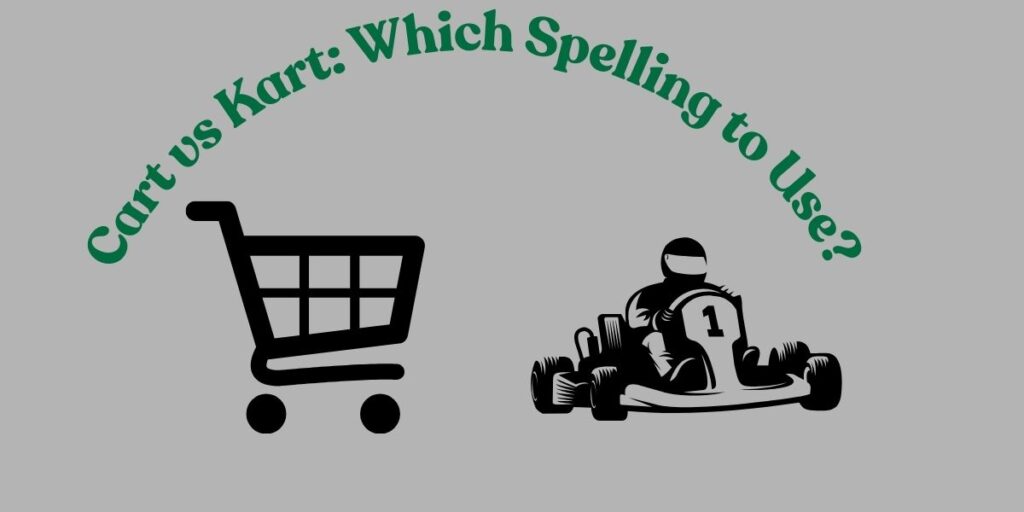
A cart is something designed to carry or transport items. Think about the metal basket you push through a supermarket aisle, or the virtual space where you collect products before checking out online. Carts have been around for centuries, serving as essential tools for moving goods from one place to another.
A kart, on the other hand, is built for speed and excitement. This is your go-kart—the small, nimble racing vehicle you’d find on a track or in an amusement park. When you hear someone talking about kart racing or playing Mario Kart, they’re referring to this high-energy world of competitive driving, not grocery shopping.
What Exactly Is a Cart?
Let’s start with the more traditional of the two words. A cart has deep roots in English, tracing back to Old English and Old Norse origins where “kartr” described a two-wheeled vehicle typically pulled by horses or pushed by hand.
Today, when we say “cart,” we’re usually talking about one of these common types:
Shopping cart – The wheeled basket you navigate through grocery stores, retail shops, or warehouses. You’ve probably wrestled with one that had a stubborn wheel at some point.
Online shopping cart – In the digital world, your cart is the virtual holding space for products before you complete your purchase. E-commerce sites rely heavily on this concept.
Baggage cart – Found in airports, hotels, and train stations, these help travelers move heavy luggage without throwing out their backs.
Hand cart – A simple utility cart for moving boxes, supplies, or equipment, often seen in warehouses or delivery settings.
The word “cart” also appears in one of English’s most enduring idioms: “Don’t put the cart before the horse.” This expression warns against doing things in the wrong order—tackling steps backward instead of following a logical sequence.
What Exactly Is a Kart?
Now for the speedier sibling. A kart is a small, lightweight racing vehicle designed specifically for go-kart racing. These machines are typically open-wheeled, meaning the tires sit outside the main body, and they’re built to zip around tracks at impressive speeds.
The spelling “kart” with a “k” became standard in American English during the 1950s when go-karting emerged as both a recreational activity and competitive sport. Before this, people occasionally used “go-cart” (with a “c”), but that older term originally referred to baby walkers or small wheeled frames for children learning to walk.
You’ll encounter karts in several contexts:
Professional kart racing – Serious motorsport with organized leagues, competitions, and highly tuned racing machines. Many Formula 1 drivers got their start in competitive karting.
Amusement park tracks – Family-friendly electric go-karts that let casual drivers experience the thrill of racing without the intensity of professional competition.
Video games – Thanks to Nintendo, Mario Kart has become one of the most recognizable uses of the word “kart” worldwide. The game franchise has sold millions of copies and introduced generations to the concept of kart racing.
Scenario Examples: Cart in Action
Understanding these words becomes much easier when you see them in real situations. Let’s explore how “cart” appears in everyday contexts.
Scenario 1: Online Shopping
Sarah spent her lunch break browsing her favorite clothing website. She found a gorgeous winter coat, added it to her shopping cart, then kept browsing. By the end of her session, she had five items waiting in her online cart. Before logging off, she received a notification: “You have items in your cart. Complete your purchase to enjoy free shipping!”
Scenario 2: Airport Travel
Marcus landed after a long international flight with three heavy suitcases. He grabbed a baggage cart near the luggage carousel and loaded everything onto it. The luggage cart made navigating the crowded terminal infinitely easier. Without it, he would’ve needed to make multiple exhausting trips.
Scenario 3: Business Email
Subject: Quick Project Planning Reminder
Hey team,
Let’s make sure we’re not putting the cart before the horse on this launch. We need to finalize the product design before we start marketing campaigns. Strategy first, execution second.
Thanks, Michelle
Scenario 4: Grocery Shopping
The grocery cart Amanda selected had one wobbly wheel that kept veering left. She navigated the produce section, carefully steering around other shoppers. By the time she reached checkout, her cart was overflowing with a week’s worth of food.
Scenario Examples: Kart in Action
Now let’s see how “kart” shows up in completely different situations involving speed, competition, and fun.
Scenario 1: Weekend Racing
Jason and his friends spent Saturday afternoon at a local go-kart track. Each driver climbed into their racing kart, secured their helmet, and waited for the green flag. The kart racing session lasted twenty minutes, with Jason finishing second place. His kart handled beautifully around the tight corners.
Scenario 2: Gaming Night
Text conversation:
Emma: “Want to come over Friday? We’re doing a Mario Kart tournament.”
David: “Absolutely! I’ve been practicing my kart drifting skills.”
Emma: “Good luck beating my record on Rainbow Road!”
Scenario 3: Birthday Party Invitation
You’re Invited!
Join us for Tyler’s 12th Birthday Bash!
We’re heading to SpeedZone Adventure Park for go-kart racing, arcade games, and pizza. Each guest gets 30 minutes of kart time on their professional track. Helmets provided!
Saturday, June 15th, 2:00 PM
Scenario 4: Racing Newsletter
Subject: New Electric Karts Arrive This Month!
Dear Racing Enthusiasts,
We’re thrilled to announce our fleet upgrade! Our new electric go-karts offer 30% more speed while maintaining zero emissions. Whether you’re a kart racing veteran or first-timer, these machines will elevate your track experience.
Professional racing kart specifications available upon request.
See you at the track, SpeedTrack Management
Common Mistakes and How to Fix Them
Even native English speakers occasionally mix up these words. Here are the most frequent errors and their corrections:
Mistake: “Let’s play Mario Cart tonight.”
Fix: “Let’s play Mario Kart tonight.”
Why: The video game features racing vehicles, not shopping baskets.
Mistake: “Please add these shoes to your kart before checking out.”
Fix: “Please add these shoes to your cart before checking out.”
Why: E-commerce uses shopping carts, not racing vehicles.
Mistake: “We raced carts at the amusement park.”
Fix: “We raced karts at the amusement park.”
Why: Racing involves go-karts, not transport vehicles.
Mistake: “Your items are waiting in your kart.”
Fix: “Your items are waiting in your cart.”
Why: Online shopping platforms use the term “shopping cart.”
Quick Memory Tricks
Struggling to remember which is which? Try these mental shortcuts:
Cart = Carry. Both words start with “car” and relate to carrying or transporting goods. If something carries items, it’s a cart.
Kart = Kinetic energy. Both start with “k” and involve movement and speed. If something races, it’s a kart.
Another approach: Think of the “k” in kart as standing for “kinetic” or “kick of speed.” The “c” in cart connects to “carry” or “commerce.”
A Bit of History
The word cart has ancient origins, appearing in Old English texts and Nordic languages well over a thousand years ago. These early carts were essential for agriculture, trade, and daily life—simple two-wheeled vehicles that revolutionized how people moved goods.
The go-kart is remarkably modern by comparison. The first go-karts appeared in the late 1940s and early 1950s in the United States. Art Ingels, a machinist in California, is often credited with building one of the first purpose-built karts in 1956. The sport exploded in popularity throughout the 1960s and hasn’t slowed down since.
Interestingly, the older spelling “go-cart” (with a “c”) originally referred to baby walkers in the 1670s—small wheeled frames that helped infants learn to walk. This completely different meaning is why the racing community adopted the “k” spelling to avoid confusion.
Why This Distinction Matters
Using the correct word isn’t just about following grammar rules—it’s about clear communication. When you write cart, readers immediately picture shopping, transport, or e-commerce. When you write kart, they think racing, speed, and competition.
In professional contexts, this precision matters even more. Imagine a marketing email for a racing venue that accidentally references “go-carts” throughout. Customers might wonder if they’re getting a professional experience or something cobbled together. Similarly, an e-commerce platform referring to a “shopping kart” looks careless and unprofessional.
Final Thoughts
The difference between cart vs kart really is straightforward once you internalize the basic rule: carts carry things, karts race. One helps you shop or transport goods; the other helps you chase speed and victory.
Next time you’re writing about either concept, pause for half a second and ask yourself: “Am I talking about carrying items or racing around a track?” That simple question will point you toward the correct spelling every single time.
Whether you’re adding products to your online shopping cart, pushing a grocery cart through the store, racing go-karts at an amusement park, or dominating your friends in Mario Kart, you now have the knowledge to use these words with complete confidence. And honestly, that’s one less thing to worry about in your writing—which means you can focus on the important stuff, like whether to actually buy those items sitting in your cart or which track to choose for your next kart racing session.