
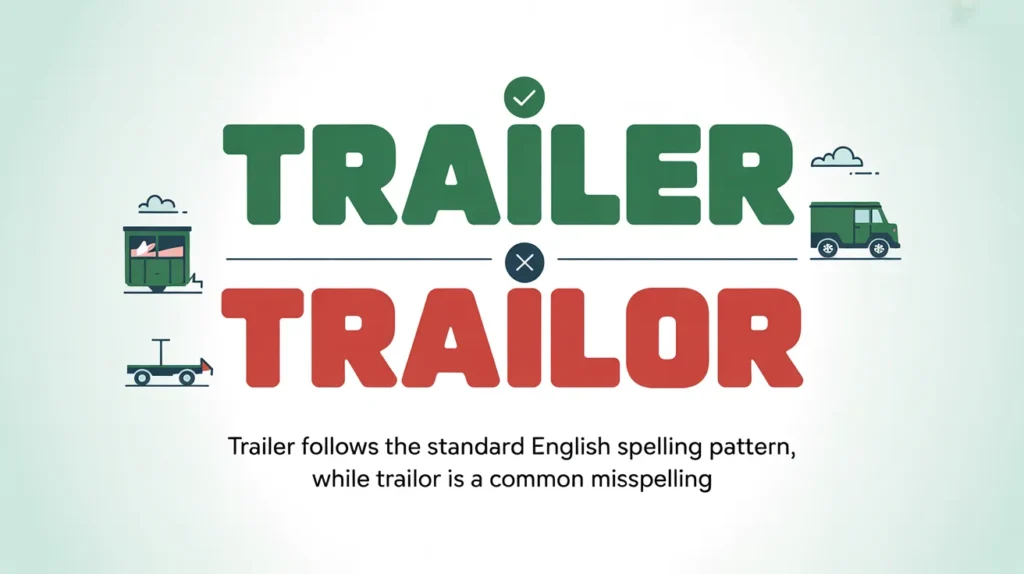
If you’ve ever paused mid-sentence wondering whether to write “trailer” or “trailor,” you’re not alone. This seemingly simple word trips up countless writers, from students crafting essays to professionals sending important emails. The confusion is understandable—English has a habit of throwing curveballs with its spelling patterns. But here’s the straightforward answer: trailer is always correct, and trailor is always wrong.
Let me walk you through why this matters, how to remember it, and what this word actually means in different contexts.
Why the Confusion Between Trailer and Trailor Exists
The mix-up between trailer vs trailor happens for legitimate reasons. When you say the word aloud, it genuinely sounds like it could end in “-or.” After all, we have plenty of English words that follow that pattern: actor, director, investor, governor. Your brain naturally tries to apply familiar rules, and suddenly “trailor” seems plausible.
Pronunciation-based mistakes are incredibly common in English. We hear a word, we make an assumption about its spelling based on similar-sounding words, and we commit to that pattern. The problem is that English doesn’t always follow consistent rules. While some agent nouns (words describing people who perform actions) use the “-or” suffix, the word for a vehicle you tow behind your truck follows a different pattern entirely.
Another factor? Simple typing errors during casual writing. When you’re firing off a quick text or rushing through an email, your fingers might default to the wrong spelling out of habit. Once that mistake gets reinforced a few times, it becomes harder to shake.
Understanding the Correct Spelling of Trailer
The correct spelling of trailer uses the “-er” suffix, and this aligns perfectly with how English handles most common nouns. Think about it: we have baker (someone who bakes), teacher (someone who teaches), and player (someone who plays). The pattern extends to objects and concepts as well—words like hammer, ladder, and printer all follow the same structure.
Trailer comes from the verb “trail,” which means to drag, pull, or follow behind something. When you add the “-er” suffix, you create a noun that describes something that trails. It’s logical once you see the connection. A trailer literally trails behind whatever is pulling it, whether that’s a truck hauling cargo or the main feature film that a movie preview introduces.
This spelling confusion in English catches people off guard because we’re often taught that “-or” endings indicate agency or action. But trailer isn’t describing a person doing something—it’s describing an object or concept that performs a trailing function.
What Does Trailer Actually Mean?
Here’s where things get interesting. Trailer isn’t just one thing—it carries multiple meanings depending on context. Understanding these different uses helps cement the correct spelling in your mind.
A Vehicle That Gets Towed
The most common meaning refers to a vehicle designed to be pulled behind another vehicle. This could be a small utility trailer for hauling lawn equipment, a massive semi-truck trailer carrying commercial goods, or a recreational travel trailer for camping adventures.
Scenario: Imagine you’re helping your friend move apartments. You send this text:
“Hey, I found a place that rents trailers for $50 a day. Want me to pick one up Saturday morning? We can load all your furniture and make it in one trip.”
Using “trailor” here would immediately signal a spelling error. Even in casual communication, the wrong spelling disrupts the message and might make the reader question your attention to detail.
A Movie or Show Preview
In entertainment, a trailer is the promotional preview shown before a film’s release. These carefully crafted snippets build anticipation and give audiences a taste of what’s coming.
Scenario: You’re working in a marketing department and need to email your team:
Subject: Final Trailer Approval Needed
“Team, the trailer for our Q2 product launch is ready for review. I’ve uploaded three versions—a 30-second teaser, a 60-second standard trailer, and a 90-second extended cut. Please watch all three and share feedback by end of day Thursday. We go live on Monday.”
In professional communication like this, misspelling of trailer would undermine your credibility. Details matter in workplace writing, and a simple spelling error can create doubt about the quality of your other work.
A Mobile Home or Dwelling
Though less common in modern conversation, trailer also refers to a mobile home—a prefabricated structure designed for residential living. Trailer parks became part of American culture in the mid-20th century and remain an affordable housing option for many families.
Scenario: You’re writing a personal essay about your childhood:
“My grandmother lived in a cozy trailer at the edge of town, surrounded by oak trees and wildflowers. Every summer, I’d spend weeks there, and despite its compact size, that trailer held more warmth and laughter than any house I’ve known since.”
The word carries different connotations depending on context, but the spelling never changes.
Common English Mistakes and How to Fix Them
Let’s look at real examples of where people stumble with trailer or trailor:
Incorrect: “I need to rent a trailor for the weekend.”
Correct: “I need to rent a trailer for the weekend.”
Incorrect: “Did you watch the new movie trailor?”
Correct: “Did you watch the new movie trailer?”
Incorrect: “They’re renovating their trailor to make it more energy-efficient.”
Correct: “They’re renovating their trailer to make it more energy-efficient.”
The pattern is clear: no matter the context, trailer is the only acceptable spelling. There’s no situation in standard English where “trailor” is correct.
The Grammar Rules Behind Trailer vs Trailor
Understanding English spelling rules helps prevent these mistakes. The “-er” suffix typically attaches to verbs to create nouns that describe either people who perform actions or things that perform functions. Since “trail” is a verb meaning to follow behind, adding “-er” gives us a noun for something that trails.
The “-or” suffix, while similar, usually appears in words borrowed from Latin or in formal agent nouns like professor, supervisor, or administrator. These words have different etymological roots than trailer, which comes from straightforward English verb construction.
When you’re dealing with noun vs verb usage, remember that trailer functions as both:
- As a noun: “The trailer was parked in the driveway.”
- As a verb: “We need to trailer the boat to the lake.” (meaning to transport it on a trailer)
In both cases, the spelling remains consistent.
Regional Differences and Universal Standards
One reassuring aspect of this spelling issue is that trailer is standard across all English-speaking regions. Whether you’re writing in American English, British English, Australian English, or Canadian English, the spelling never varies. This isn’t like “color/colour” or “organize/organise” situations where regional preferences exist.
This universal standard means you can confidently use trailer regardless of your audience. You’re writing a formal report for London colleagues? Trailer. Sending a casual email to friends in Sydney? Trailer. Posting on social media from Toronto? Still trailer.
Why Spelling Accuracy Matters in Professional Writing
In today’s digital world, writing clarity directly impacts how others perceive your competence and professionalism. A misspelled word might seem minor, but it creates friction in communication. Readers notice errors, even subconsciously, and those errors accumulate to form impressions about your reliability and expertise.
Scenario: You’re applying for a job that requires frequent written communication:
“I have extensive experience in logistics coordination, including managing trailer shipments, coordinating delivery schedules, and ensuring compliance with transportation regulations.”
If you spelled trailer as “trailor” in your resume or cover letter, a hiring manager might wonder what other details you overlook. Fair or not, spelling errors carry weight in professional contexts.
Memory Tricks to Remember the Correct Spelling
Since pronunciation-based mistakes cause most of the confusion, try these mental shortcuts:
Connect it to the verb: Trailer comes from “trail” + “er.” You can’t trail without the word “trail,” which clearly uses “-il,” not “-ilor.”
Think of similar words: Remember words like “retailer” or “wholesaler.” These follow the same pattern and would look ridiculous spelled with “-or.”
Visualize the object: Picture a physical trailer being pulled behind a truck. The mental image can reinforce the correct spelling.
The Bottom Line
The answer to trailer vs trailor is definitive and unchanging: trailer is correct, trailor is not. This applies whether you’re discussing vehicles, movie previews, mobile homes, or using the word as a verb. The misspelling of trailer happens frequently, but understanding the word’s origins, grammar rules, and proper usage helps you avoid this common pitfall.
English can be frustrating with its inconsistencies, but this particular case follows a logical pattern once you understand it. Master this spelling, and you’ll communicate more clearly and professionally across all contexts—from casual texts to important business documents. Remember: if something trails, it’s a trailer, always with an “-er,” never with an “-or.”